Practice AI Blog

Discover AI tools that streamline legal workflows, optimize case management, and enhance client relationships.
Featured
How AI Tools for Law Firms Are Changing Legal Work in 2025
January 30, 2026
3
min read

The legal industry is experiencing a fundamental shift. In 2025, artificial intelligence is no longer experimental or optional for law firms. AI tools for law firms have become core infrastructure, reshaping how legal professionals manage cases, communicate with clients, and deliver results faster than ever before.

Lawyers today face mounting pressure. Clients demand speed, transparency, and cost efficiency. Competition is increasing. Case volumes are growing. Traditional workflows—manual document review, repetitive drafting, and fragmented tools—are no longer sustainable. This is where legal AI steps in.

AI in law is not about replacing attorneys. It is about amplifying legal expertise. Modern law practice AI software helps lawyers reduce administrative work, improve accuracy, and focus on strategy, negotiation, and advocacy. From AI demand letters to automated client intake and litigation support, AI legal tools are redefining legal work across the entire firm.

In this article, we explore how AI tools for law firms are changing legal practice in 2025, the key areas being transformed, and why firms that adopt AI early gain a lasting competitive advantage.

1. The Rise of AI in Law Practice

AI adoption in legal practice has accelerated rapidly over the past few years. In 2025, the use of AI in law practice is driven by necessity, not novelty. Law firms are dealing with more data, more documents, and tighter timelines. Human-only workflows simply cannot scale at the same pace.

Legal AI tools now assist with tasks that once required hours of manual effort. These include reviewing medical records, summarizing cases, drafting demand letters, organizing evidence, and preparing litigation materials. AI systems analyze large volumes of legal data in minutes, identifying patterns and extracting key facts with high accuracy. One major factor behind this rise is improved AI reliability. Earlier concerns about accuracy and hallucinations are now addressed through structured workflows, source citations, and human review layers. Modern law practice AI software is designed specifically for legal use cases, not generic writing.

Another driver is cost pressure. Clients increasingly resist high fees for routine work. AI allows firms to reduce operational costs while maintaining quality. This enables predictable pricing models and better client satisfaction.

AI in legal practice is no longer limited to large firms. Solo practitioners and mid-sized firms now use AI-powered practice management tools to compete at a higher level. In 2025, the question is not whether AI will be used in law—but which firms will use it best.

2. AI Tools for Law Firms and Workflow Automation

One of the biggest impacts of AI tools for law firms is workflow automation. Legal work involves countless repetitive steps that consume time without adding strategic value. AI automates these steps while keeping lawyers in control.

Client intake is a strong example. AI-powered intake systems can engage leads automatically, collect structured information, and qualify cases before a lawyer ever reviews them. This reduces back-and-forth communication and ensures no opportunity is missed.

Document collection is another area transformed by AI. Instead of manual follow-ups, AI systems send reminders, track uploads, and organize documents by case. This eliminates chaos and ensures every file is accessible when needed. Case organization has also improved. AI legal tools group documents by provider, date, or issue, creating a single source of truth. Lawyers no longer waste time searching across folders, emails, or systems.

Workflow automation does not remove judgment. It removes friction. Lawyers still make decisions, approve outputs, and define strategy. AI simply ensures that routine tasks happen faster, cleaner, and with fewer errors.

In 2025, firms using AI-powered workflow automation close cases faster, respond to clients quicker, and operate with smaller teams—without sacrificing quality.

3. AI Demand Letters and Faster Case Resolution

AI demand letters are one of the most practical applications of legal AI in 2025. Drafting demand letters traditionally required hours of writing, reviewing records, calculating damages, and formatting exhibits. AI has streamlined this entire process. Modern AI demand letter tools generate structured, evidence-backed drafts using uploaded medical records, bills, and case facts. The system organizes treatment summaries, calculates specials, and references exhibits automatically. Lawyers then review, edit, and finalize the output.

This process offers multiple advantages. First, it dramatically reduces drafting time. What once took days can now be completed in minutes. Second, it improves consistency. AI ensures every demand follows firm standards and includes required sections.

AI also supports multiple demand types, such as standard demands, policy-limit demands, and settlement offers. Each output is tailored to the case context. This flexibility allows lawyers to respond strategically without rewriting from scratch.

Faster demand generation leads to faster settlements. Insurers receive clear, well-supported letters sooner, reducing delays and disputes. In 2025, firms using AI demand letters resolve cases more efficiently and improve cash flow.

4. Case Summaries Powered by AI Legal Tools

Case summaries are critical in legal practice. They inform strategy, negotiation, and litigation decisions. In the past, summarizing records required manual review of hundreds or thousands of pages. AI has transformed this process.

AI-powered case summary tools analyze uploaded documents and produce structured summaries that highlight key facts, timelines, providers, and treatments. Chronologies are generated automatically, allowing lawyers to spot gaps or inconsistencies quickly.

These AI legal tools do not replace legal judgment. They accelerate preparation. Lawyers spend less time reading raw records and more time analyzing implications.

Case summaries are especially valuable for team collaboration. Paralegals can prepare summaries quickly. Attorneys can review outputs and focus on higher-level strategy. New team members can onboard to cases faster. In litigation, AI-generated summaries support discovery, depositions, and trial prep. Lawyers enter proceedings with a clearer understanding of the case narrative. In 2025, AI case summaries are becoming a standard expectation, not a luxury.

5. AI for Legal Research and Litigation Support

AI in legal practice extends beyond drafting and organization. Legal research and litigation support are also being transformed.

AI legal tools can analyze prior cases, identify relevant precedents, and summarize legal arguments faster than traditional research methods. This reduces research time while expanding coverage. In litigation support, AI assists with discovery review, issue spotting, and trial preparation. It helps lawyers organize exhibits, prepare witness outlines, and test arguments against case facts. These tools are especially valuable in complex cases with large document volumes. AI accelerates preparation without compromising accuracy, provided human verification remains in place.

In 2025, AI is becoming an essential research partner. Lawyers who combine legal expertise with AI insights gain stronger arguments and improved confidence in court.

6. AI-Powered Practice Management and Firm Operations

Beyond legal work itself, AI is reshaping firm operations. AI-powered practice management tools help law firms run more efficiently. These systems track workloads, identify bottlenecks, and optimize resource allocation. AI insights reveal where time is lost and where processes can improve. Billing and reporting also benefit from AI. Automated tracking reduces leakage and improves transparency. Firms can analyze performance metrics and make data-driven decisions. AI-powered practice management enables scalability. Firms can grow without proportionally increasing staff. This is critical in a competitive market.

In 2025, operational excellence is a differentiator. Firms using AI to manage their practice operate leaner, smarter, and more profitably.

7. Ethics, Accuracy, and Challenges of AI in Legal Practice

Despite its benefits, AI in legal practice presents challenges. Accuracy, ethics, and compliance remain top concerns.

AI systems must never invent facts. Lawyers are responsible for verifying outputs against source documents. Responsible AI tools include guardrails, citations, and regeneration workflows to support verification. Confidentiality is another concern. Legal AI platforms must meet strict security standards, including SOC 2 and HIPAA compliance where applicable. There are also ethical considerations. Lawyers must understand how AI tools work and disclose AI use when required. AI should support professional judgment, not replace it.

In 2025, firms that succeed with AI are those that combine technology with strong governance, training, and review processes.

8. Why AI Tools for Law Firms Are a Competitive Advantage

AI tools for law firms are no longer optional. They are a competitive advantage.

Firms using AI handle more cases with fewer resources. They respond faster, reduce errors, and deliver consistent quality. Clients notice the difference.

AI also improves job satisfaction. Lawyers spend less time on repetitive tasks and more time on meaningful legal work. This reduces burnout and improves retention.

In a crowded market, firms that adopt law practice AI software position themselves as modern, efficient, and client-focused.

Final Thoughts: The Future of Legal Work

In 2025, AI is redefining how legal work is done. From intake to settlement, AI tools for law firms streamline processes, enhance accuracy, and unlock new levels of efficiency. Law Practice AI and similar platforms are not replacing lawyers. They are empowering them. The future belongs to firms that embrace AI thoughtfully, ethically, and strategically. Those firms will not only survive—but lead.

AI & Lawyers: A Winning Partnership
To showcase how AI-powered solutions like AI Demands™ and AI Case Summary™ from Practice AI™ help personal injury and lemon law attorneys streamline legal documentation, improve compliance, and enhance case efficiency.
July 28, 2025
0
min read

Artificial intelligence is transforming the legal industry, enabling law firms to operate more efficiently, reduce costs, and improve case outcomes. AI-driven tools are particularly valuable for personal injury and lemon law attorneys, helping them streamline case analysis, draft legal documents, and ensure compliance with evolving legal standards. At the forefront of this revolution is Practice AI™, a leading provider of AI-powered legal solutions designed to optimize workflow and enhance productivity.

How AI is Reshaping the Legal Field

AI for legal professionals is no longer a futuristic concept—it’s a game-changer in how law firms handle documentation, research, and case preparation. AI-driven case summaries and automated legal drafting tools are revolutionizing legal workflows, ensuring accuracy and consistency while saving valuable time.

Practice AI™ is leading this transformation with its flagship solutions, AI Demands™ and AI Case Summary. These tools are specifically designed to help personal injury and lemon law attorneys handle the complexities of legal document generation with ease.

  • AI Demands™: Automates the creation of demand letters, reducing the time spent on drafting while maintaining legal compliance and accuracy.
  • AI Case Summary™: Generates structured case summaries from medical records, police reports, and other legal documents, enabling faster case analysis and decision-making.

By leveraging AI-powered legal and medical solutions like these, law firms can reduce the administrative burden and focus on advocating for their clients.

Time-Saving AI for Lawyers: The Key Benefits

1. Speed & Efficiency

Manual legal document drafting can be tedious and time-consuming. AI-driven tools like AI Demands™ significantly cut down the hours spent on preparing demand letters and case summaries, allowing attorneys to allocate more time to case strategy and negotiations.

2. Enhanced Accuracy & Compliance

AI legal compliance is a major concern for law firms, especially in personal injury and lemon law cases where missing crucial details can impact settlements. AI-powered solutions like AI Case Summary™ ensure that legal documents remain precise and up to date with the latest regulations.

3. Cost Reduction

Hiring additional staff to manage legal documentation is costly. AI-driven solutions automate repetitive tasks, reducing operational expenses while maintaining efficiency.

4. Improved Case Outcomes

AI-driven case summaries help attorneys quickly identify key details, allowing for stronger case preparation. With AI for law firms, lawyers can anticipate potential challenges and make data-driven decisions that improve client outcomes.

Why Personal Injury and Lemon Law Firms Need AI

Personal injury and lemon law attorneys handle large volumes of cases that require extensive documentation, demand letters, and case evaluations. AI in the legal field is particularly beneficial for these practice areas, as it automates complex tasks and provides actionable insights.

With AI Demands™, personal injury lawyers can ensure their demand letters are structured, persuasive, and legally sound—leading to faster settlements. Similarly, AI Case Summary™ extracts and organizes critical case details, helping attorneys build compelling arguments with less manual effort.

The Future of AI for Legal Professionals

The legal industry is evolving, and AI is playing an increasingly crucial role in shaping its future. AI-powered legal and medical solutions will continue to improve efficiency, compliance, and case strategy for law firms worldwide. Law firms that embrace AI now will gain a competitive advantage, enabling them to handle cases more effectively while providing exceptional client service.

Ready to experience the power of AI for law firms? Sign up with Practice AI™ today and explore AI Demands™ and AI Case Summary™!

Identifying High-value Personal Injury and Lemon Law Cases Using Practice AI
Identifying high-value cases is critical for success in personal injury and lemon law cases. These cases often involve significant damages, compelling evidence, and clear liability, making them more likely to yield favorable outcomes for both the client and the firm. However, the process of evaluating potential cases is often time-consuming and complex, requiring careful review of medical records, police reports, and other critical documentation.
February 20, 2025
0
min read

Identifying high-value cases is critical for success in personal injury demand letters and lemon law cases. These cases often involve significant damages, compelling evidence, and clear liability, making them more likely to yield favorable outcomes for both the client and the firm. However, the process of evaluating potential cases is often time-consuming and complex, requiring careful review of medical records, police reports, and other critical documentation.

Practice AI’s innovative tools—AI Demands and AI Doc Reader—are transforming how personal injury and lemon law attorneys assess case value. By leveraging AI technology, these tools streamline the evaluation process, providing faster, more accurate insights that empower attorneys to focus on the cases with the highest potential.

Table of Contents

  1. The Importance of Identifying High-Value Cases
  2. Challenges in Case Evaluation
  3. How Practice AI Helps Identify High-Value Cases
    1. AI Demands for Case Strength Analysis
    2. AI Doc Summary for Data Insights
  4. Benefits of Using Practice AI Tools

The Importance of Identifying High-Value Cases

High-value personal injury and lemon law cases can make a significant difference for a law firm. These cases often:

  • Provide larger settlements or verdicts due to the extent of damages involved.
  • Strengthen a firm’s reputation by showcasing its ability to handle complex, impactful cases.
  • Allow attorneys to maximize their time and resources by focusing on cases with the highest return on investment.

Identifying these cases early in the process ensures that resources are allocated effectively, avoiding wasted effort on low-value or unviable claims. AI for law firms can play a pivotal role in this early assessment by helping firms distinguish truly valuable cases from less promising ones.

Challenges in Case Evaluation

Despite its importance, evaluating personal injury demand letter and lemon law demand letter cases comes with challenges, including:

  • Complex Medical Records in Personal Injury Cases: Understanding and summarizing extensive medical documentation can be overwhelming and prone to errors.
  • Insufficient Vehicle Information in Lemon Law Cases: A lemon law case may be missing crucial repair orders, details regarding faults and issues, or inconclusive documents that require deep investigations.
  • Inconsistent Evidence: Piecing together police reports, witness statements, repair orders, and other documents to assess liability can be time-consuming.
  • Subjectivity in Valuation: Estimating damages and potential settlement values often relies on subjective judgment, leading to variability in assessments.

These challenges highlight the need for legal document automation tools that can simplify and standardize the evaluation process, enabling attorneys to make informed decisions with confidence.

How Practice AI Helps Identify High-Value Cases

Practice AI’s tools for law firms are designed to address the pain points in personal injury and lemon law case evaluation. By automating data analysis and providing actionable insights, these legal AI tools help attorneys identify cases with the highest potential value.

AI Demands for Case Strength Analysis

AI Demands streamlines the process of drafting demand letters, but its utility goes far beyond documentation. Here’s how it helps in case evaluation:

  • Statute Integration: AI Demands for lemon law cases and AI Demands for personal injury lawyers ensure that these include relevant legal statutes, helping attorneys identify strong legal foundations for their cases.
  • Liability Analysis: The tool evaluates evidence to highlight key factors that establish liability which enables attorneys to assess case strength at a glance, crucial for writing a demand letter for personal injury or lemon law claims.
  • Projected Damages: By analyzing medical records, repair orders and other data, AI Demands, serving as an AI demand letter, provides insights into potential damages, helping attorneys estimate case value more accurately.

AI Doc Summary for Data Insights

AI Doc Summary excels in processing and analyzing complex documentation. Its features include:

  • Medical Summaries: The tool extracts critical information from electronic medical records (EMRs), highlighting injuries, treatments, and prognosis that are central to determining case value.
  • Pattern Recognition: AI algorithms identify trends and correlations in data, such as recurring injuries or treatment inconsistencies, that may impact case strength.
  • Document Organization: By this AI legal document generator with capabilities categorizing and summarizing large volumes of documentation, AI Doc Reader saves attorneys valuable time and ensures no critical detail is overlooked.

Benefits of Using Practice AI Tools

Attorneys who integrate Practice AI into their workflow experience numerous advantages:

  • Increased Efficiency: Automating time-consuming tasks allows attorneys to focus on strategic decision-making.
  • Enhanced Accuracy: AI minimizes errors in document analysis and case valuation, providing reliable insights in both personal injury and lemon law cases.
  • Streamlined Workflows: Tools like AI Demands and AI Doc Reader simplify complex processes, reducing stress and improving law firm efficiency and overall productivity.
  • Better Client Outcomes: By identifying high-value cases early, attorneys can allocate resources to achieve the best possible results for their clients.

For lawyers and legal staff looking for a professional personal injury demand letter or personal injury letter writing service, Practice AI offers reliable, automated tools to boost productivity and results.

Use Legal AI Tools to Identify Your Most Valuable Cases

Identifying high-value personal injury and lemon law cases is essential for maximizing success in the legal profession. With Practice AI’s AI-powered legal tools, attorneys can evaluate cases more efficiently, accurately, and confidently. AI Demands and AI Doc Reader empower legal professionals to streamline workflows, reduce errors, and focus on the cases that matter most.

Sign up with Practice AI today and discover how AI Demands and AI Doc Reader can help you identify high-value personal injury and lemon law cases with ease and precision—whether you're writing a sample personal injury demand letter, handling complex medical documentation, or optimizing your legal document AI workflow!

Top 10 AI Tools for Lawyers in 2025
Provide a comprehensive guide on the top AI tools for law firms in 2025, emphasizing how Practice AI™ and AI Demands™ optimize demand letter drafting.
July 21, 2025
0
min read

Is Your Law Firm Ready for AI?

The legal industry is rapidly evolving, and artificial intelligence is playing a critical role in streamlining workflows, reducing manual workload, and improving legal research. From AI-powered legal document generators to contract review platforms, the right AI tools can save time, minimize errors, and boost efficiency for law firms.

In 2025, AI technology is more sophisticated than ever, and law firms must stay ahead by adopting the best tools available. Below, we explore the top 10 AI tools for lawyers and how they are transforming the legal landscape.

1. Practice AI™: AI Demands™ and AI Case Summary™

Best for: Personal injury and lemon law firms

Practice AI™ provides AI-powered legal and medical solutions to automate demand letter generation and case summaries. AI Demands™ simplifies the drafting of demand letters, reducing human error and ensuring compliance with current legal standards. AI Case Summary™ automates case summaries, making document review and analysis faster and more efficient.

Key Features:

  • Automates demand letter creation in minutes
  • Ensures accuracy by integrating verified legal frameworks
  • Saves time by structuring case summaries efficiently
  • Helps firms scale by reducing manual drafting workloads

2. Darrow

Best for: Litigation intelligence and legal violation detection

Darrow’s Legal Intelligence Platform identifies hidden legal violations through AI-driven data analysis. By scanning public data sources, Darrow helps attorneys detect potential class-action cases and maximize legal opportunities.

Key Features:

  • AI-powered anomaly detection for case discovery
  • Automated plaintiff matching via PlaintiffLink
  • Data-backed litigation support

3. Lexis+ AI (LexisNexis)

Best for: AI legal research and brief analysis

Lexis+ AI combines LexisNexis’s vast legal database with AI-driven tools for quick and efficient legal research. It features Brief Analysis, which reviews legal documents in minutes, and Judicial Analytics, which provides insights into judges’ ruling patterns.

Key Features:

  • AI-powered document drafting
  • Smart citation validation
  • Judicial analytics for case strategy

4. Harvey

Best for: Contract analysis and due diligence

Harvey’s AI legal assistant streamlines contract review by identifying key provisions, risks, and obligations across multiple documents. The platform improves due diligence and document review speed.

Key Features:

  • AI-powered contract analysis
  • Multijurisdictional legal research
  • Collaborative workflow tools

5. Clio Duo

Best for: Law firm operations and automation

Clio Duo, powered by GPT-4, enhances Clio’s legal practice management software with AI-driven automation. It assists with scheduling, document generation, and predictive analytics.

Key Features:

  • AI-powered legal automation
  • Predictive analytics for case outcomes
  • Smart client intake and scheduling

6. Spellbook

Best for: AI contract drafting and risk analysis

Spellbook helps transactional lawyers draft and review contracts with AI-generated clauses and risk analysis. It learns from a firm’s existing contracts to provide context-based suggestions.

Key Features:

  • AI-assisted contract generation
  • Risk analysis engine
  • Clause library for improved drafting

7. NexLaw

Best for: Litigation support and legal research

NexLaw’s AI Trial Copilot helps attorneys during trials by providing real-time legal references, procedural guidance, and objection suggestions.

Key Features:

  • AI-powered trial support
  • Smart legal search engine
  • Case outcome prediction

8. MyCase

Best for: AI-powered document automation and billing

MyCase provides AI-driven legal document automation, client insights, and smart time-tracking tools, reducing manual administrative burdens for law firms.

Key Features:

  • Automated legal document creation
  • AI-driven email management
  • Smart billing and time tracking

9. Thomson Reuters CoCounsel

Best for: Legal research and case analysis

CoCounsel leverages AI to review case law, generate legal memos, and track regulatory updates, allowing attorneys to stay ahead of legal changes.

Key Features:

  • AI-powered legal research
  • Automated legal memorandum drafting
  • Real-time regulatory updates

10. IronClad

Best for: AI-powered contract lifecycle management

IronClad automates contract drafting, execution, and approval workflows, making contract management seamless for legal teams.

Key Features:

  • Intelligent contract workflow automation
  • AI-driven risk flagging
  • Plain-English contract translation

The Future of AI in Law Firms

The legal industry is undergoing a transformation with AI-powered legal and medical solutions. Adopting AI tools like Practice AI™, Darrow, and Lexis+ AI can help firms optimize legal research, demand letter generation, contract drafting, and litigation strategies.

Is your firm ready to embrace AI? Sign up with Practice AI today and explore AI Demands™ to revolutionize your legal workflow!

Sign up with Practice AI now and explore AI Demands™ to streamline your lemon law demand letter drafting process!

Top 5 Reasons Law Firms Should Embrace AI in Their Workflows
How Artificial Intelligence Strengthens, Not Replaces, the Human Element in Legal Practice
July 15, 2025
0
min read

1. Amplify Efficiency Without Replacing Expertise

AI gives teams back their time by handling repetitive, high-volume tasks that don't require specialized legal reasoning or advocacy. Examples include:

  • Document summarization: AI can condense your long documents such as contracts, discovery materials, medical chronologies, demand letters or court filings into digestible briefs in seconds.

  • Legal research: AI-powered research tools can scan thousands of statutes, case laws, and regulations to surface relevant information to you faster than any associate alone.

  • Template-driven drafting: AI can generate first drafts for case summaries, demand letters,  NDAs, engagement letters, motions, and pleadings (to name a few) using firm-approved language keeping writing styles consistent.

Why it matters:
This frees your teams to do what only they can—apply nuanced judgment, build case strategies, advise clients, and think creatively. It leads to better legal outcomes, more billable value per hour, and less burnout.

2. Enhance Accuracy and Reduce Risk

In law, precision is paramount. A missed deadline, overlooked clause, or incorrect citation can carry significant consequences. AI can help you minimize this risk by:

  • Performing consistent reviews across documents, catching errors or omissions a team might accidentally overlook.

  • Highlighting gaps in treatment, strengths and weaknesses in documents and identifying non-compliant or risky language in contracts. Allowing you to immediately identify sensitive areas in documents that require more human oversight.

  • Tracking dates, obligations, and filing requirements automatically to prevent missed deadlines and to elevate performance across the team. .

Why it matters:
AI provides you with a second set of eyes—diligent, tireless, and consistent. It increases confidence in your firm’s work product, improves quality control, and helps meet your client’s growing demands for high quality and fast turnaround. 

3. Unlock Time and Cost Savings

AI dramatically compresses the time required for your routine legal tasks. This improves productivity across departments, from paralegals to senior partners. 

For example:

  • A manual task that takes a paralegal 3 hours such as extracting key provisions from 20 contracts, can be completed with the help of AI in under 5 minutes (think summarizing lengthy medical histories or writing demand letters). Using AI allows paralegals, demand writers and case managers to produce more for the firm thus increasing the firm's  profit margin.

  • AI-assisted billing can also help you to auto-generate time entries based on calendar and document activity, saving hours of manual input.

  • Legal teams can review 10x more documents using AI-driven tools, without increasing costs and headcount.

Why it matters:
Firms gain the capacity to empower their human staff with the tools and resources which increase their productivity and job satisfaction while improving both profitability and scalability. It also gives smaller firms the tools to compete with larger ones, what we call “leveling the playing field.”

4. Improve Client Experience and Responsiveness

Modern clients expect you to act with speed, clarity, and to be accessible. AI helps you not only meet but to  exceed those expectations by enabling you to complete:

  • Near instant document generation for common agreements, demand letters, case summaries or filings, reducing turnaround time from days to hours or minutes.

  • Automated intake and triage systems that collect case details and route clients to the right legal team, improving client satisfaction from day one.

  • Predictive insights on case timelines or litigation risk, helping your firm and clients make informed decisions faster.

Why it matters:
AI can transform your client service capabilities from reactive to proactive. Your firm can deliver faster updates, better communication, and data-driven insights, fine tuning your  legal services into a client-centric experience, not a black box.

5. Future-Proof the Practice

Legal technology is evolving rapidly and AI isn’t just a tool anymore. AI is becoming part of the mainstream legal infrastructure with as many as 70% of firms adopting it into their workflows in some fashion. 

Your firm’s adoption of AI can provide benefits such as:

  • Competitive edge over firms still doing everything manually.  You’re saving time, money and increasing your firm’s output. Savings can be put towards marketing and scaling.

  • Talent retention, hire and retain the top talent, especially among younger attorneys who expect tech-savvy workplaces. Top talent wants efficient and effective workflows.

  • Flexibility to explore new offerings like flat-fee services, self-service portals, or hybrid billing models

Firms that delay adoption risk:

  • Falling behind competitors already using AI to improve speed and cut costs. Again as many of 70% of your competitors are already adopting AI. Are you moving in this direction?

  • Losing top talent who prefer tech-enabled environments. Can you afford to lose talent to your competitors?

  • Missing out on innovation that could open new revenue streams or practice areas for your firm.

Why it matters:
Integrating AI positions your firm as a forward-thinking, adaptive leader prepared for what’s next in the legal industry. Your firm will be better positioned to thrive, adapting to new client expectations, attracting next-generation lawyers, and showing leadership in a profession where innovation is quickly becoming a differentiator.

Final Word: AI Doesn’t Replace the Lawyer, It Reinforces the Lawyer’s Value

The future of law is not human or machine, it’s human plus machine (ai + hi). It strengthens human judgment, speeds up routine tasks, and creates space for attorneys to do what they do best: advise, advocate, and solve complex problems.

The end result? Firms are able to do more meaningful, high-impact work while improving the quality, affordability, and accessibility of legal services.

AI is not the end of the legal profession, it’s the next evolution of it.

Curious How AI Could Work at Your Firm? Let’s Talk.

Every law firm is different. That’s why Practice AI offers tailored, consultative demos designed around your practice areas, workflows, and client needs

👉 Schedule Your Demo with Practice AI
Let’s explore how AI can elevate your people, your productivity, and your practice.

Whether you're just exploring or ready to pilot, we’ll help you identify real use cases where AI can deliver immediate value—securely, ethically, and strategically.

Practice AI and Legal Soft to Showcase Legal Tech Innovation at AAJ 2025
To announce and promote Practice AI™ and Legal Soft®'s participation in the AAJ 2025 Annual Convention, highlight key product features (AI Demands™ and AI Case Summary™), and position the companies as leaders in responsible legal tech innovation.
July 15, 2025
0
min read

Practice AI and Legal Soft to Showcase Legal Tech Innovation at AAJ 2025

Woodland Hills, California – Practice AI™, in partnership with Legal Soft®, will attend and exhibit at the American Association for Justice (AAJ) 2025 Annual Convention at the Moscone Center in San Francisco, from July 18–22. Recognized as the premier event for trial attorneys and legal professionals, AAJ 2025 offers an unparalleled platform for continuing legal education, networking, and exposure to game-changing legal technologies.

Over five action-packed days, thousands of legal professionals will explore new litigation strategies, meet with thought leaders, and engage with cutting-edge vendors. Practice AI™ and Legal Soft® are proud to stand among the innovators shaping the future of law, showcasing their latest AI-powered solutions that streamline legal practice without sacrificing the human touch.

“AI is not here to replace lawyers—it’s here to eliminate repetitive tasks and empower legal teams to focus on advocacy and strategy,” said Hamid Kohan, CEO of Practice AI™ and Legal Soft®. “As technology advances, our responsibility is to ensure that AI tools uphold ethical standards, protect client confidentiality, and align with the real‑world needs of law firms.”

Live Demonstrations of Industry-Leading AI Solutions

Practice AI™ will offer live demos of AI Demands™, its flagship tool that automates the drafting of statute-compliant personal injury and lemon law demand letters in under ten minutes. This allows law firms to cut manual drafting time by over 80%, reduce human error, and refocus staff time on client engagement and litigation strategy.

Attendees can also experience AI Case Summary™, which distills complex medical records, police reports, and other legal documents into clear, actionable case summaries—within seconds. These tools represent a powerful shift in legal operations, bringing speed and clarity to document-heavy casework.

Designed for the Legal Field—with the Legal Field

Rather than applying generic AI models to legal work, Practice AI™ builds its tools specifically for trial attorneys, legal assistants, and paralegals. Each product is developed in consultation with practicing attorneys to ensure usability, compliance, and relevance to real-world legal challenges.

“Attending AAJ is a vital opportunity to engage with the legal community,” said Hamid Kohan. “We believe that AI must be developed in partnership with the bar to address real challenges in practice. By demonstrating our platforms live, we aim to gather feedback directly from trial attorneys and paralegals, ensuring our solutions are continuously refined to meet the highest standards of performance and reliability.”

Technology That Builds Trust

The legal industry rightly demands high standards when it comes to data security, ethical compliance, and results. Practice AI™ and Legal Soft® design their products to align with these expectations. Hosted on secure, HIPAA-compliant cloud systems, these tools protect client data while improving case throughput.

Rather than replacing attorneys, the AI acts as a force multiplier—supporting lawyers in their effort to serve clients, win cases, and grow their practices.

Join Us at AAJ 2025

Legal professionals attending AAJ 2025 in San Francisco are invited to stop by the Practice AI™ and Legal Soft® booth to:

  • Watch live product demonstrations

  • Ask questions about implementation

  • Sign up for our FREE trial with Practice AI™

  • Share feedback on challenges they face in legal operations

With the AI revolution well underway, Practice AI™ and Legal Soft® are proud to offer practical, ethical tools that help legal professionals work smarter—not harder.

Ready to See the Future of Legal Tech?

Learn more about how AI Demands™ and AI Case Summary™ are changing the game for personal injury and litigation practices. Visit us at AAJ 2025 or contact us.

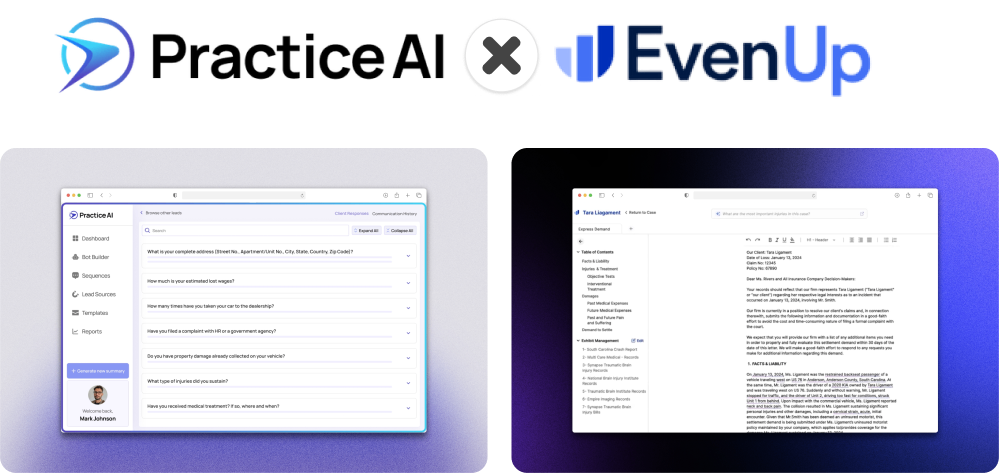
Practice AI™ vs. EvenUp™: Which Legal AI Tool Best Serves Your Firm's Needs?
To provide a clear, unbiased comparison between Practice AI™ and EvenUp™, highlighting their features, benefits, and limitations. This will assist legal professionals in making informed decisions about which AI tool aligns best with their firm's requirements.
July 8, 2025
0
min read

Introduction

In today's fast-paced legal environment, efficiency and accuracy are paramount. Legal professionals are increasingly turning to AI-powered legal tools to streamline tasks like drafting personal injury demand letters, summarizing medical records, and managing case workflows. 

Two prominent players in this space are Practice AI™ and EvenUp™. While both offer solutions aimed at enhancing legal operations, they differ in features, performance, and user experience. This article delves into a side-by-side comparison to help you determine which tool aligns best with your firm's needs, especially if you're searching for the best AI for lawyers or evaluating AI legal assistant platforms.

What Practice AI™ Offers

Practice AI™ is designed to automate and simplify the drafting process for legal professionals. Key features include:

  • AI-Generated Demand Letters: Quickly create precise and persuasive AI-powered demand letters tailored to various case types, including personal injury and lemon law. This is ideal for attorneys looking for an AI legal document generator that saves time and boosts accuracy.

  • Medical Records Summaries and Chronologies: Automatically generate comprehensive summaries and timelines from medical records, aiding in case preparation and strategy. This capability is especially beneficial for firms handling AI for healthcare legal cases or needing AI document summarization for large files.

  • HIPAA-Compliant Storage via Microsoft Azure: Ensures that all data is stored securely, maintaining compliance with healthcare privacy regulations. This meets the growing need for AI HIPAA compliance and addresses concerns around data security in AI.

  • Customizable Templates and User Access Controls: Offers flexibility in document formatting and robust access management to maintain data integrity and security—ideal for firms seeking legal document automation tools or investing in AI for legal professionals.

What EvenUp™ Offers

EvenUp™ provides AI-driven solutions aimed at personal injury law firms. Its offerings include:

  • AI-Generated Demand Letters with Human Review: Combines AI demand letter drafting with in-house legal expert reviews to produce demand letters.
  • Medical Chronologies and Case Preparation Tools: Assists in organizing and summarizing medical information pertinent to cases, helping attorneys manage workflows that intersect with AI in medical tech or AI for medical records.
  • Integration of Proprietary AI Models and In-House Legal Expertise: Utilizes a combination of AI technology and legal professionals to enhance document quality.

Key Differences at a Glance

Feature Practice AI™ EvenUp™
AI-Generated Demand Letters ✅ Yes ✅ Yes, with human review
Medical Records Summaries ✅ Yes ✅ Yes
HIPAA-Compliant Storage ✅ Yes (Microsoft Azure) 🟧 Partial (SOC 2, not HIPAA-certified)
Customizable Templates ✅ Yes ❌ No
User Access Controls ✅ Yes ❌ No
Delivery Time ✅ Fast and predictable ❌ Slow and unpredictable
Legal Citations in Documents ✅ Comprehensive ❌ Limited
Revision Flexibility ✅ Unlimited ❌ Limited
Billing and Sign-Up Process ✅ Transparent and straightforward ❌ Confusing and costly
Document Output Formats ✅ Multiple formats ❌ Word files only

Which Tool is Best for Your Firm?

Practice AI™ is ideal for firms seeking:

  • Efficiency: Rapid generation of demand letters and medical summaries in minutes.This is especially useful for law offices handling bulk documentation, including AI-generated legal documents for high-volume caseloads.
  • Customization: Flexibility in document templates and formatting makes Practice AI™ an ideal solution for those exploring AI for attorneys
  • Security: Robust data protection with HIPAA-compliant storage and user access controls—important for firms handling sensitive client records and those interested in AI in data security or AI for medical professionals.

EvenUp™ may suit firms that:

  • Prefer Human Oversight: Value the combination of AI drafting with human legal review, especially in complex personal injury or lemon law cases where nuance is critical.
  • Focus on Personal Injury Cases: Specialize in personal injury law and can accommodate the platform's limitations.

Why Practice AI™ Is the Best AI Legal Assistant for Law Firms

Selecting the right AI tool is crucial for enhancing your firm's productivity and client service. Practice AI™ offers a comprehensive, secure, and customizable solution that addresses common pain points in legal document preparation. Its emphasis on speed, accuracy, and user control makes it a compelling choice for modern legal practices evaluating AI in the legal field or looking to invest in AI for law firms.

The platform is led by industry veteran Hamid Kohan, whose vision for legal AI innovation continues to shape how law firms adopt intelligent automation tools.He has proven that in this lifetime, AI is indeed a useful tool to support human efforts and he showed it through the platform, Practice AI.

Explore Practice AI™ today to experience how it can transform your legal operations, whether you’re looking to automate legal documents, improve AI-powered legal writing, or drive faster resolutions with AI for faster settlements. Schedule a demo or start your free trial to see the benefits firsthand.