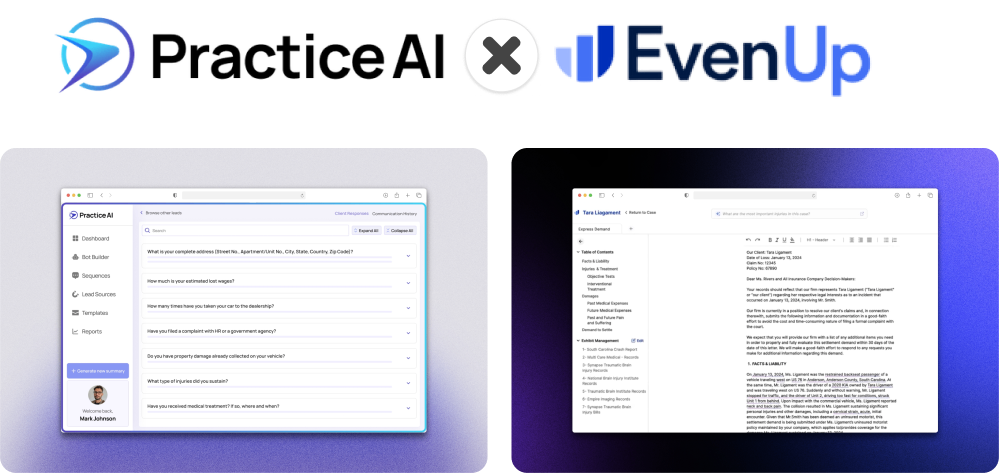
Practice AI™ vs. EvenUp™: Which Legal AI Tool Best Serves Your Firm's Needs?
To provide a clear, unbiased comparison between Practice AI™ and EvenUp™, highlighting their features, benefits, and limitations. This will assist legal professionals in making informed decisions about which AI tool aligns best with their firm's requirements.
In today's fast-paced legal environment, efficiency and accuracy are paramount. Legal professionals are increasingly turning to AI-powered legal tools to streamline tasks like drafting personal injury demand letters, summarizing medical records, and managing case workflows.
Two prominent players in this space are Practice AI™ and EvenUp™. While both offer solutions aimed at enhancing legal operations, they differ in features, performance, and user experience. This article delves into a side-by-side comparison to help you determine which tool aligns best with your firm's needs, especially if you're searching for the best AI for lawyers or evaluating AI legal assistant platforms.
What Practice AI™ Offers
Practice AI™ is designed to automate and simplify the drafting process for legal professionals. Key features include:
AI-Generated Demand Letters: Quickly create precise and persuasive AI-powered demand letters tailored to various case types, including personal injury and lemon law. This is ideal for attorneys looking for an AI legal document generator that saves time and boosts accuracy.
Medical Records Summaries and Chronologies: Automatically generate comprehensive summaries and timelines from medical records, aiding in case preparation and strategy. This capability is especially beneficial for firms handling AI for healthcare legal cases or needing AI document summarization for large files.
HIPAA-Compliant Storage via Microsoft Azure: Ensures that all data is stored securely, maintaining compliance with healthcare privacy regulations. This meets the growing need for AI HIPAA compliance and addresses concerns around data security in AI.
Customizable Templates and User Access Controls: Offers flexibility in document formatting and robust access management to maintain data integrity and security—ideal for firms seeking legal document automation tools or investing in AI for legal professionals.
What EvenUp™ Offers
EvenUp™ provides AI-driven solutions aimed at personal injury law firms. Its offerings include:
AI-Generated Demand Letters with Human Review: Combines AI demand letter drafting with in-house legal expert reviews to produce demand letters.
Medical Chronologies and Case Preparation Tools: Assists in organizing and summarizing medical information pertinent to cases, helping attorneys manage workflows that intersect with AI in medical tech or AI for medical records.
Integration of Proprietary AI Models and In-House Legal Expertise: Utilizes a combination of AI technology and legal professionals to enhance document quality.
Key Differences at a Glance
Feature
Practice AI™
EvenUp™
AI-Generated Demand Letters
✅ Yes
✅ Yes, with human review
Medical Records Summaries
✅ Yes
✅ Yes
HIPAA-Compliant Storage
✅ Yes (Microsoft Azure)
🟧 Partial (SOC 2, not HIPAA-certified)
Customizable Templates
✅ Yes
❌ No
User Access Controls
✅ Yes
❌ No
Delivery Time
✅ Fast and predictable
❌ Slow and unpredictable
Legal Citations in Documents
✅ Comprehensive
❌ Limited
Revision Flexibility
✅ Unlimited
❌ Limited
Billing and Sign-Up Process
✅ Transparent and straightforward
❌ Confusing and costly
Document Output Formats
✅ Multiple formats
❌ Word files only
Which Tool is Best for Your Firm?
Practice AI™ is ideal for firms seeking:
Efficiency: Rapid generation of demand letters and medical summaries in minutes.This is especially useful for law offices handling bulk documentation, including AI-generated legal documents for high-volume caseloads.
Customization: Flexibility in document templates and formatting makes Practice AI™ an ideal solution for those exploring AI for attorneys
Security: Robust data protection with HIPAA-compliant storage and user access controls—important for firms handling sensitive client records and those interested in AI in data security or AI for medical professionals.
EvenUp™ may suit firms that:
Prefer Human Oversight: Value the combination of AI drafting with human legal review, especially in complex personal injury or lemon law cases where nuance is critical.
Focus on Personal Injury Cases: Specialize in personal injury law and can accommodate the platform's limitations.
Why Practice AI™ Is the Best AI Legal Assistant for Law Firms
Selecting the right AI tool is crucial for enhancing your firm's productivity and client service. Practice AI™ offers a comprehensive, secure, and customizable solution that addresses common pain points in legal document preparation. Its emphasis on speed, accuracy, and user control makes it a compelling choice for modern legal practices evaluating AI in the legal field or looking to invest in AI for law firms.
The platform is led by industry veteran Hamid Kohan, whose vision for legal AI innovation continues to shape how law firms adopt intelligent automation tools.He has proven that in this lifetime, AI is indeed a useful tool to support human efforts and he showed it through the platform, Practice AI.
Explore Practice AI™ today to experience how it can transform your legal operations, whether you’re looking to automate legal documents, improve AI-powered legal writing, or drive faster resolutions with AI for faster settlements. Schedule a demo or start your free trial to see the benefits firsthand.
AI is transforming the way law firms research and prepare cases. Traditional legal research is time-consuming, error-prone, and often scattered across multiple tools. Law Practice AI Litigation Support centralizes case data, verdict insights, and judge intelligence, empowering lawyers to focus on strategy, advocacy, and winning cases.
The Critical Role of Accuracy in Modern Legal Practice
In today’s fast-paced legal environment, accuracy is no longer a luxury—it is a necessity. Legal professionals handle massive volumes of information, including pleadings, discovery files, witness statements, expert opinions, medical records, and court transcripts. Within this complexity, accurate case summaries serve as a guiding framework that brings order and clarity to chaos. A case summary is not merely a condensed version of documents; it is a strategic interpretation of facts, legal issues, timelines, and procedural posture. When summaries are accurate, attorneys gain a reliable foundation for every legal decision they make. Inaccurate summaries, however, can distort the narrative of a case, leading to flawed legal reasoning and missed opportunities. Accuracy ensures that no critical detail is overlooked and that every fact aligns with the evidence. It allows legal professionals to focus on strategy rather than fact-checking under pressure. As legal cases grow more complex and data heavy, accurate case summaries become essential tools for maintaining control, reducing stress, and delivering consistent, high-quality legal outcomes.
Creating Clarity from Complex Legal Information
Legal cases are inherently complex, often involving overlapping facts, evolving legal theories, and extensive documentation. Accurate case summaries transform this complexity into clarity by organizing information in a logical and accessible format. A strong summary clearly outlines the background of the case, identifies key parties, explains relevant laws, and highlights crucial evidence. This clarity allows attorneys to understand the case at a glance without sacrificing depth. When legal teams have access to clear summaries, they can quickly identify strengths, weaknesses, and strategic opportunities. Clarity also improves collaboration, ensuring that everyone involved in the case operates from the same understanding. Without accurate summaries, confusion can arise, leading to inconsistent arguments and misaligned strategies. Clear summaries help attorneys stay focused on the most relevant issues, eliminating distractions caused by unnecessary details. By simplifying complex information without losing accuracy, case summaries become powerful tools that enhance legal reasoning and decision making throughout the litigation process.
Reducing Legal Risk and Preventing Costly Errors
Errors in legal practice can have serious consequences, ranging from weakened arguments to financial penalties or case dismissal. Accurate case summaries significantly reduce these risks by serving as a reliable reference point for legal teams. When facts are clearly summarized and verified, attorneys are less likely to misstate information in court filings or oral arguments. Accurate summaries also help identify inconsistencies early, allowing legal professionals to address issues before they escalate. Risk reduction is especially critical in high-stakes litigation where small mistakes can lead to major setbacks. By providing a single source of truth, case summaries minimize reliance on memory or fragmented notes. This precision protects attorneys from avoidable errors and strengthens their credibility before judges and opposing counsel. Ultimately, accurate summaries act as a safeguard that preserves the integrity of legal arguments and supports successful outcomes.
Enhancing Time Efficiency and Legal Productivity
Time is one of the most valuable resources in legal practice, and accurate case summaries are essential for maximizing efficiency. Attorneys often manage multiple cases simultaneously, making it impractical to review full files repeatedly. A comprehensive summary allows quick access to essential facts, saving hours of document review. This efficiency is particularly valuable during hearings, depositions, and negotiations where immediate recall is required. Accurate summaries also streamline onboarding for new team members, enabling them to understand cases quickly and contribute effectively. By reducing repetitive work, summaries free up time for strategic thinking and client communication. Over time, improved efficiency leads to lower costs for clients and increased capacity for law firms. When attorneys spend less time searching for information and more time applying legal expertise, overall performance improves. Accurate case summaries therefore play a vital role in enhancing productivity and delivering better legal outcomes.
Strengthening Legal Strategy and Case Planning
Effective legal strategy begins with a thorough understanding of the case. Accurate case summaries provide the insights necessary to plan litigation strategies with confidence. By highlighting key facts, legal issues, and procedural milestones, summaries allow attorneys to anticipate challenges and prepare responses. This strategic clarity enables better decision making regarding motions, discovery, and trial preparation. Accurate summaries also support long-term planning by providing a clear roadmap of the case’s progression. When legal teams rely on accurate information, they can allocate resources more effectively and avoid unnecessary actions. Strategic planning grounded in accurate summaries reduces uncertainty and enhances focus. As a result, attorneys are better positioned to pursue favorable outcomes through informed and proactive strategies.
Improving Courtroom Performance and Advocacy
Courtroom success depends heavily on preparation and confidence. Accurate case summaries provide attorneys with a clear understanding of facts, enabling them to present arguments coherently and persuasively. When attorneys know their case inside and out, they can respond confidently to questions and counterarguments. Accurate summaries also help ensure consistency across briefs, motions, and oral arguments. This consistency enhances credibility and professionalism. Judges and juries are more likely to trust attorneys who present clear and accurate narratives. By reinforcing factual accuracy, case summaries strengthen advocacy and improve courtroom performance. Preparation rooted in accuracy is a key factor in achieving favorable rulings and verdicts.
Supporting Smarter Settlements and Negotiations
Settlement decisions often determine the ultimate outcome of a legal case. Accurate case summaries provide the factual clarity needed to evaluate settlement options objectively. They help attorneys assess liability, damages, and evidentiary strength without emotional bias. This objective assessment supports realistic settlement recommendations and effective negotiation strategies. Accurate summaries also improve communication with opposing counsel by grounding discussions in verified facts. When negotiations are based on clarity rather than assumptions, resolutions are reached more efficiently. Poor settlements often result from incomplete or inaccurate information. By contrast, accurate summaries empower attorneys to guide clients toward informed and favorable decisions. Smarter settlements save time, reduce costs, and minimize stress for all parties involved.
Enhancing Client Communication and Trust
Clear communication is essential for building strong attorney-client relationships. Accurate case summaries allow attorneys to explain complex legal matters in a way that clients can understand. This transparency builds trust and confidence, making clients feel informed and involved. When clients understand their cases, they are more likely to cooperate and make timely decisions. Accurate summaries also help manage expectations by clearly outlining strengths and risks. Honest communication reduces misunderstandings and strengthens long-term relationships. Law firms that prioritize clarity through accurate summaries demonstrate professionalism and client-centered service. Trust built through transparency often leads to higher client satisfaction and better outcomes.
Ensuring Consistency Across Legal Teams
Large legal teams often involve multiple attorneys, paralegals, and support staff working on the same case. Accurate case summaries ensure consistency by providing a shared understanding of facts and strategy. This alignment reduces miscommunication and duplication of effort. When everyone operates from the same summary, collaboration improves and errors decrease. Consistency is particularly important in complex cases where details can easily be misinterpreted. Accurate summaries serve as a central reference point, ensuring that all team members stay aligned throughout the case lifecycle. This coordination enhances efficiency and strengthens overall case management.
Supporting Appeals and Long-Term Case Management
Accurate case summaries are invaluable beyond trial, especially during appeals and long-term case management. Appeals require precise understanding of trial records and legal arguments. Summaries provide a clear overview that simplifies review and analysis. They also support continuity when cases extend over long periods or change hands between attorneys. Accurate summaries preserve institutional knowledge and ensure that critical details are not lost over time. This continuity is essential for maintaining momentum and consistency in legal strategy. By supporting long-term case management, summaries contribute to sustained legal success.
Leveraging Technology for Better Case Summaries
Modern legal practice increasingly relies on technology to manage information efficiently. Accurate case summaries benefit greatly from structured, technology-driven approaches. Digital tools enable better organization, searchability, and accessibility of summaries. When combined with legal expertise, technology enhances accuracy and usability. Mobile-friendly summaries allow attorneys to access information anytime, anywhere. This flexibility supports faster decision making and improved responsiveness. As technology continues to evolve, accurate summaries will become even more integral to effective legal practice.
How Law Practice AI Sets a Higher Standard
AtLaw Practice AI, we recognize that accurate case summaries are critical to achieving better legal outcomes. Our approach combines deep legal knowledge with structured analysis to deliver summaries that are clear, precise, and actionable. We focus on accuracy, clarity, and real-world usability, ensuring that our summaries support every stage of litigation. Designed to be mobile-friendly and easy to review, our summaries help legal professionals stay organized and confident. By reducing errors, saving time, and strengthening strategy, Law Practice AI empowers attorneys to perform at their best.
Ready to improve your legal outcomes with accurate case summaries?
Get started with Law Practice AI today and experience clarity, confidence, and strategic advantage in every case.
AtPractice AI, we understand the challenges lemon law attorneys face. That’s why we’ve expandedAI Demands—our cutting-edge demand letter generation tool—to support not just personal injury firms, but also those handling lemon law cases.
When it comes to resolving lemon law claims, have you ever wondered why some demand letters get quick responses while others are delayed or ignored? The key is precision. A clear, well-organized demand letter can make all the difference in how fast and fairly a manufacturer responds.
Manufacturers take claims more seriously when the demand letter is detailed and to the point. It should clearly outline the car’s defects, repair history, and why the claim qualifies under lemon law. If the letter is vague or missing key details, it can lead to delays, extra back-and-forth, or even a rejection.
A precise demand letter not only speeds up the process but also strengthens your case. When it includes solid documentation and references the right legal statutes, it shows the manufacturer you mean business. This increases the chances of a faster settlement, better compensation, and a smoother resolution.
What Goes into a Strong Lemon Law Demand?
So, what exactly should a strong lemon law demand letter include? Let’s break it down:
✅ Detailed Vehicle Information – The make, model, year, VIN, and purchase details set the foundation for your claim. ✅ Repair History – A timeline of repair attempts, including dates, issues, and dealership visits, establishes a pattern of defects. ✅ Manufacturer Communications – Any previous attempts to resolve the issue with the manufacturer demonstrate good faith efforts. ✅ Legal Basis – Citing the relevant lemon law statutes strengthens the legal standing of the demand. ✅ Requested Resolution – Whether your client seeks a buyback, replacement, or compensation, the demand must be clear and specific.
A vague or incomplete demand can weaken your client’s case, delay resolution, or give the manufacturer a reason to deny the claim. That’s why precision isn’t just helpful—it’s critical.
How AI Demands Transforms Lemon Law Cases
Wouldn’t it be easier if there were a way to ensure every lemon law demand was flawlessly drafted? That’s exactly whatAI Demands offers. Here’s how it can help your firm:
🚀 Faster Drafting – Generate high-quality demand letters in minutes, not hours. 📑 Error-Free Documents – Reduce the risk of missing crucial details. ⚖️ Legal Compliance – Ensure all statutory requirements are met for each state. 🔄 Customization – Tailor demand letters to specific client cases with ease. 💼 Scalability – Handle a higher volume of cases without sacrificing quality.
With AI handling the drafting, attorneys can focus on strategy and client advocacy, rather than spending hours formatting and refining demand letters.
Start Using AI Demands for Lemon Law Today
Are you ready to revolutionize how your firm handles lemon law cases? With Practice AI, you can draft precise, legally sound demand letters faster than ever.