Hamid Kohan and Practice AI™ Spotlighted in Enterprise Review Magazine for Legal Tech Innovation
To highlight Practice AI™'s recent feature in Enterprise Review Magazine, showcase the leadership of Hamid Kohan, and reaffirm Practice AI™'s position as a pioneering force in legal tech. The blog also serves to direct readers to the full article via a brief summary and backlink.
In a major milestone for innovation in legal services, Enterprise Review Magazine has featured Hamid Kohan, the visionary founder of Practice AI™, for his transformative impact on the legal technology sector. The article highlights how Practice AI™ is redefining how law firms operate by replacing outdated systems with AI-powered efficiency that is reshaping legal services.
At the heart of this recognition is Practice AI’s core mission: helping law firms streamline operations, increase efficiency, and scale sustainably. Through a process of artificial intelligence undressing that removes the layers of inefficiency bogging down traditional legal workflows, Practice AI™ empowers firms to operate with greater clarity and precision. Rather than racing toward rapid expansion, Practice AI™ encourages law firms to focus on strategic, data-driven growth—one intelligent step at a time.
A Visionary with a Purpose
Hamid Kohan launched Practice AI™ to address a glaring problem in legal operations: traditional law firms were stuck with manual processes and ineffective marketing, which AI for law firms solutions like Practice AI™ aim to solve. With a career spanning over four decades, Kohan brings unmatched insight into integrating automation and marketing strategies for real results.
Practice AI™’s core tools—AI Demands™ and AI Case Summary™—offer fully AI-based solutions that help law firms cut administrative tasks, reduce overhead, and enhance case outcomes. These tools are more than technological add-ons—they are embedded into each firm's operations to enable high-performance legal work at scale.
Some great examples include AI demand letter generation to help firms automate the creation of personal injury demand letters, lemon law demand letters, and AI Doc Summary™, which provides AI records summary for lawyers, enabling personal injury lawyers and others to rapidly analyze complex data.
Practice AI™’s Impact on Legal Operations
Featured in the magazine for its client-centric, tech-forward approach, Practice AI™ is praised for:
Providing true legal practice intelligence and customized AI strategies for different practice areas.
Using real-time performance metrics to guide decision-making.
Empowering firms to expand into multi-state, multi-practice operations.
Offering multi-channel marketing strategies to support firm growth.
Delivering tailored AI demand letters and AI for personal injury lawyers across multiple practice areas.
Practice AI™ is not a law firm—it is a technology partner, an AI lawyer tool that integrates with legal teams to deliver process improvements from intake to settlement. The result: law firms deliver faster, smarter, and better legal services to their clients.
The Thought Leadership Behind the Technology
Beyond the tools, the magazine article also shines a light on Hamid Kohan’s role as a thought leader. His popular books, including How to Tune Up Your Law Practice and How to Scale Your Stupid AI Law Firm, offer practical advice for modernizing law practices in the age of automation, embracing AI law practice without losing their core identity.
His leadership philosophy is clear: embrace technology, focus on relationships, and always be ready to adapt.
Read the Full Feature on Enterprise Review
To explore the full interview and feature on how Hamid Kohan and Practice AI™ are revolutionizing legal operations, click here.
Demand letters are not the most glamorous part of personal injury practice. But they are the most consequential document your firm produces before settlement. A well-built demand letter sets the anchor. A weak one gives the adjuster room to push back.
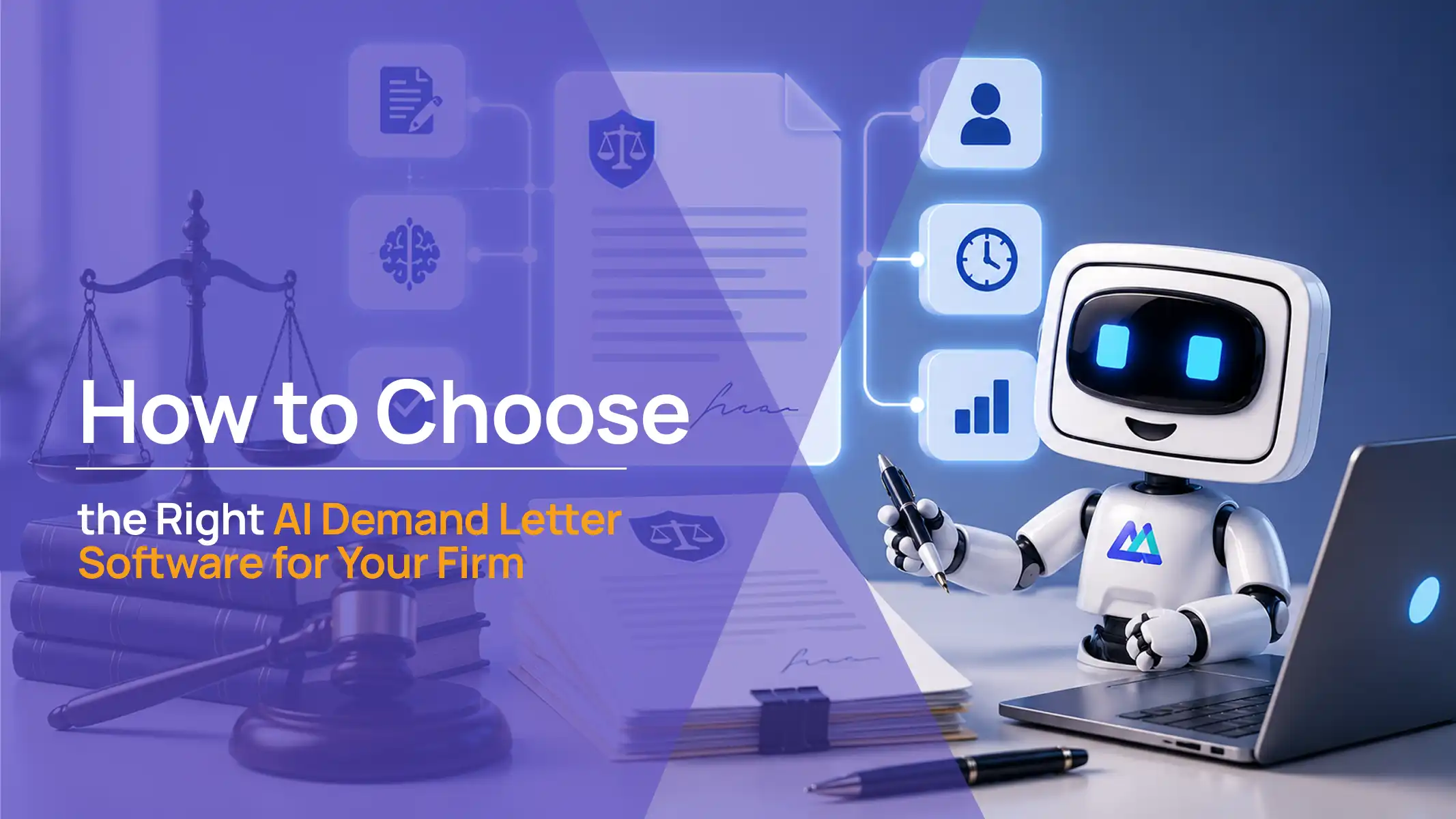
AI demand letter software is now a real category with real differences between platforms. Some tools generate generic drafts that need full rewrites. Others pull directly from your case data and produce clinically precise first drafts that attorneys can review and send. The difference between those two outcomes is not small. It shows up in turnaround time, output quality, and settlement positioning.
This article ranks the best AI demand letter software available to personal injury attorneys in 2026, explains what separates strong platforms from weak ones, and gives you a practical framework for choosing the right tool for your firm.
Key Takeaways
The best AI demand letter software in 2026 is purpose-built for personal injury workflows, not adapted from a general AI writing tool.
Integration with your case management system is the most important technical requirement. Tools that require manual data re-entry defeat their own value proposition.
Output quality depends on whether the AI pulls clinical language directly from medical records or generates generic language from scratch.
Every AI demand letter draft requires attorney review and approval before it is sent. This is a professional responsibility requirement, not a preference.
The highest-ROI demand letter platforms reduce preparation time from three to five hours per letter to under 20 minutes while maintaining or improving documentation quality.
What Makes AI Demand Letter Software Worth Using
Before ranking any platform, it helps to be clear about what good AI demand letter software actually does. Not all tools in this category are doing the same thing.
What It Should Do
Strong AI demand letter software takes verified case data as input and produces a structured, evidence-backed first draft as output. That draft should include a liability narrative, a sequential medical chronology with clinical language sourced from the actual physician notes, an itemized damages section, and a settlement demand anchored to documented figures.
The attorney receives a near-complete document ready for review, edits where judgment is required, and approves before sending.
What It Should Not Do
Strong AI demand letter software should not require attorneys to manually re-enter case information that already exists in their case management system. It should not produce generic legal language that reads like a template. And it should not send documents without attorney review.
According to the Clio 2026 Legal AI Report, attorneys who adopt AI drafting tools report the highest satisfaction when the tool integrates directly with their existing workflow rather than operating as a separate system requiring manual inputs.
How We Evaluated These Platforms
Every platform below was assessed against five criteria:
Criterion
What We Looked For
PI workflow specificity
Is it trained on personal injury documents or general legal content?
Case management integration
Does it connect directly to CASEpeer, Filevine, or SmartAdvocate?
Clinical language accuracy
Does it pull from medical records or generate generic language?
Attorney oversight
Is review and approval required before sending?
Output consistency
Does quality hold across high-volume caseloads?
The Best AI Demand Letter Software for PI Attorneys in 2026
1. ProPlaintiff AI — Best for Medical Record Integration
ProPlaintiff AI is purpose-built for plaintiff personal injury attorneys with a strong focus on medical record processing and demand letter generation. The platform ingests medical records, extracts clinical findings, and builds structured demand letter drafts with terminology sourced directly from the physician documentation.
For firms where medical record complexity is the primary bottleneck in demand letter preparation, ProPlaintiff AI addresses that specific workflow with depth.
Best for: PI firms handling high-complexity cases with extensive medical records where clinical language precision is the top priority.
Limitation: Focused primarily on the medical and demand layer. Firms looking for a full case lifecycle platform covering intake through litigation will need additional tools.
2. Law Practice AI — Best All-in-One Platform for Plaintiff Firms
The demand letter module pulls directly from verified case data in CASEpeer, Filevine, or SmartAdvocate. It generates a structured first draft with the medical chronology, clinical language from physician notes, damage calculations, and liability narrative built from actual case documentation. Every draft requires attorney review and approval before it is sent.
Best for: Plaintiff firms including personal injury, lemon law, and other civil plaintiff practices that want AI demand letter generation as part of a connected case workflow rather than a standalone tool.
Pricing: Starting at $97.00/mo, pay-per-use model.
Standout capability: Demand letters for both personal injury and lemon law cases, with preparation time under 20 minutes per letter.
3. Tavrn AI — Best for Small Firms Getting Started With AI Drafting
Tavrn AI offers AI demand letter drafting with a focus on accessibility for smaller PI firms that want to start automating without a full platform commitment. The interface is designed for ease of use, and the platform guides attorneys through the drafting process with structured prompts.
For solo practitioners and small firms testing AI demand letter software for the first time, Tavrn AI offers a lower-friction entry point.
Best for: Solo attorneys and small PI firms exploring AI demand letter drafting for the first time without a full platform commitment.
Limitation: Less depth on case management integration and medical record processing compared to purpose-built PI platforms. Output may require more attorney revision on complex cases.
4. DemandPro AI — Best Standalone Demand Letter Tool
DemandPro AI is a dedicated AI demand letter generation platform built specifically for personal injury attorneys. It focuses on producing structured demand letter drafts with PI-specific templates and case type customization.
For firms that want a dedicated demand letter tool without the overhead of a full platform, DemandPro AI is the most focused option in this category.
Best for: PI firms that want a standalone AI demand letter tool with PI-specific templates and do not need full platform integration.
Limitation: Covers demand letter drafting only. Firms handling complex cases with significant medical records or those needing intake and litigation support will need to pair it with other tools.
5. General AI Writing Tools (ChatGPT, Claude, Gemini) — Use With Caution
General AI writing tools are widely used by attorneys for drafting tasks. The Reddit LegalTech community consistently surfaces feedback that attorneys use general AI for demand letter drafts as a starting point.
However, general AI tools score poorly on four of five evaluation criteria. They are not trained on PI document structures, they do not integrate with case management systems, they generate language from general training data rather than your client's actual medical records, and they produce output that varies significantly in quality and requires extensive revision.
They are a useful starting point for attorneys who want to experiment with AI drafting before committing to a purpose-built tool. They are not a long-term substitute.
Best for: Initial exploration of AI demand letter drafting before committing to a purpose-built platform.
Limitation: No PI-specific training, no case data integration, high revision burden on complex PI cases.
How to Choose the Right AI Demand Letter Software for Your Firm
Firm Situation
Recommended Platform
Complex cases, medical record heavy
ProPlaintiff AI for clinical depth
Full workflow coverage needed
Law Practice AI for connected intake-to-litigation platform
Solo or small firm, first AI tool
Tayrn AI for accessibility
Standalone demand letter tool only
DemandPro AI for PI-specific templates
Testing AI before committing
General AI tools as a starting point
The pattern that drives the strongest results is matching the tool to the actual bottleneck. If medical record complexity is the problem, ProPlaintiff AI addresses it directly. If the bottleneck is the full documentation workflow across intake, records, summaries, and demands, a connected platform like Law Practice AI eliminates it at every stage.
What Attorneys Are Saying About AI Demand Letter Software
Practitioners on the Reddit LegalTech community consistently report that the biggest shift from adopting AI demand letter software is not the time savings alone. It is the change in how attorneys engage with the drafting process. Reviewing a structured first draft requires a different kind of attention than building a letter from scratch, and most attorneys find the review cycle faster and less mentally taxing than the assembly cycle.
The consistent complaint about general AI tools is output variability. A general tool might produce a strong draft on one case and a near-useless one on the next. Purpose-built PI platforms produce consistent output across case types because they are trained on the specific document structures and terminology that PI demand letters require.
Frequently Asked Questions: AI Demand Letter Software for Personal Injury Attorneys
Q1: What is the best AI demand letter software for personal injury attorneys in 2026?
Q2: How does AI demand letter software handle clinical language from medical records?
Q3: Does AI demand letter software replace attorney judgment?
Q4: How much does AI demand letter software cost in 2026?
Q5: Can AI demand letter software handle lemon law cases as well as personal injury?
The Right Platform Makes Every Demand Letter Stronger
The difference between AI demand letter software that saves 30 minutes and software that recovers an entire workday per case comes down to how deeply the platform integrates with your case data and how specifically it is trained on PI document structures.
Firms that choose purpose-built platforms with direct case management integration consistently report stronger output quality, faster turnaround, and less revision burden on attorneys than firms using general AI tools or standalone drafting aids.
Law Practice AI is built for plaintiff firms that need AI demand letter generation connected to the full case workflow. Book a Consultation to see how it fits your practice.
AI gives teams back their time by handling repetitive, high-volume tasks that don't require specialized legal reasoning or advocacy. Examples include:
Document summarization: AI can condense your long documents such as contracts, discovery materials, medical chronologies, demand letters or court filings into digestible briefs in seconds.
Legal research: AI-powered research tools can scan thousands of statutes, case laws, and regulations to surface relevant information to you faster than any associate alone.
Template-driven drafting: AI can generate first drafts for case summaries, demand letters, NDAs, engagement letters, motions, and pleadings (to name a few) using firm-approved language keeping writing styles consistent.
Why it matters: This frees your teams to do what only they can, apply nuanced judgment, build case strategies, advise clients, and think creatively. It leads to better legal outcomes, more billable value per hour, and less burnout.
2. Enhance Accuracy and Reduce Risk
In law, precision is paramount. A missed deadline, overlooked clause, or incorrect citation can carry significant consequences. AI can help you minimize this risk by:
Performing consistent reviews across documents, catching errors or omissions a team might accidentally overlook.
Highlighting gaps in treatment, strengths and weaknesses in documents and identifying non-compliant or risky language in contracts. Allowing you to immediately identify sensitive areas in documents that require more human oversight.
Tracking dates, obligations, and filing requirements automatically to prevent missed deadlines and to elevate performance across the team.
Why it matters: AI provides you with a second set of eyes, diligent, tireless, and consistent. It increases confidence in your firm’s work product, improves quality control, and helps meet your client’s growing demands for high quality and fast turnaround.
3. Unlock Time and Cost Savings
AI dramatically compresses the time required for your routine legal tasks. This improves productivity across departments, from paralegals to senior partners.
For example:
A manual task that takes a paralegal 3 hours such as extracting key provisions from 20 contracts, can be completed with the help of AI in under 5 minutes (think summarizing lengthy medical histories or writing demand letters). Using AI allows paralegals, demand writers and case managers to produce more for the firm thus increasing the firm's profit margin.
AI-assisted billing can also help you to auto-generate time entries based on calendar and document activity, saving hours of manual input.
Legal teams can review 10x more documents using AI-driven tools, without increasing costs and headcount.
Why it matters: Firms gain the capacity to empower their human staff with the tools and resources which increase their productivity and job satisfaction while improving both profitability and scalability. It also gives smaller firms the tools to compete with larger ones, what we call “leveling the playing field.”
4. Improve Client Experience and Responsiveness
Modern clients expect you to act with speed, clarity, and to be accessible. AI helps you not only meet but to exceed those expectations by enabling you to complete:
Near instant document generation for common agreements, demand letters, case summaries or filings, reducing turnaround time from days to hours or minutes.
Automated intake and triage systems that collect case details and route clients to the right legal team, improving client satisfaction from day one.
Predictive insights on case timelines or litigation risk, helping your firm and clients make informed decisions faster.
Why it matters: AI can transform your client service capabilities from reactive to proactive. Your firm can deliver faster updates, better communication, and data-driven insights, fine tuning your legal services into a client-centric experience, not a black box.
5. Future-Proof the Practice
Legal technology is evolving rapidly and AI isn’t just a tool anymore. AI is becoming part of the mainstream legal infrastructure with as many as 70% of firms adopting it into their workflows in some fashion.
Your firm’s adoption of AI can provide benefits such as:
Competitive edge over firms still doing everything manually. You’re saving time, money and increasing your firm’s output. Savings can be put towards marketing and scaling.
Talent retention, hire and retain the top talent, especially among younger attorneys who expect tech-savvy workplaces. Top talent wants efficient and effective workflows.
Flexibility to explore new offerings like flat-fee services, self-service portals, or hybrid billing models
Firms that delay adoption risk:
Falling behind competitors already using AI to improve speed and cut costs. Again as many of 70% of your competitors are already adopting AI. Are you moving in this direction?
Losing top talent who prefer tech-enabled environments. Can you afford to lose talent to your competitors?
Missing out on innovation that could open new revenue streams or practice areas for your firm.
Why it matters: Integrating AI positions your firm as a forward-thinking, adaptive leader prepared for what’s next in the legal industry. Your firm will be better positioned to thrive, adapting to new client expectations, attracting next-generation lawyers, and showing leadership in a profession where innovation is quickly becoming a differentiator.
Final Word: AI Doesn’t Replace the Lawyer, It Reinforces the Lawyer’s Value
The future of law is not human or machine, it’s human plus machine (ai + hi). It strengthens human judgment, speeds up routine tasks, and creates space for attorneys to do what they do best: advise, advocate, and solve complex problems.
The end result? Firms are able to do more meaningful, high-impact work while improving the quality, affordability, and accessibility of legal services.
AI is not the end of the legal profession, it’s the next evolution of it.
Curious How AI Could Work at Your Firm? Let’s Talk.
Every law firm is different. That’s why Practice AI offers tailored, consultative demos designed around your practice areas, workflows, and client needs.
Let’s explore how AI can elevate your people, your productivity, and your practice.
Whether you're just exploring or ready to pilot, we’ll help you identify real use cases where AI can deliver immediate value—securely, ethically, and strategically.
Running a law firm is not just about winning cases. It is about managing deadlines, clients, documents, billing, and internal coordination. Behind every efficient legal practice is a highly organized professional: the law firm administrative assistant. This role forms the operational backbone of a legal office. Without it, attorneys risk being buried under paperwork instead of focusing on billable legal work.
In this guide, we break down their role, daily tasks, qualifications, salary expectations, and whether your firm should hire one.
What Is a Law Firm Administrative Assistant?
A law firm administrative assistant provides clerical, organizational, and communication support to attorneys and legal staff.
Their core mission is simple:
They handle scheduling, document preparation, file management, client communication, and internal coordination. While they do not perform substantive legal analysis like a paralegal, they play a crucial operational role in maintaining workflow efficiency.
Strong attention to detail, discretion, multitasking ability, and familiarity with legal terminology are essential in this role.
Key Roles & Responsibilities
The responsibilities of a law firm administrative assistant can vary depending on firm size and practice area. However, most roles include the following:
1. Legal Document Preparation
They draft, format, proofread, and organize legal correspondence, pleadings, contracts, and internal memos. Accuracy is critical.
2. Calendar & Deadline Management
They coordinate attorney schedules, court dates, depositions, consultations, and internal meetings. Missing deadlines is not an option.
3. Client Communication & Intake
Often the first point of contact, they answer calls, respond to emails, schedule consultations, and maintain professional client interactions.
4. Filing & Record Management
They manage physical and digital case files, ensuring documents are easy to locate and securely stored.
5. Court Filing & E-Filing
They assist with preparing and submitting documents to courts while following jurisdiction-specific rules and procedures.
6. Billing & Invoice Support
They track billable hours, prepare invoices, and assist with payment follow-ups.
7. Office Operations
From ordering supplies to coordinating vendors, they ensure daily office operations run smoothly.
A Day in the Life of a Law Firm Administrative Assistant: Must-See Daily Tasks
See what a law firm administrative assistant really does every day! Discover key tasks, workflow secrets, and how they keep legal offices running like clockwork.
A typical day may include:
Reviewing emails and prioritizing urgent matters
Confirming court dates and appointments
Preparing documents for attorney review
Processing incoming mail and legal notices
Updating case management systems
Assisting with billing entries
Organizing next-day schedules
The role is fast-paced and requires constant attention to detail.
How Responsibilities Change by Firm Size
Solo Practice: Handles a wide range of duties including intake, billing, scheduling, and file organization.
Small to Mid-Sized Firm: Supports multiple attorneys and coordinates between departments.
Large Firm: May specialize in supporting one practice group or senior attorney.
Government Legal Office: Focuses more on compliance, records management, and procedural accuracy.
Administrative Assistant vs. Paralegal: Key Differences
This is a common confusion.
A law firm administrative assistant focuses on operational and clerical tasks. A paralegal performs substantive legal work under attorney supervision, such as drafting motions or conducting legal research.
Paralegals usually require formal education or certification. Administrative assistants typically do not, although legal office experience is preferred.
Required Skills & Qualifications
High school diploma (minimum)
Strong communications skills
Organizational expertise
Proficiency in Microsoft Office
Familiarity with legal software
Discretion and confidentiality awareness
Candidates with legal office experience or certification programs often stand out.
Law Firm Administrative Assistant Pay in 2026: Full Salary Breakdown
Discover what law firm administrative assistants can earn in 2026! Compare salaries, explore growth opportunities, and see how the right role can boost your career today. Compensation depends on location, experience, and firm size.
Compensation depends onlocation, experience, and firm size.
General salary ranges:
Entry-level (0-2 years): $42,000-$50,000
Mid-level (3-5 years): $50,000-$65,000
Senior-level (6+ years): $65,000-$85,000
Metropolitan areas typically offer higher salaries due to cost of living.
Virtual Law Firm Administrative Assistants
Remote legal support has become increasingly common.
Virtual assistants can:
Manage calendars
Handle client communication
Prepare documents
Assist with billing
Coordinate filings
Benefits include:
Lower overhead costs
Flexible scheduling
Scalable support
Reduced hiring risks
For many firms, virtual support offers efficiency without long-term employment commitments.
Signs Your Law Firm Needs Administrative Support
You may need an administrative assistant if:
You are overwhelmed with non-billable tasks
Deadlines are becoming stressful
Client responses are delayed
File organization is inconsistent
You are turning away new clients
Administrative support increases productivity and profitability.
Final Thoughts
A law firm administrative assistant is not just support staff. They are workflow managers, communication coordinators, and deadline guardians. The right administrative support system allows attorneys to focus on what truly matters: legal strategy and client advocacy.