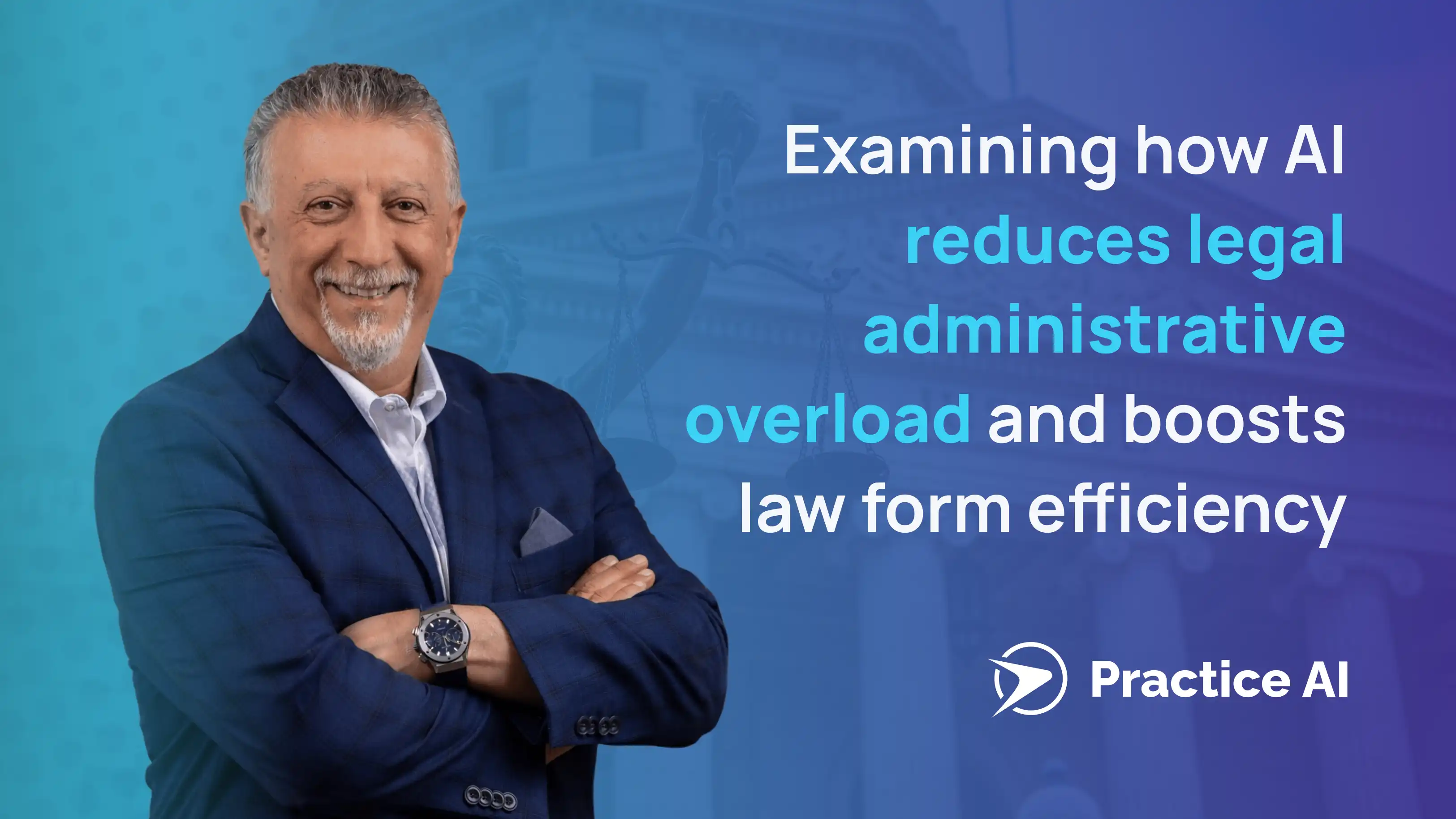


LOS ANGELES, CA (April 21, 2026) — Hamid Kohan, CEO and Founder of Law Practice AI, has been published in The AI Journal with a contributed piece examining how artificial intelligence is helping law firms reduce administrative overload and recover lost billable capacity. The article draws on Kohan's experience building AI-powered legal platforms and offers a data-backed analysis of where inefficiency is costing law firms the most.
The piece opens by identifying administrative misallocation as the core operational problem facing modern law firms. Kohan cites a Bloomberg Law survey on attorney workload finding that attorneys work an average of 48 hours per week, with only 36 of those hours billable. The remaining 12-hour weekly gap represents administrative overhead that compounds across every attorney on staff. The same survey found that attorneys spend two out of every eight working hours on administrative duties such as tracking hours and managing projects, with burnout reported 42% of the time on average, reaching 51% among mid-to-senior associates.
Kohan argues that AI does not eliminate jobs in legal practice. It eliminates the low-value repetition that has quietly drained firm capacity for years. He describes AI as infrastructure rather than a tool, one that spans the full case lifecycle from intake and qualification through document collection, case file organization, and draft generation.
A significant portion of the article addresses what Kohan calls the fragmentation problem. Citing Law.com, he notes that 42% of legal professionals report using legal-specific AI while firm-wide adoption remains lower at 34%. The gap between individual use and institutional adoption, he argues, points to a structural issue rather than a demand problem. An ABA Legal Industry Report finding cited in the piece found that 43% of legal professionals identify integration with existing software as their top priority, above features, output quality, or cost.
On the financial case for AI adoption, Kohan references the 2025 Thomson Reuters Future of Professionals Report, which found that professionals using AI save an estimated five hours per week, representing approximately $19,000 in billables per professional annually. Across the United States, the report projects AI-driven efficiency could represent a combined $32 billion annual impact for the legal and tax industries.
On revenue impact, Kohan cites data showing 36% of legal professionals report AI has positively impacted firm revenue, rising to 69% among those who have widely adopted it. Among firms with no significant AI integration, the gap widens 3.5 times.
Kohan closes by returning to where the problem begins: administrative overload. The firms seeing the greatest gains are not simply adopting AI as a productivity tool. They are using it to systematically eliminate the administrative drag that has quietly consumed attorney capacity for years. When the 12-hour weekly gap between hours worked and hours billed is treated as an infrastructure problem rather than an individual performance issue, the entire operational model of a law firm changes. That shift, from reactive administration to structured, AI-supported workflows, is what separates firms that are growing from those that are falling behind.
The full article is available on The AI Journal.