Enhancing Legal and Healthcare Data Protection with Practice AI™
Safeguarding legal and healthcare data protection, specifically patient privacy, is a top priority in the realm of legal and medical fields, especially when using advanced tools like Practice AI™. Given the rise of AI-driven solutions for summarizing and analyzing medical records, healthcare data security like patient confidentiality continues to remain a critical concern.
Below, we explore key strategies to enhance healthcare data protection while leveraging Practice AI for law firms and medical professionals in legal cases.
Understanding the Importance of Legal and Healthcare Data Protection
Healthcare data protection is governed by strict regulations such as the Health Insurance Portability and Accountability Act (HIPAA) in the U.S., which aims to protect sensitive health information. In legal cases, patient data, such as medical records, police reports, or other personal health information (PHI), must be handled with the utmost care to ensure compliance with these privacy laws.
Additionally, legal AI solutions help law firms manage large volumes of sensitive medical data when preparing personal injury demand letters or handling AI-driven case summaries.
Challenges in Maintaining Patient Privacy with AI
While general Legal AI tool and technologies streamline the processing of documents, they introduce potential risks to patient privacy, such as:
Data Insecurity in AI: The transmission and storage of medical records could expose sensitive information to unauthorized access if systems are not secure.
Data Anonymization: Identifiable information in medical records may need to be redacted to prevent breaches of privacy.
Over-reliance on AI: AI in the Legal field, if not properly governed, reliance on AI-powered demand letters or legal document automation tools and other AI tools could result in human oversight being diminished, risking unintentional exposure of sensitive data.
Strategies to Enhance Patient Privacy when Using Medical & Legal AI Tools
Strategies to enhance patient privacy and healthcare Data protection with AI
Removing Sensitive Details from Documents One of the most effective ways to maintain healthcare data protection is by anonymizing or de-identifying medical records before they are processed by AI document summarization tools. Removing direct identifiers, such as names, addresses, and Social Security numbers, reduces the risk of re-identification and ensures compliance with privacy regulations.
Access Controls and Secure Storage Every AI for legal professionals tool should be deployed within secure environments that enforce access controls. Only authorized personnel, such as legal experts and medical professionals, should have access to sensitive patient data. Data should be stored using encryption and access logs to monitor and maintain security.
Transparent Data Use Policies Establish clear policies about how patient data will be used, shared, and protected. Users should be informed about AI HIPAA compliance and other data handling practices and agree to consent before AI tools process their medical records. Transparency builds trust and ensures compliance with privacy laws.
Regular Privacy Audits and Monitoring Implement ongoing privacy audits to ensure that patient data is handled according to established policies and regulations. Healthcare data protection monitoring systems should detect potential breaches and take corrective actions as necessary.
AI Model Transparency and Accountability AI systems should be regularly reviewed to ensure that they adhere to privacy standards. Legal professionals and AI for medical professionals using AI tools should be accountable for data security and ensure that AI-generated documents comply with privacy regulations.
The Role of Practice AI in Enhancing Privacy
Practice AI offers powerful tools that enhance the efficiency of legal processes by summarizing and analyzing complex medical records, and ensures the highest level of security through the following measures:
Advanced Encryption: We use 4096-bit encryption to safeguard data transmission.
Compliance with Standards: We adhere to GDPR, CCPA, SOC-2, HITRUST, and ISO 27001 to ensure full compliance and data protection. Additionally, Practice AI is built on Microsoft Azure, a HIPAA-compliant server and infrastructure provider.
Cloud Infrastructure: Our partnership with Microsoft Azure provides a robust infrastructure with secure access controls, automatic backups, and reliable disaster recovery systems.
Practice AI ensures that patient confidentiality is respected, helping legal and medical professionals deliver high-quality, compliant services without compromising patient privacy.
Ensure your legal practice adheres to privacy regulations—sign up with Practice AI today to streamline your workflow while safeguarding patient data.
Artificial Intelligence isn’t just a buzzword anymore, it’s a real tool transforming how law firms manage their caseloads, especially in personal injury and lemon law. Drafting demand letters is one of the most time-consuming, repetitive, and high-stakes parts of the legal process. One error can delay settlements, frustrate clients, or even jeopardize the case.
Enter AI-powered solutions like Law Practice AI’s Demand AI, which streamline demand letter generation for personal injury and lemon law cases. But beyond convenience, the benefits of using AI go far deeper.
Here are 10 major advantages AI offers legal professionals in these practice areas:
1. Faster Turnaround Times
AI significantly reduces the time required to create fully developed demand letters, from hours (or days) to just minutes. By using templates, auto-filled data, and case-specific language, attorneys can deliver faster results without sacrificing quality.
2. Increased Accuracy and Legal Consistency
AI ensures every letter follows a logical structure, includes necessary case elements, and avoids omissions that could weaken the demand. Consistency in language, legal terminology, and formatting strengthens your professional credibility.
3. Enhanced Compliance with State Laws
Personal injury and lemon law vary by state. AI Demands is trained to align with current statutes and jurisdiction-specific requirements, helping attorneys stay compliant without manually checking each clause or reference.
4. Reduced Attorney Burnout
Legal burnout is real, especially in high-volume practices. By automating repetitive, low-reward tasks like demand drafting, lawyers can reduce mental fatigue and focus on what they do best: advocacy and strategy.
5. More Time for Case Strategy
AI clears your calendar. Instead of spending your time wordsmithing documents, you can investigate liability, prepare discovery, negotiate better settlements, or build trial strategies, all tasks that directly impact your client’s outcomes.
6. Improved Client Satisfaction
When letters go out faster and contain more complete, persuasive arguments, clients feel confident in your process. Speed + precision = trust. AI allows you to deliver better service at scale.
7. Cost Savings for Firms
Drafting letters manually often requires high hourly billing or hiring assistants. With AI, firms can dramatically lower drafting costs while increasing output, making this ideal for contingency fee practices.
8. Easier Document Management
Practice AI’s AI Demands integrates document tracking, so every draft is saved, categorized, and versioned. This improves internal workflows, avoids lost files, and simplifies audits or compliance reviews.
9. Scalable Growth for High-Volume Practices
Whether you’re handling dozens or hundreds of cases per month, AI ensures you can scale without sacrificing quality. New paralegals or team members can be onboarded with minimal training thanks to standardized AI workflows.
10. Real-Time Updates to Legal Language
AI models evolve. As new laws, court rulings, and industry best practices emerge, Practice AI updates its templates and logic, keeping you ahead of the curve without lifting a finger.
Conclusion: Empower Your Firm with Smart Legal Tech
AI doesn’t replace legal expertise, it enhances it. Whether you’re running a boutique lemon law practice or a high-volume personal injury firm, AI Demands empowers you to move faster, reduce risk, and deliver stronger outcomes.
Ready to draft demand letters in minutes, not hours?
Sign up now to explore how AI Demands can transform your firm’s workflow.
Personal injury firms run on documentation. Every case requires intake records, medical files, billing statements, demand letters, and litigation materials, all assembled, organized, and reviewed before a single negotiation begins. For most firms, that documentation process consumes a significant portion of every attorney and paralegal's working day.
Law Practice AI software is built to automate that documentation layer so attorneys spend less time on assembly and more time on the work that actually moves cases forward. This article breaks down what the software automates, how each workflow changes, and what the verified data says about the results.
Key Takeaways
Law Practice AI software automates five core personal injury workflows: client intake, document collection, case summarization, demand letter drafting, and litigation support.
Every automated workflow still requires attorney review and approval before output is used or sent. Automation handles assembly. Attorneys handle judgment.
Firms using Law Practice AI report handling 40% more active cases per attorney compared to firms using manual drafting workflows, according to data published in the National Law Review.
Demand letter preparation time drops from an average of three hours per letter to under 20 minutes, based on Law Practice AI client performance data.
The platform integrates directly with CASEpeer, Filevine, and SmartAdvocate so existing case data flows into automated workflows without manual re-entry.
Workflow 1: Client Intake Goes from Manual to Automated
What It Looked Like Before
In a traditional PI firm intake process, a paralegal spends 30 to 45 minutes with each prospect collecting incident details, checking for conflicts, documenting the case, and routing the file. For firms receiving a high volume of inquiries, this process consumes significant paralegal hours every week, with no guarantee that every prospect receives the same quality of intake experience.
What Law Practice AI Software Does
The AI intake module uses an AI voice agent to conduct structured qualification interviews with prospects. It collects incident details, flags liability indicators, documents the conversation, and delivers an organized case summary to the attorney for review. Cases with strong merit are routed immediately. Cases that do not meet threshold criteria are handled appropriately without consuming attorney time.
What Changes
The paralegal role in intake shifts from data collection to quality review. The attorney receives a pre-qualified, documented case file rather than raw intake notes. The prospect receives an immediate, professional response rather than waiting for a callback.
According to the 2026 Legal Industry Report by 8am, 70% of legal professionals now use generative AI tools at work, a figure that more than doubled in a single year. Intake automation is consistently cited as one of the first workflows firms implement because the time savings are immediate and the output is measurable from the first week.
Workflow 2: Document Collection Becomes Trackable and Consistent
What It Looked Like Before
Gathering medical records, billing statements, police reports, and supporting documents is one of the most administratively intensive parts of personal injury case preparation. Most firms manage this through a combination of manual requests, email follow-ups, and spreadsheet tracking. Records arrive out of order, get buried in email threads, or require repeated follow-up before they are received.
What Law Practice AI Software Does
The document collection module sends automated requests to medical providers and other sources, tracks responses, and follows up automatically when records have not been received. Documents that arrive are organized, labeled, and synced automatically to Google Drive, OneDrive, or Dropbox. Every file is accessible from the case record without manual sorting.
What Changes
The administrative burden of record collection shifts from active management to exception handling. Staff only intervene when a request requires escalation rather than managing every request manually from start to finish. Case files are consistently organized and current, which reduces the time attorneys spend searching for documents when they need them.
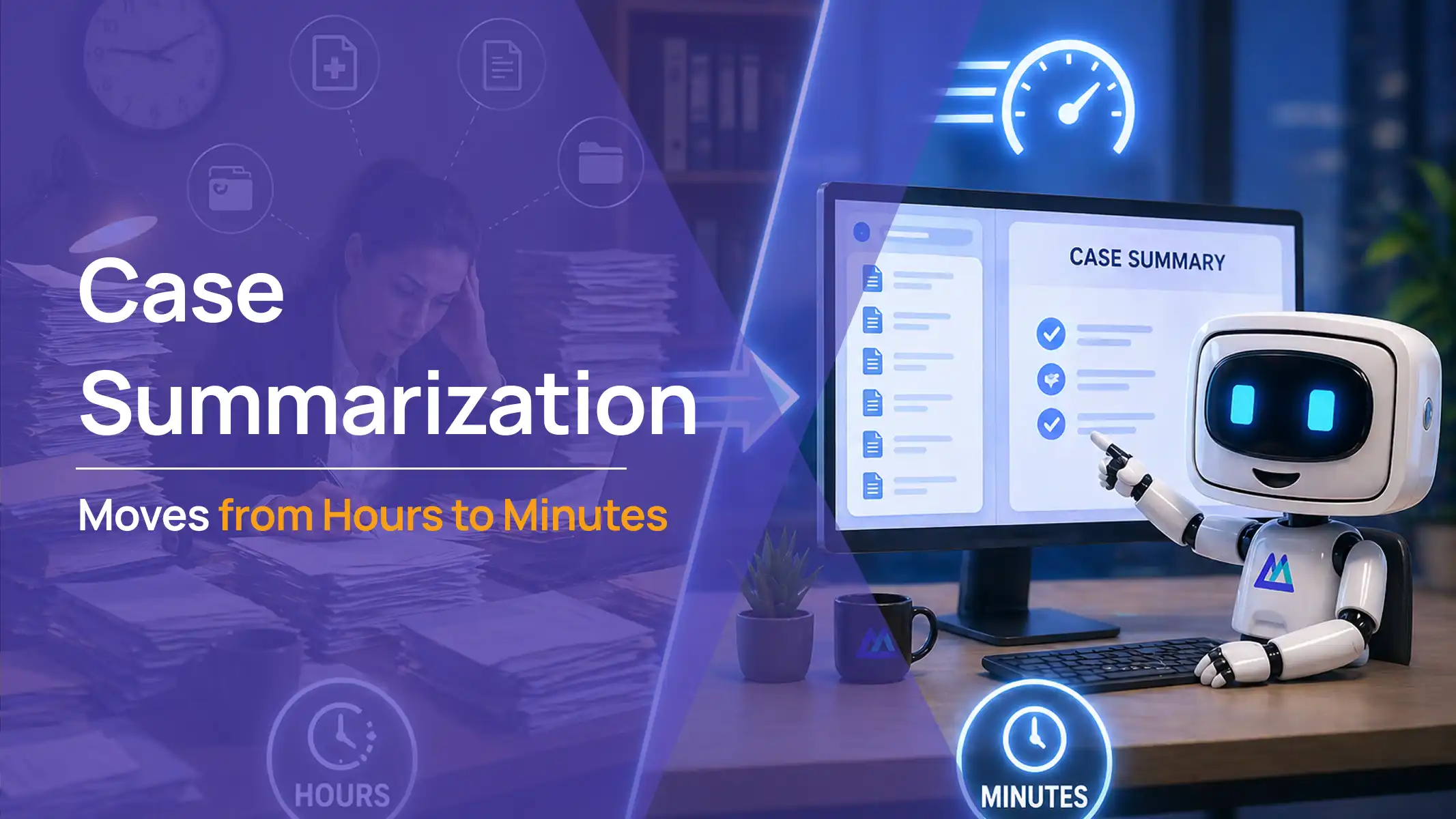
Workflow 3: Case Summarization Moves from Hours to Minutes
What It Looked Like Before
Reviewing a full case file, including hundreds of pages of medical records, to produce a structured case summary is one of the most time-intensive tasks in personal injury practice. A paralegal or attorney reads through the raw records, extracts the key clinical details, and organizes them into a format that can be used for the demand letter. On a complex case, this process can take several hours.
What Law Practice AI Software Does
The case summary module reads the verified case documentation and generates a structured AI case summary that pulls key facts, medical findings, ICD-coded diagnoses, liability indicators, and damage figures into a single organized document. The attorney reviews the summary for accuracy and completeness before it is used downstream.
What Changes
Case review time drops significantly. Attorneys receive a structured overview of the case rather than raw records to read through. The summary feeds directly into the demand letter drafting workflow so no information has to be re-entered between stages. Case files have a consistent structure regardless of which staff member handled the initial review.
Workflow 4: Demand Letter Drafting Becomes Faster and More Consistent
What It Looked Like Before
A complex personal injury demand letter requires a complete medical chronology, clinical language pulled from physician notes, itemized damage calculations, a liability narrative, and a settlement anchor tied to comparable verdicts. Building that from scratch on every case is time-consuming by design. Manual preparation averages three to five hours per letter.
What Law Practice AI Software Does
The demand letter module pulls from the verified case data assembled in the earlier workflow stages. It generates a structured first draft that includes the organized medical chronology, clinical language sourced from the actual physician notes, damage calculations from the documented figures, and a liability narrative built from the case documentation. The attorney reviews, edits where judgment is required, and approves the final letter before it is sent.
What Changes
Preparation time drops from an average of three hours to under 20 minutes per letter, based on Law Practice AI client performance data published in the National Law Review in March 2026. When every demand letter is built from verified case data with consistent clinical language, the output quality does not vary based on workload or available staff. Every adjuster receives a letter that reflects the same standard of documentation.
Workflow 5: Litigation Support Is Built In from Day One
What It Looked Like Before
For cases that proceed beyond the demand stage, building litigation-ready documentation is a separate, manual process. Chronologies, exhibit packets, and case arguments are assembled by hand, often under time pressure as trial dates approach.
What Law Practice AI Software Does
Litigation Support is included in every Law Practice AI plan at no additional cost. The module organizes documentation for court readiness from the moment a case opens, not when litigation becomes imminent. Chronologies, exhibits, and case arguments are structured and available throughout the case lifecycle.
What Changes
Attorneys are not scrambling to assemble litigation materials under deadline pressure. The documentation is organized and current from day one because it feeds from the same case data used across all other workflow stages.
Before and After: Law Practice AI Software Across All Five Workflows
Workflow
Before Law Practice AI
After Law Practice AI Software
Client intake
30 to 45 min per prospect, manual paralegal process
Automated requests, tracking, cloud sync, organized by case
Case summarization
Manual record review, several hours per complex case
AI-generated summary from verified records, attorney reviews
Demand letter drafting
3 to 5 hours per letter, manual assembly
Under 20 minutes per letter, attorney reviews AI draft
Litigation support
Built separately, often under deadline pressure
Included in every plan, organized from case open
What the Data Says
The National Law Review reported in March 2026 that firms using Law Practice AI's demand letter drafting handle an average of 40% more active cases per attorney compared to firms relying on manual workflows, with preparation time dropping from three hours to under 20 minutes per letter.
The 2025 Thomson Reuters Future of Professionals Report found that legal professionals using AI save an estimated five hours per week, representing approximately $19,000 in recovered billable capacity per attorney annually. For a five-attorney firm, that is $95,000 in recovered capacity per year without adding headcount.
The Insurance Research Council found that attorney-represented claimants receive settlements averaging 3.5 times higher than unrepresented claimants. That multiplier narrows when demand letter quality is inconsistent. Law Practice AI software addresses that inconsistency directly by standardizing the documentation process across every case.
Frequently Asked Questions: Law Practice AI Software
Q1: Does Law Practice AI software replace my case management system?
Q2: Is attorney review required at every stage?
Q3: What file types does the document collection module support?
Q4: Can the demand letter module handle different case types?
Q5: How does Law Practice AI software handle data security?
The Documentation Bottleneck Is the Growth Constraint
For most personal injury firms, the limit on how many cases an attorney can actively manage is not skill or strategy. It is a documentation capacity. Every hour spent on manual assembly is an hour not spent on negotiation, client relationships, or case strategy.
Law Practice AI software removes that bottleneck workflow by workflow, starting with the highest-friction tasks and connecting every stage into a single system that runs on verified case data.
Book a Consultation to see how it fits your firm's specific workflows at Law Practice AI. You can also explore how each module works at Law Practice AI Solutions.
AI Demands™ by Practice AI™ is a cutting-edge tool designed to streamline the creation of personal injury demand letters. It automates the process, ensuring that lawyers can produce professional, accurate, and legally compliant demand packages in just minutes. This powerful AI legal document generator allows attorneys to focus on more strategic aspects of their practice.
AI Demand streamlines the process of creating professional, accurate, and legally compliant demand packages in just minutes. With pre-built templates for various personal injury cases, including motor vehicle accidents (global policy, regular time limit, and third policy cases), slip-and-fall incidents, and dog bites, personal injury lawyers can efficiently produce tailored documents.
Personal injury lawyers can also revise and customize the language to highlight the physical and emotional impact of injuries, ensuring the final personal injury demand letter is polished, persuasive, and perfectly suited to the case. By saving hours of drafting and revision, AI Demands™ enables lawyers to focus on other critical aspects of their practice.
Benefits of Using AI Demands:
Save Time on Demand Letters: Writing letters from scratch takes time. AI-powered demand letters quickly create detailed, professional letters, so you can focus on other priorities.
Ensure Accuracy and Quality:AI legal document automation tools provide precision, reducing errors and ensuring every demand meets legal standards.
Boost Efficiency: Handle more cases with ease, enhancing productivity and client service with AI for law firms.
Stress-free Security & Compliance: Built with the highest standards of data security in AI and privacy. Our platform runs on infrastructure that is compliant with GDPR, HITRUST (HIPAA), ISO 27001, SOC-2, and CCPA.
Reduce Team Burnout: Drafting letters can be repetitive and draining. AI Demands takes care of it, allowing your team to focus on meaningful work and stay motivated.
Do What Matters Most: Time spent drafting is time away from important tasks like negotiations or client care. AI Demands™ helps you focus on what truly matters by leveraging legal AI solutions to automate demand letters effectively.
Exclusive Advantages for CAALA Members:
As a proud partner ofLegal Soft, sponsoring recent CAALA events, we are now providing benefit packages for CAALA members. This offer allows you to experience the full benefits of AI Demands at no cost, maximizing efficiency and keeping your practice competitive with AI-powered legal writing.




.jpg)