News or updates icon
Blog

Practice AI Blog

Explore how AI-driven solutions can automate routine tasks, allowing legal professionals to focus on more strategic activities.

These tools can assist in document review, legal research, and even predicting case outcomes, thereby increasing efficiency and accuracy.

Personal Injury Case Valuation Software: How to Evaluate

0
min read
June 19, 2026

Every plaintiff attorney has done the manual version of personal injury case valuation.

Pull the medical bills. Tally the past expenses. Estimate the future treatment costs. Apply a pain and suffering multiplier based on judgment and experience. Double-check the wage loss calculation. Hope nothing was missed.

That process works. But it is slow, it is inconsistent across attorneys, and it is entirely dependent on the person running the numbers having every document in front of them at the right time.

Personal injury case valuation software is designed to replace that manual process with a structured, data-driven output that gives attorneys a consistent starting point on every case.

This article walks through what case valuation tools actually do, how to evaluate them, and what separates a useful personal injury damages calculator from one that just produces a number your attorney cannot rely on.

KEY TAKEAWAYS

  • Personal injury case valuation software should pull figures from your actual case documentation, not from a generic multiplier formula applied to entered numbers.
  • The most important output from a case valuation tool is not a dollar figure. It is the structured breakdown of how that figure was calculated.
  • Personal injury law firm software used for case valuation must be HIPAA compliant before any medical records enter the workflow.
  • An automated case valuation tool that flags missing documentation before producing an output is significantly more reliable than one that calculates from whatever data is available.

Defining Personal Injury Case Valuation

Personal injury case valuation is the process of calculating the total compensatory damages a plaintiff is entitled to based on the documented evidence in their case file.

A complete personal injury case valuation is not a single number. It is a structured, component-by-component breakdown covering past medical expenses, future treatment costs, lost wages, pain and suffering, and property damage. Each component is drawn from verified documentation, not from estimates or averages.

The valuation forms the foundation of the settlement demand. How it is calculated, what documentation it is based on, and how each figure is supported determines whether the demand holds up under adjuster scrutiny or gives opposing counsel grounds to challenge it.

What Personal Injury Case Valuation Actually Involves

Before evaluating any software, it helps to be precise about what personal injury case valuation means in practice for a plaintiff law firm.

Case valuation is not a single calculation. It is a multi-component process that requires accurate documentation of every relevant damages category.

The Core Damages Categories

A complete personal injury case valuation covers the following:

Past Medical Expenses: Total billed amounts organized by provider, including emergency department care, specialist visits, imaging, physical therapy, and any other documented treatment. The figure is drawn from verified billing statements, not estimates.

Future Medical Expenses: Projected ongoing care costs based on treating physician recommendations. This typically includes physical therapy, specialist follow-ups, pain management, and any anticipated surgical interventions.

Pain and Suffering: Non-economic damages calculated using either a multiplier applied to total medical expenses or a per diem approach based on the duration and severity of the injury. Multipliers typically range from 1.5x to 5x total medical expenses depending on injury severity. A soft tissue case may support 1.5x to 2x, while a permanent disability case with documented long-term functional limitations may support 4x or higher. 

Per diem calculations assign a daily value to the injury and multiply it by the number of days the plaintiff experienced pain and limitation. The appropriate method depends on jurisdiction, documented injury severity, and the strength of the clinical evidence.

Lost Wages: Income lost during the recovery period, documented with employer verification and pay stubs. Where applicable, future earning capacity loss is addressed with vocational expert input.

Property Damage: Vehicle repair or total loss value, documented with appraisals or repair estimates.

Why Manual Case Valuation Creates Inconsistency

When personal injury case valuation is done manually, the output depends entirely on who is running the numbers, what documentation they have in front of them, and what multiplier they choose to apply.

Two attorneys at the same firm can review the same case file and arrive at materially different valuations. That inconsistency affects settlement positioning, negotiation strategy, and ultimately client outcomes.

Personal injury case valuation software standardizes the process by applying consistent calculation logic to the same verified documentation every time.

What Case Valuation Software Actually Does
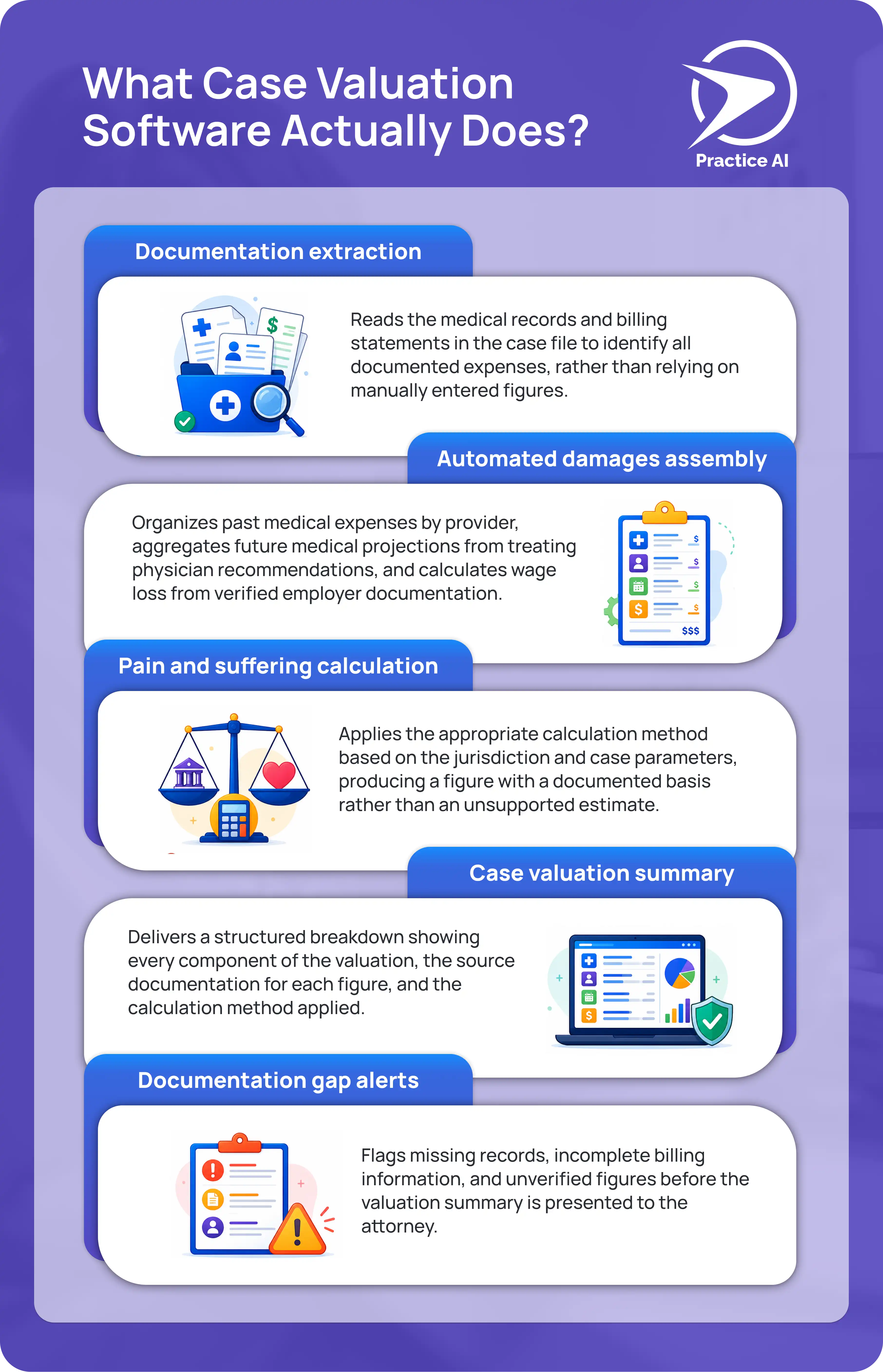
Infographic showing five functions of case valuation software including documentation extraction, automated damages assembly, pain and suffering calculation, case valuation summary, and documentation gap alerts by Law Practice AI

A personal injury damages calculator embedded in a plaintiff law firm workflow does more than multiply medical bills by a number.

Here is what a properly built case valuation tool produces:

  • Documentation extraction

Reads the medical records and billing statements in the case file to identify all documented expenses, rather than relying on manually entered figures.

  • Automated damages assembly

Organizes past medical expenses by provider, aggregates future medical projections from treating physician recommendations, and calculates wage loss from verified employer documentation.

  • Pain and suffering calculation

Applies the appropriate calculation method based on the jurisdiction and case parameters, producing a figure with a documented basis rather than an unsupported estimate.

  • Case valuation summary

Delivers a structured breakdown showing every component of the valuation, the source documentation for each figure, and the calculation method applied.

  • Documentation gap alerts

Flags missing records, incomplete billing information, and unverified figures before the valuation summary is presented to the attorney.

A personal injury damages calculator that skips any of these steps is producing a number, not a valuation.

How to Evaluate Case Valuation Software for a Plaintiff PI Firm

AI robot taking notes on a tablet beside analytics charts and a client protection icon, how to evaluate case valuation software for a plaintiff PI firm.

These are the criteria that separate useful case valuation software from tools that add more steps than they remove.

1. Does It Read Your Actual Case Documents?

The most important question is whether the tool reads your uploaded case documents or asks you to enter figures manually.

A tool that accepts manual entries produces output based on what someone typed in. A tool that reads your uploaded records produces output based on what the documentation actually shows.

For personal injury case valuation, that distinction is significant. A billing total entered manually is only as accurate as the person who entered it. A billing total extracted from the uploaded provider records is verified against the source.

2. Does It Integrate With Your Legal Software?

Case valuation software that does not connect to your existing platform CASEpeer, Filevine, SmartAdvocate requires your team to re-enter information that is already in your system.

Personal injury law firm software used for case valuation should pull case data, billing records, and client information automatically. An automated case valuation that requires manual data transfer between platforms is not actually automated.

3. Does It Produce a Structured Breakdown, Not Just a Total?

A dollar figure without a breakdown is not a usable case valuation for a plaintiff attorney.

The output needs to show every component of the calculation, the source for each figure, and the method used to calculate pain and suffering. An attorney reviewing the valuation should be able to verify every line before using it to set a demand.

4. Does It Flag What Is Missing?

An automated case valuation tool that calculates from whatever documentation is available, without flagging what is missing, will produce an inaccurate valuation whenever the case file is incomplete.

The tool should identify missing provider records, unverified wage loss documentation, incomplete billing statements, and any other gaps before presenting the valuation. Catching missing documentation before the calculation runs is significantly better than discovering it after the demand letter is sent.

5. Is It HIPAA Compliant and SOC 2 Certified?

Every personal injury case file contains protected health information. Any case valuation software that processes medical records must be HIPAA compliant and SOC 2 Type II certified, with a signed Business Associate Agreement in place before any client data enters the platform.

This is not optional for plaintiff law firms. It is a baseline requirement.

6. Does Attorney Review Remain Mandatory?

No automated case valuation should produce a final figure that goes directly into a demand letter without attorney review.

The software handles the data assembly and calculation. The attorney reviews the output, adjusts where judgment requires it, and approves the final valuation before it is used. Firms using tools that skip this step are assuming professional responsibility risk they do not need to take.

General Calculator vs. Purpose-Built Case Valuation Software

Factor General PI Calculator Purpose-Built Case Valuation Software
Input method Manually entered figures Reads uploaded case documents
Damages breakdown Total only Component by component with sources
Legal software integration None Native with CASEpeer, Filevine, SmartAdvocate
Documentation gap detection None Flags missing records before calculating
Pain and suffering method Single multiplier Jurisdiction-aware calculation
HIPAA compliance Varies Required and certified
Attorney review step Optional Mandatory
Output usability Reference only Ready for attorney review and demand drafting

How Law Practice AI Handles Personal Injury Case Valuation

Law Practice AI includes automated case valuation software built specifically for plaintiff law firms.

The platform reads the uploaded medical records, billing statements, and case documentation to assemble a complete valuation. Past medical expenses are organized by provider. Future medical projections are drawn from treating physician recommendations. Wage loss is calculated from verified employer documentation.

The pain and suffering calculation is documented with the method and basis used. Every component of the valuation shows its source so the attorney can verify every figure before using it.

Documentation gaps are flagged before the valuation summary is produced. Attorney review is required before any output is used. No valuation leaves the platform without explicit attorney approval.

Law Practice AI is HIPAA compliant and SOC 2 Type II certified. A signed Business Associate Agreement is in place with every firm before any client data enters the platform.

Frequently Asked Questions

Frequently Asked Questions: Personal Injury Case Valuation

Q1: What is personal injury case valuation?

Q2: How does a personal injury damages calculator work?

Q3: How does Law Practice AI automated case valuation differ from a general PI damages calculator?

Q4: Is HIPAA compliance required for personal injury case valuation software?

Q5: Does Law Practice AI offer a free trial?

The Right Case Valuation Tool Produces a Breakdown Your Attorney Can Actually Use

A personal injury case valuation is only as reliable as the documentation behind it.

Tools that accept manual inputs produce estimates. Tools that read your actual case documents, flag what is missing, and deliver a component-by-component breakdown with documented sources produce valuations.

That is the distinction worth holding every case valuation software option to before your firm commits to using it.

Book a Consultation to see how automated case valuation software fits your plaintiff practice.

Browse more blogs

Enhancing Patient Outcomes with AI Doc Summary: AI-Powered Medical Document Summaries

0
min read

Medical professionals, from doctors to medical assistants, require records and documents to provide the best care for their patients. The accuracy and timeliness of patient record analysis can greatly affect patient outcomes. However, this means dedicating hours to generating summaries or analyses or using tools that may not always guarantee compliant and accurate summaries. This has created the need for efficient and accurate document summarization and review, driving innovation in AI-powered solutions and expanding careers in artificial intelligence within the healthcare industry.

Our fully AI-powered legal and medical solution, AI Doc Summary, focuses on transforming the way both medical and legal professionals handle document reviews by analyzing multiple documents and files and generating summaries with precision. This ensures that crucial information is swiftly and accurately identified. AI Doc Summary can be used by both AI for medical professionals and AI for legal professionals to apply to their medical and legal workflows.

Table of Contents:

  1. The Growing Need for AI in Medical Document Review
  2. How AI Doc Summary Enhances Patient Care
  3. Real-World Impact on Patient Outcomes
  4. Getting Started with AI Doc Summary

The Growing Need for AI in Medical Document Review and Compliance

The rapid growth of medical information technology has created challenges for healthcare providers, who find it difficult to manage the ever-increasing amount of data. 

From patient histories to treatment plans, each document contains vital information that must be understood and acted upon swiftly. AI Doc Summary is designed with precision and speed in mind, eliminating a large portion of the manual work needed for document summaries.

How AI Doc Summary Enhances Patient Care

  1. Accurate Summaries: One of the standout features of AI Doc Summary is its ability to swiftly generate accurate AI-powered legal writing summaries from complex medical records. This capability allows healthcare providers to quickly understand the main points and pertinent details, freeing up time to focus on patient care and critical decision-making.
  2. Highlighting Key Details: Missing key details can be disastrous in patient care. AI Doc Summary is designed to scan documents meticulously and highlight critical information, ensuring that no essential detail is overlooked. This feature is instrumental in developing comprehensive treatment plans and making informed decisions.
  3. Reducing Errors: Human error is inevitable, especially when dealing with vast amounts of information under tight deadlines. AI Doc Summary reduces these errors by providing a more reliable document review process. With its ability to analyze information accurately, healthcare professionals can be confident in the decisions they make, based on dependable data. As careers in artificial intelligence continue to grow, AI-driven tools like AI Doc Summary are not only enhancing efficiency and accuracy in medical workflows but also shaping the future of AI-driven healthcare solutions.
  4. Review & Revise as Needed: Revising summaries or analyses can be a time-consuming and redundant process, and it may lead to complications with document control. With Demands AI, medical professionals can make adjustments and edits if necessary, ensuring that all generated summaries meet their requirements.

Real-World Impact: AI-Driven Accuracy for Better Patient Outcomes 

Consider a scenario where a patient's treatment plan needs urgent revision based on the latest test results. With AI Doc Summary, medical teams can quickly identify and act on key information, reducing the time taken from diagnosis to treatment. Such efficiency not only optimizes resource use but can significantly improve AI for healthcare legal cases like patient outcomes by ensuring timely and accurate interventions.

Getting Started with AI Doc Summary

Adopting AI Doc Summary into your healthcare practice is simple and rewarding. The tool is designed for intuitive use, making integration seamless for medical teams seeking to enhance their document management in healthcare such as document review processes. 

By offering a clear and user-friendly interface, AI Doc Summary ensures that healthcare professionals can adapt quickly and start reaping the benefits almost immediately.

Transform Your Document Workflow

Adopt AI Doc Summary to simplify document review, improve efficiency, and help healthcare teams manage medical documents with ease.

Special Offer for CAALA Members: Demand Generation Benefit Package

0
min read

What is AI Demand by Practice AI?

AI Demands™ by Practice AI™ is a cutting-edge tool designed to streamline the creation of personal injury demand letters. It automates the process, ensuring that lawyers can produce professional, accurate, and legally compliant demand packages in just minutes. This powerful AI legal document generator allows attorneys to focus on more strategic aspects of their practice.

AI Demand streamlines the process of creating professional, accurate, and legally compliant demand packages in just minutes. With pre-built templates for various personal injury cases, including motor vehicle accidents (global policy, regular time limit, and third policy cases), slip-and-fall incidents, and dog bites, personal injury lawyers can efficiently produce tailored documents. 

Personal injury lawyers can also revise and customize the language to highlight the physical and emotional impact of injuries, ensuring the final personal injury demand letter is polished, persuasive, and perfectly suited to the case. By saving hours of drafting and revision, AI Demands™ enables lawyers to focus on other critical aspects of their practice.

Benefits of Using AI Demands:

  • Save Time on Demand Letters: Writing letters from scratch takes time. AI-powered demand letters quickly create detailed, professional letters, so you can focus on other priorities.
  • Ensure Accuracy and Quality: AI legal document automation tools provide precision, reducing errors and ensuring every demand meets legal standards.
  • Boost Efficiency: Handle more cases with ease, enhancing productivity and client service with AI for law firms.
  • Stress-free Security & Compliance: Built with the highest standards of data security in AI and privacy. Our platform runs on infrastructure that is compliant with GDPR, HITRUST (HIPAA), ISO 27001, SOC-2, and CCPA.
  • Reduce Team Burnout: Drafting letters can be repetitive and draining. AI Demands takes care of it, allowing your team to focus on meaningful work and stay motivated.
  • Do What Matters Most: Time spent drafting is time away from important tasks like negotiations or client care. AI Demands™ helps you focus on what truly matters by leveraging legal AI solutions to automate demand letters effectively.

Exclusive Advantages for CAALA Members:

As a proud partner of Legal Soft, sponsoring recent CAALA events, we are now providing benefit packages for CAALA members. This offer allows you to experience the full benefits of AI Demands at no cost, maximizing efficiency and keeping your practice competitive with AI-powered legal writing.

How CAALA Members Can Sign Up:

  1. Visit www.lawpractice.ai.
  2. Sign up and subscribe to AI Demands.
  3. Start generating professional personal injury demand letters in minutes!
  4. Email support@mylawfirm.ai to confirm your CAALA membership and activate your benefit package.

Don’t miss this opportunity to streamline your law firm’s workflow, leverage AI-generated legal documents, and enhance your practice

How AI-Powered Tools Empower Legal and Medical Professionals

0
min read

Artificial intelligence (AI) is transforming how professionals work—especially in the legal industry and medical fields. This powerful AI technology isn't about replacing experts but helping them do their tasks better and faster. AI-powered tools can take care of routine tasks, handle complex data, and provide insights that enhance decision-making in both legal practice and medical fields.

Table of Contents:

  1. What Is the Impact of AI in Legal Industry and the Medical Field?
  2. What Are the Common Misconceptions About AI?
  3. Can ChatGPT Handle Legal AI Solutions and Medical AI Solutions?
  4. Meet Practice AI Solutions - Demands AI & AI Doc Summary
  5. Why Practice AI Solutions?Summary: How Can AI Empower Professionals Like You?

What Is the Impact of AI in Legal Industry and the Medical Field?

AI tools are growing quickly and finding their way into more industries. For legal and medical professionals, AI isn’t just a buzzword—it’s becoming a vital tool for getting things done efficiently.

According to LITSLINK, AI is already easing healthcare providers' workloads and boosting time for clinical work, making it an essential asset for modern medical professionals.

The same is becoming true in the legal profession—AI tools are helping lawyers, paralegals, and legal assistants spend less time on paperwork and more time on strategy, client interaction, and case outcomes.

AI In the legal field:

AI for legal professionals can help with tasks like drafting personal injury demand letters, reviewing specific contracts and legal documents, and researching case laws. Instead of spending hours on paperwork, lawyers can focus on meeting clients, creating strategies, and negotiating settlements. AI for law firms is helping both larger firms and smaller firms improve efficiency and accuracy.

AI In the medical field:
AI solutions can assist doctors and other health care professionals by analyzing patient records, identifying patterns, and even helping with diagnoses. This saves time and reduces the risk of human error, leading to better patient outcomes. By taking care of repetitive tasks, AI lets professionals concentrate on what they do best—applying their expertise to solve complex problems.

What Are the Common Misconceptions About AI?

There’s a lot of misunderstanding about AI. Let's clear up a couple of common myths:
Myth 1: Will AI replace human professionals?
The truth is, AI is a tool—not a replacement. It works alongside professionals, handling routine or time-consuming tasks so experts can focus on higher-level work. For example, AI can draft a contract or retainer, but a lawyer or legal professional still needs to review it to ensure it meets client needs and legal standards.
Myth 2: Is AI too complicated to use?
Many professionals resist AI technology because they think it’s hard to use. In reality, today’s AI-powered tools are designed to be user-friendly. Training and education can help medical or legal teams see AI as a partner, not a threat. The goal is to enhance human skills, not replace them.

Can ChatGPT Handle Legal AI Solutions and Medical AI Tasks?

ChatGPT is reshaping how legal and medical professionals handle complex documentation and compliance. From drafting AI-powered demand letters to AI medical record summarization, it streamlines tedious tasks, allowing professionals to focus on what truly matters—clients and patients.
For lawyers, AI for legal professionals streamlines demand letter generation, accelerating the creation of personal injury demand letters and lemon law demand letters, making case preparation more efficient. In healthcare, AI for healthcare legal cases ensures precise analysis while maintaining AI legal compliance and AI document security.
By embracing AI-powered legal and medical solutions, professionals can enhance accuracy, save time, and optimize workflow, ensuring a more efficient future for both industries.

Meet Practice AI Solutions - Demands AI & AI Doc Summary

At Practice AI, we understand the unique challenges legal and medical professionals face. That’s why we’ve developed specialized AI tools—Demands AI and AI Doc Summary—to meet your specific needs.

How Does Demands AI Improve Personal Injury Demand Letters?

Personal injury demand letters are critical in legal cases. They need to be detailed, persuasive, and legally sound. Demands AI generates comprehensive personal injury demand letters quickly and accurately.
Advantages:

  • Understands Legal Language: Demands AI is built with knowledge of personal injury law, ensuring your letters are thorough and compliant.
  • Offers Customizable Pre-built Templates: Demands AI offers pre-built templates for a variety of personal injury cases, such as motor vehicle accidents, dog bites, lemon law demand letters, premise liability, and slip and fall cases. Users can also customize these templates using their own branding.
  • Saves Time: Instead of spending hours drafting a letter from scratch, you can generate a high-quality draft in minutes.
  • Offers Unlimited Revisions: If you are not happy with the AI-generated demand letters, fear not; Demands AI allows you to review a demand letter and edit it as many times as you see fit.
  • Increases Success Rates: A well-crafted demand letter can lead to faster settlements. With Demands AI, you get professional, polished letters every time.


Experience the power of Demands AI. Sign up with Practice AI now and explore Demands AI.

How Does AI Doc Summary Simplify Document Review?

Reviewing medical and legal documents is time-consuming. AI Doc Summary makes it easier by summarizing and analyzing complex documents with high precision.
Key benefits:

  • Accurate Summaries: Quickly get the main points from long documents, so you can focus on what matters most.
  • Spot Key Details: AI Doc Summary highlights important information, ensuring nothing gets missed.
  • Reduces Errors: AI minimizes human mistakes, improving the reliability of your work.


Simplify document review with AI Doc Summary. Sign up with Practice AI now and explore AI Doc Summary.

Why Practice AI Solutions?

You might wonder why you should choose our specialized AI tools over general ones. Here’s the difference:

  1. Are These Tools Trained Specifically for Legal/Medical Needs? Demands AI and AI Doc Summary are created specifically for legal and medical professionals. They understand the language, context, and standards of legal statutes and medical regulations.
  2. Do They Offer Higher Accuracy? These tools are trained on industry-specific data, leading to more accurate and reliable results.
  3. Can They Save Time and Money? Automating routine tasks using Practice AI tools allows you to save valuable time, boosting productivity while also helping you achieve a better work-life balance.
  4. Can They Help with Your Legal/Medical Practice’s Results and Settlements? Demands AI and AI Doc Summary are designed to enhance both efficiency and accuracy, leading to enhanced results and maximized settlements for your practice and clients.

Ready to transform your workflow? Sign up with Practice AI now and explore Demands AI & AI Doc Summary.

How Can Practice AI Empower Lawyers and Doctors Like You?

AI is here to help, not replace. It’s about working smarter, not harder. By automating routine tasks and improving accuracy, Practice AI allows legal professionals such as paralegals, case managers, legal assistants, and medical professionals such as healthcare workers and medical assistants to focus on what they do best—providing expert care and service.

Choosing the right AI tools is crucial. Demands AI and AI Doc Summary are designed to meet the unique needs of legal and medical professionals. They offer the precision, reliability, and efficiency you need to excel.

Click here to explore Demands AI & AI Doc Summary and sign up for the trial to unlock your full potential.