5
min read time

Best AI Demand Letter Software for Personal Injury Attorneys (2026)

AI robot reviewing a legal document beside scales of justice with client screening icons, AI demand letter software for personal injury attorneys by Law Practice AI

Demand letters are not the most glamorous part of personal injury practice. But they are the most consequential document your firm produces before settlement. A well-built demand letter sets the anchor. A weak one gives the adjuster room to push back.

AI demand letter software is now a real category with real differences between platforms. Some tools generate generic drafts that need full rewrites. Others pull directly from your case data and produce clinically precise first drafts that attorneys can review and send. The difference between those two outcomes is not small. It shows up in turnaround time, output quality, and settlement positioning.

This article ranks the best AI demand letter software available to personal injury attorneys in 2026, explains what separates strong platforms from weak ones, and gives you a practical framework for choosing the right tool for your firm.

Key Takeaways

  • The best AI demand letter software in 2026 is purpose-built for personal injury workflows, not adapted from a general AI writing tool.
  • Integration with your case management system is the most important technical requirement. Tools that require manual data re-entry defeat their own value proposition.
  • Output quality depends on whether the AI pulls clinical language directly from medical records or generates generic language from scratch.
  • Every AI demand letter draft requires attorney review and approval before it is sent. This is a professional responsibility requirement, not a preference.
  • The highest-ROI demand letter platforms reduce preparation time from three to five hours per letter to under 20 minutes while maintaining or improving documentation quality.

What Makes AI Demand Letter Software Worth Using

Before ranking any platform, it helps to be clear about what good AI demand letter software actually does. Not all tools in this category are doing the same thing.

What It Should Do

Strong AI demand letter software takes verified case data as input and produces a structured, evidence-backed first draft as output. That draft should include a liability narrative, a sequential medical chronology with clinical language sourced from the actual physician notes, an itemized damages section, and a settlement demand anchored to documented figures.

The attorney receives a near-complete document ready for review, edits where judgment is required, and approves before sending.

What It Should Not Do

Strong AI demand letter software should not require attorneys to manually re-enter case information that already exists in their case management system. It should not produce generic legal language that reads like a template. And it should not send documents without attorney review.

According to the Clio 2026 Legal AI Report, attorneys who adopt AI drafting tools report the highest satisfaction when the tool integrates directly with their existing workflow rather than operating as a separate system requiring manual inputs.

How We Evaluated These Platforms

Every platform below was assessed against five criteria:

Criterion What We Looked For
PI workflow specificity Is it trained on personal injury documents or general legal content?
Case management integration Does it connect directly to CASEpeer, Filevine, or SmartAdvocate?
Clinical language accuracy Does it pull from medical records or generate generic language?
Attorney oversight Is review and approval required before sending?
Output consistency Does quality hold across high-volume caseloads?

The Best AI Demand Letter Software for PI Attorneys in 2026

1. ProPlaintiff AI — Best for Medical Record Integration

ProPlaintiff AI is purpose-built for plaintiff personal injury attorneys with a strong focus on medical record processing and demand letter generation. The platform ingests medical records, extracts clinical findings, and builds structured demand letter drafts with terminology sourced directly from the physician documentation.

For firms where medical record complexity is the primary bottleneck in demand letter preparation, ProPlaintiff AI addresses that specific workflow with depth.

Best for: PI firms handling high-complexity cases with extensive medical records where clinical language precision is the top priority.

Limitation: Focused primarily on the medical and demand layer. Firms looking for a full case lifecycle platform covering intake through litigation will need additional tools.

2. Law Practice AI — Best All-in-One Platform for Plaintiff Firms

Law Practice AI ranks second because it is the only platform on this list that connects AI demand letter generation to the full case workflow: intake, document collection, case summarization, demands, and litigation support all on one platform.

The demand letter module pulls directly from verified case data in CASEpeer, Filevine, or SmartAdvocate. It generates a structured first draft with the medical chronology, clinical language from physician notes, damage calculations, and liability narrative built from actual case documentation. Every draft requires attorney review and approval before it is sent.

Best for: Plaintiff firms including personal injury, lemon law, and other civil plaintiff practices that want AI demand letter generation as part of a connected case workflow rather than a standalone tool.

Pricing: Starting at $97.00/mo, pay-per-use model.

Standout capability: Demand letters for both personal injury and lemon law cases, with preparation time under 20 minutes per letter.

3. Tavrn AI — Best for Small Firms Getting Started With AI Drafting

Tavrn AI offers AI demand letter drafting with a focus on accessibility for smaller PI firms that want to start automating without a full platform commitment. The interface is designed for ease of use, and the platform guides attorneys through the drafting process with structured prompts.

For solo practitioners and small firms testing AI demand letter software for the first time, Tavrn AI offers a lower-friction entry point.

Best for: Solo attorneys and small PI firms exploring AI demand letter drafting for the first time without a full platform commitment.

Limitation: Less depth on case management integration and medical record processing compared to purpose-built PI platforms. Output may require more attorney revision on complex cases.

4. DemandPro AI — Best Standalone Demand Letter Tool

DemandPro AI is a dedicated AI demand letter generation platform built specifically for personal injury attorneys. It focuses on producing structured demand letter drafts with PI-specific templates and case type customization.

For firms that want a dedicated demand letter tool without the overhead of a full platform, DemandPro AI is the most focused option in this category.

Best for: PI firms that want a standalone AI demand letter tool with PI-specific templates and do not need full platform integration.

Limitation: Covers demand letter drafting only. Firms handling complex cases with significant medical records or those needing intake and litigation support will need to pair it with other tools.

5. General AI Writing Tools (ChatGPT, Claude, Gemini) — Use With Caution

General AI writing tools are widely used by attorneys for drafting tasks. The Reddit LegalTech community consistently surfaces feedback that attorneys use general AI for demand letter drafts as a starting point.

However, general AI tools score poorly on four of five evaluation criteria. They are not trained on PI document structures, they do not integrate with case management systems, they generate language from general training data rather than your client's actual medical records, and they produce output that varies significantly in quality and requires extensive revision.

They are a useful starting point for attorneys who want to experiment with AI drafting before committing to a purpose-built tool. They are not a long-term substitute.

Best for: Initial exploration of AI demand letter drafting before committing to a purpose-built platform.

Limitation: No PI-specific training, no case data integration, high revision burden on complex PI cases.

How to Choose the Right AI Demand Letter Software for Your Firm
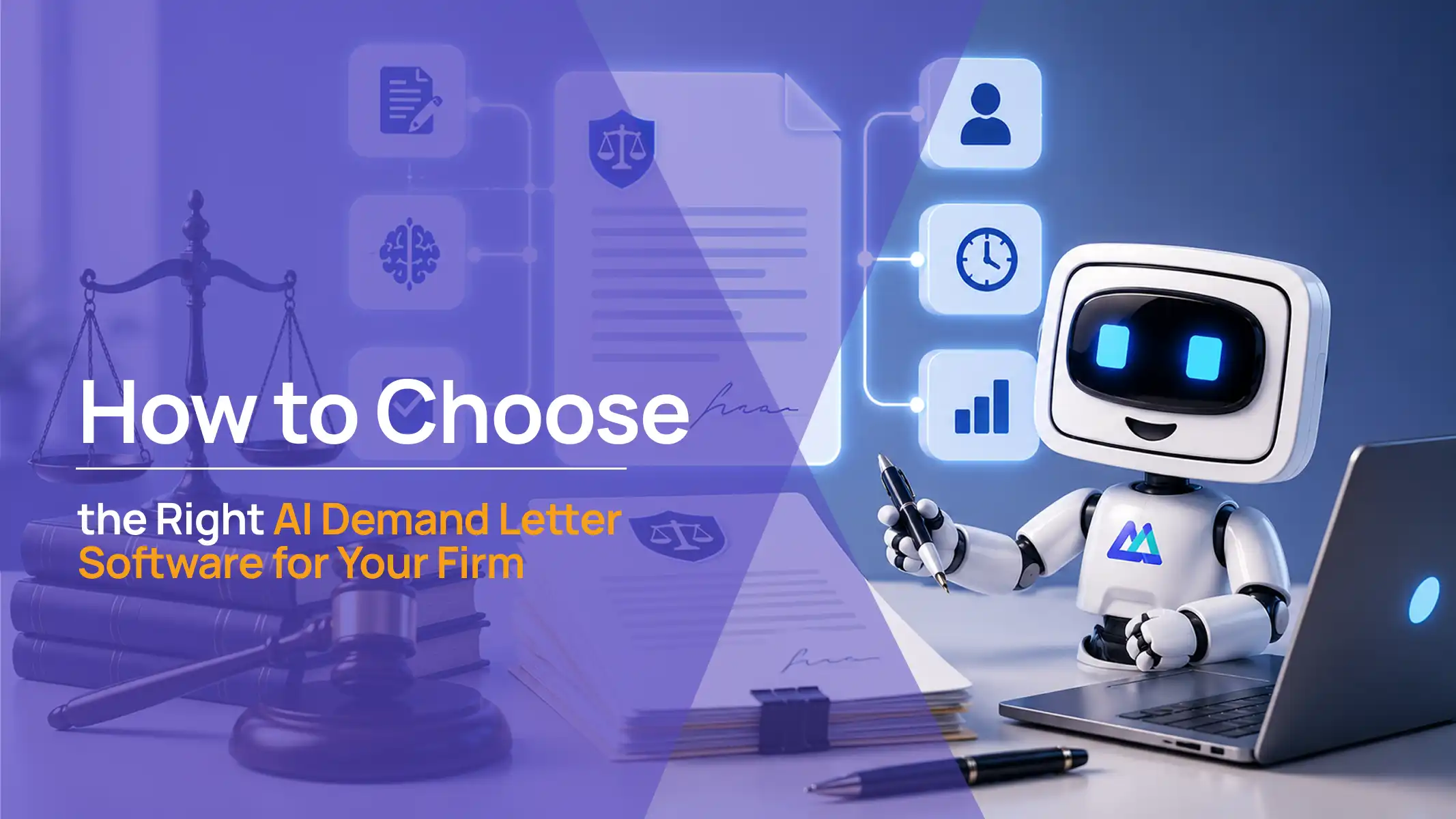
AI robot writing at a desk beside floating icons for user, time, and performance metrics, how to choose the right AI demand letter software for your firm
Firm Situation Recommended Platform
Complex cases, medical record heavy ProPlaintiff AI for clinical depth
Full workflow coverage needed Law Practice AI for connected intake-to-litigation platform
Solo or small firm, first AI tool Tayrn AI for accessibility
Standalone demand letter tool only DemandPro AI for PI-specific templates
Testing AI before committing General AI tools as a starting point

The pattern that drives the strongest results is matching the tool to the actual bottleneck. If medical record complexity is the problem, ProPlaintiff AI addresses it directly. If the bottleneck is the full documentation workflow across intake, records, summaries, and demands, a connected platform like Law Practice AI eliminates it at every stage.

What Attorneys Are Saying About AI Demand Letter Software

Practitioners on the Reddit LegalTech community consistently report that the biggest shift from adopting AI demand letter software is not the time savings alone. It is the change in how attorneys engage with the drafting process. Reviewing a structured first draft requires a different kind of attention than building a letter from scratch, and most attorneys find the review cycle faster and less mentally taxing than the assembly cycle.

The consistent complaint about general AI tools is output variability. A general tool might produce a strong draft on one case and a near-useless one on the next. Purpose-built PI platforms produce consistent output across case types because they are trained on the specific document structures and terminology that PI demand letters require.

Frequently Asked Questions: AI Demand Letter Software for Personal Injury Attorneys

Q1: What is the best AI demand letter software for personal injury attorneys in 2026?

Q2: How does AI demand letter software handle clinical language from medical records?

Q3: Does AI demand letter software replace attorney judgment?

Q4: How much does AI demand letter software cost in 2026?

Q5: Can AI demand letter software handle lemon law cases as well as personal injury?

The Right Platform Makes Every Demand Letter Stronger

The difference between AI demand letter software that saves 30 minutes and software that recovers an entire workday per case comes down to how deeply the platform integrates with your case data and how specifically it is trained on PI document structures.

Firms that choose purpose-built platforms with direct case management integration consistently report stronger output quality, faster turnaround, and less revision burden on attorneys than firms using general AI tools or standalone drafting aids.

Law Practice AI is built for plaintiff firms that need AI demand letter generation connected to the full case workflow. Book a Consultation to see how it fits your practice.

Browse more blogs

Hamid Kohan and Practice AI™ Spotlighted in The Excellence Review

0
min read

Hamid Kohan and Practice AI™ Spotlighted in The Excellence Review for Legal Tech Leadership

In a world where bold innovation and visionary leadership define success, The Excellence Review has spotlighted Hamid Kohan, CEO of Practice AI™, for his groundbreaking contributions to the legal tech landscape. Recognized as one of the world’s most influential CEOs of 2025, Kohan is leading a quiet revolution in how law firms use artificial intelligence to scale smarter, serve better, and compete effectively.

The feature, titled “Hamid Kohan: Shaping the Future of Legal Tech with AI,” explores his remarkable journey from Silicon Valley to the forefront of legal innovation, where he continues to transform law firm operations through strategic, AI-powered solutions.

A Legacy of Innovation: From Silicon Valley to Legal AI

With an early start in engineering at 17 and an MBA by 21, Kohan's tech career began at pioneering companies like GRiD Systems and SUN Microsystems, where he contributed to world-first technologies including the laptop and high-performance servers. But his true calling emerged in building solutions that solve real problems.

That vision came to life in Practice AI™, an AI-first legal technology company committed to eliminating outdated workflows in law firms and replacing them with intelligent automation.

Practice AI™: Turning Complex Problems Into Smart Solutions

At the core of The Excellence Review's profile is Practice AI’s mission: help legal teams scale with precision by eliminating repetitive tasks and refocusing energy on strategic work.

Practice AI™ offers two flagship tools:

  • AI Demands – Automates personal injury and lemon law demand letters with clarity and compliance.
  • AI Case Summary – Extracts key facts from medical records, police reports, and legal documents to streamline case management.

These tools are not simple add-ons; they’re embedded into law firm workflows to create operational excellence at every level.

Innovation with Purpose: A CEO Who Executes

As The Excellence Review highlights, Kohan’s leadership is defined by execution, speed, and clarity. Under his guidance, Practice AI™ has:

  • Cut law firm drafting time by over 80%.
  • Expanded into multi-state, multi-practice legal sectors.
  • Built strategic partnerships with top law firms and staffing agencies.
  • Earned industry praise for its data-driven, results-focused model.

Kohan’s mantra, “Speed, strategy, and execution”, defines his formula for scaling technology that works.

Overcoming Resistance, One Success Story at a Time

The article also notes Kohan’s realistic view of industry challenges. He acknowledges that some attorneys resist AI out of tradition or fear, but emphasizes that education is key.

“Once firms see how our tools reduce overhead and improve accuracy, the hesitation fades,” Kohan explains in the interview. “They’re not just adopting technology, they’re transforming their operations.”

Culture and Vision: The Practice AI™ Difference

Kohan has built a company culture centered on trust, experimentation, and accountability. Innovation isn’t just a goal, it’s the foundation.

At Practice AI™, the team is encouraged to:

  • Move fast and test ideas quickly.
  • Focus on solving client problems, not just building flashy tools.
  • Own their work and drive measurable results.

This culture has powered Practice AI™’s rapid growth while keeping it grounded in user needs.

Looking Ahead: AI as the Backbone of Legal Practice

In The Excellence Review, Kohan outlines a bold vision for the future:

  • Expand AI tools across more legal sectors.
  • Partner with national law firms to improve efficiency.
  • Lead advancements in AI-powered legal research and document automation.

In his words, “AI will be as fundamental to legal work as case law, and Practice AI™ will be at the center of that shift.”

A Message to Law Firms: Don’t Wait

Kohan’s closing message is urgent and clear: “AI isn’t the future of legal work, it’s the present. Waiting is no longer an option. The firms that act today will lead tomorrow.”

Practice AI™, AI Demands™, and AI Case Summary™ are more than tools, they’re part of a smarter legal ecosystem designed to elevate performance, cut costs, and enhance results.

Read the Full Feature in The Excellence Review

To dive deeper into Hamid Kohan’s journey and how Practice AI™ is shaping the legal tech revolution, read the full article on The Excellence Review.

https://theexcellencereview.com/hamid-kohan-shaping-the-future-of-legal-tech-with-ai/

Collaborating with Smart Advocate to Elevate Legal Tech in 2025

0
min read

A Partnership That Moves Legal Tech Forward

In 2025, the legal tech market is overflowing with new promises. Tools emerge every day, but only a few truly address the real challenges law firms face. At Practice AI, we believe meaningful impact comes from solutions designed around your actual workflow. That’s why our partnership with SmartAdvocate isn’t just another tech announcement, it’s about delivering tools that genuinely make a difference for legal professionals.

This isn’t just another integration. It’s a partnership designed for you. With SmartAdvocate’s established case management as the foundation, Practice AI layers in AI automation that handles tasks like demand letter drafting, document summarization, and deadline tracking, letting your team work smarter, not harder.

 Collaborating with Smart Advocate to Elevate Legal Tech in 2025

What Law Firms Gain from This AI Collaboration

SmartAdvocate gives you the powerful features of case management. Practice AI adds intelligent automation. When your system already organizes cases neatly, these tools boost that foundation,automating workflows and giving you the ability to get more done without more effort.

The integration is fully bidirectional, meaning it syncs key case data, communication logs, and document workflows across both platforms in real time. No switching screens. No duplicate data entry. No missed updates.

Now, with Smart Advocate and Law Practice AI working together, firms get:

  1. Smarter workflows
    Case data, documents, and communications stay synced across both platforms — no double entry, no switching back and forth.
  2. Zero setup fees
    Both platforms have waived onboarding fees, making it easy to get started without extra costs.
  3. Better team visibility
    Real-time updates keep everyone on the same page, from intake to litigation support.
  4. Ongoing innovation
    This isn’t a one-off. We’re working together long-term to roll out AI-driven features, product updates, and shared support.

Whether you’re running a high-volume personal injury practice or a multi-location litigation team, this integration helps you move faster and cleaner, without the noise.

Mark Your Calendar: SmartAdvocate Connect 2025 Is Coming!

Read our live press release on this partnership and event updates here.  Stay current as we roll out announcements in real time!

SmartAdvocate's annual event is gearing up to deliver actionable training, expert Q&A, CLE credits, and networking, designed to help you get more out of your tech stack. If you already use SmartAdvocate or want to see how automation can fit into your firm, this is one to consider.

This year’s highlights include:

  • Customized training tracks for every skill level — whether you’re just getting started or looking to go deeper
  • A dedicated Ask the Expert area for one-on-one help and workflow insights
  • CLE credit opportunities, so you can continue your education while staying on top of tech
  • Plus, networking sessions and a hospitality suite to make the experience seamless

For firms already using SmartAdvocate or considering adopting a smarter workflow with the help of partners like Practice AI, this is a great opportunity to explore what’s possible.

What’s Next for Practice AI and Smart Advocate

This partnership is just the beginning. You can expect joint feature rollouts, focused resources, and support paths that keep automation simple, and let your firm keep pace as legal tech evolves. You’ll feel the difference in how smoothly your workflow runs.

You’ll be seeing more of us in upcoming SmartAdvocate updates, industry conversations, and conference circuits in 2025. But more importantly, you’ll feel the difference inside your workflow.

(Insert Graphics)

Shaping the Future of Law Firm Technology

Our integration with SmartAdvocate is a reflection of who we are and how we work. We show up, we contribute, and we build things that matter.We’re proud to be part of this partnership, not just as a tech provider, but as an active voice in the future of law firm innovation.

If you use SmartAdvocate and want to see how Practice AI’s automation can streamline your process, let’s talk. Schedule a quick demo and see how this integration works for your firm, today.

The Challenges California Law Firms Face If Demand Letters Are Not Completed on Time

0
min read

Demand letters play a crucial role in personal injury and lemon law cases across California, especially in busy legal hubs like Los Angeles. They set the stage for settlement negotiations, provide a legal basis for claims, and demonstrate an attorney’s commitment to advocating for their client. However, when these letters are delayed, California law firms face serious consequences, including missed opportunities, frustrated clients, and potential financial losses.

Attorneys in Los Angeles and throughout California are already managing heavy caseloads, and drafting demand letters manually can slow down the legal process. This is where automation becomes essential. AI Demands™, an AI-powered tool by Practice AI™, ensures demand letters are generated quickly, accurately, and in compliance with California legal standards, helping law firms stay on track and avoid unnecessary delays.

The Cost of Delayed Demand Letters in California

When California law firms fail to complete demand letters on time, they risk:

1. Missed Deadlines and Case Delays

Personal injury and lemon law cases in California often involve strict deadlines. Delayed demand letters can push back settlement discussions, leading to longer case timelines and dissatisfied clients. In worst-case scenarios, missing legal deadlines can result in forfeited claims, especially under California’s statute of limitations.

2. Reduced Negotiation Power

A well-crafted demand letter establishes the strength of a case early on. If it’s delayed, the opposing party may take advantage of the delay, prolong negotiations, or push for a lower settlement. Quick, well-documented demands demonstrate confidence and urgency, especially important in competitive legal markets like Los Angeles.

3. Client Dissatisfaction and Loss of Trust

Clients expect efficiency from their attorneys. A delayed demand letter can make a client feel neglected or question the competence of the law firm. For Los Angeles firms competing for referrals and positive online reviews, one bad experience can significantly impact reputation.

4. Increased Workload for Attorneys and Staff

When demand letters pile up, California law firms experience workflow bottlenecks. Attorneys and paralegals are forced to rush through drafting, increasing the likelihood of errors. This extra workload leads to burnout and reduced overall efficiency.

5. Potential Revenue Loss

California law firms depend on settlements to generate revenue. The longer it takes to submit demand letters, the longer it takes to receive settlements, impacting cash flow and firm profitability.

How AI Demands™ Solves These Challenges for California Law Firms

AI-powered legal tools like AI Demands™ eliminate drafting delays and ensure demand letters are submitted on time. Here’s how:

1. Automated Drafting for Faster Turnaround

Instead of spending hours manually drafting demand letters, AI Demands™ generates high-quality letters in minutes, allowing Los Angeles attorneys to submit claims faster and keep cases moving.

2. Compliance with California Legal Deadlines

AI Demands™ ensures letters align with jurisdictional requirements across California, reducing the risk of missed filings or technical errors.

3. Improved Accuracy and Legal Consistency

By using AI-driven legal intelligence, demand letters are free from common drafting errors. The tool incorporates case facts, legal references, and persuasive language automatically, aligned with California laws and regulations.

4. Scalable Solution for High-Volume Law Firms

Law firms in cities like Los Angeles that handle multiple cases simultaneously can easily scale their practice by automating demand letter creation. AI Demands™ allows attorneys to focus on legal strategy rather than time-consuming drafting.

5. Enhanced Client Satisfaction

With quicker demand letter turnaround times, clients in California receive faster case resolutions. Happy clients lead to more referrals, positive reviews, and a stronger reputation for the firm.

How AI Demands™ Solves These Challenges

AI-powered legal tools like AI Demands™ eliminate drafting delays and ensure demand letters are submitted on time. Here’s how:

1. Automated Drafting for Faster Turnaround

Instead of spending hours manually drafting demand letters, AI Demands™ generates high-quality letters in minutes—allowing attorneys to submit claims faster and keep cases moving.

2. Compliance with Legal Deadlines

AI Demands™ ensures letters align with jurisdictional requirements and legal deadlines, reducing the risk of missed filings or technical errors.

3. Improved Accuracy and Legal Consistency

By using AI-driven legal intelligence, demand letters are free from common drafting errors. The tool incorporates case facts, legal references, and persuasive language automatically.

4. Scalable Solution for High-Volume Firms

Law firms handling multiple cases simultaneously can easily scale their practice by automating demand letter creation. AI Demands™ allows attorneys to focus on legal strategy rather than time-consuming drafting.

5. Enhanced Client Satisfaction

With quicker demand letter turnaround times, clients receive faster case resolutions. Happy clients lead to more referrals, positive reviews, and a stronger reputation for the firm.

AI Demands™ vs. Manual Drafting: A Performance Breakdown

Challenge AI Demands™ Solution Manual Drafting Issue
Speed Generates letters in minutes Takes hours or days
Accuracy Uses built-in legal intelligence Prone to human error
Deadline Compliance Keeps cases on schedule Risk of delays
Cost Efficiency Reduces labor costs Requires more staff time
Client Satisfaction Faster results, happier clients Frustrated clients due to delays

Don’t Let Delays Cost Your California Firm, Automate with AI Demands™

Law firms in Los Angeles and throughout California can’t afford to let demand letter delays impact their case outcomes, client satisfaction, or revenue. AI Demands™ ensures that demand letters are drafted quickly, accurately, and in compliance with California legal standards, helping firms avoid unnecessary setbacks.

✅ Increase efficiency
✅ Meet California legal deadlines
✅ Reduce workload and burnout
✅Maximize client satisfaction

Sign up with Practice AI™ today and discover how AI Demands™ can transform your demand letter process in California.

FAQS

1. Why are demand letters important in personal injury and lemon law cases?
2. What happens if a law firm delays sending demand letters?
3. How does AI Demands™ help prevent demand letter delays?
4. Is AI Demands™ customizable for different case types?
5. Can AI Demands™ integrate with my law firm’s existing systems?
6. How accurate is an AI-generated demand letter?
7. Will using AI Demands™ reduce the need for human oversight?
8. How can AI Demands™ improve client satisfaction?
9. Is AI Demands™ suitable for high-volume law firms?
10. How do I get started with AI Demands™?