5
min read time

Legal Medical Summary Example - Complete Guide

Discover a comprehensive legal medical summary example to streamline case management and enhance efficiency. Learn the steps to create medical summaries.
Legal Medical Summary

You're staring at a stack of medical records three inches thick, and your client's case hearing is next week. Sound familiar? Medical record summaries can turn that overwhelming pile of documentation into an organized narrative that strengthens your case.

Whether you're handling a personal injury case or just want to learn about the process, this guide will give you the practical steps and walk you through everything from structuring your summary to using modern tools that can streamline your work.


What Is a Medical Summary?

A medical summary is a concise document that organizes and condenses information from a patient’s medical records. It highlights key details such as diagnoses, treatments, and prognoses, while excluding unnecessary data.

Medical summaries serve as reference tools that allow attorneys, insurance adjusters, and other legal professionals to quickly understand a patient's medical history without having to review hundreds of pages of raw medical records.


What to Include in a Legal Medical Summary

When creating a medical summary, focus on pulling in the right documents and information that directly support your case. Let's break it down.

Documents

Your medical summary should reference all relevant medical documents that support your case, including:

  • Hospital admission and discharge summaries
  • Physician office visit notes
  • Emergency room records
  • Laboratory test results
  • Imaging reports (e.g., X-rays, MRIs, CT scans)
  • Surgical or procedure reports
  • Prescription and medication records
  • Physical therapy or rehabilitation notes
  • Specialist consultation reports
  • Billing statements (for cost-related claims)

Don’t overlook any document that helps establish the severity of injuries, duration of treatment, or the connection between the incident and the medical care. These documents work together to build a clear timeline and ensure your summary is fully backed by verifiable evidence.

Information

Each entry in your medical summary should include the following important information:

  • Date of Service: The exact date the medical event occurred, crucial for establishing a chronological timeline.
  • Provider and Facility: The name and specialty of the doctor, hospital, or clinic that provided the service.
  • Bates Number (or Page Reference): The unique identifier for the page(s) in the original records where the fact can be verified.
  • Diagnosis (DX): The official medical finding or condition identified by the provider to link to the legal claims.
  • Chief Complaint (CC): What the patient specifically reported or complained about during that visit.
  • Treatment or Plan (TX/Plan): The medical intervention performed, such as surgery, medication, or a referral for therapy.
  • Test results: Key findings from labs or imaging that support or refute the claims.
  • Prognosis: Any statement by the provider regarding the expected outcome, long-term effects, or future limitations.
  • Pre-existing conditions: Relevant medical history that helps distinguish new injuries from pre-existing issues.

Include all information that helps you create a clear narrative that supports your legal arguments. The more accurate and complete your entries are, the easier it becomes to identify strengths, weaknesses, and gaps in your case.


How to Structure a Medical Record Summary

Start with a brief introduction that outlines the context of the injury and the cause of the case. Follow this with the body of your summary, presented as a chronological breakdown of the care received. Next, include a section highlighting the key supporting evidence such as diagnoses, test results, and significant medical findings.

End with a summary section that synthesizes the most important information. This is where you connect the dots between treatments, identify any gaps in care, and emphasize facts that support your legal theory.

This structure ensures that all essential legal and medical details are easy to locate and understand, making it simpler for any reader—whether a judge, adjuster, or opposing counsel—to follow the narrative.


Legal Medical Summary Example (Free Template)

Here’s an example to have better analysis on the structure of a legal medical summary.

TO: Michael Rodriguez, Esq.

FROM: Patricia Chen, Paralegal | Legal Support Services

DATE: November 12, 2025

RE: Medical Summary - Robert Martinez v. Summit Construction Group, LLC

Case Information

Patient: Robert Martinez, DOB: 08/22/1981 (Age 43)

Case No: 2024-CV-08947 (Superior Court, Maricopa County)

Date of Incident: March 15, 2024

Records Period: March 15, 2024 through October 28, 2025

Incident Description

On March 15, 2024, at approximately 2:35 p.m., Mr. Robert Martinez, a 43-year-old warehouse supervisor, was struck by a falling pallet of construction materials while conducting a safety inspection at the defendant's construction site. Witness statements indicate improperly secured materials became dislodged when a forklift operator collided with support scaffolding. Mr. Martinez was struck on his left side and fell approximately 4 feet onto concrete. He remained conscious but was unable to stand without assistance due to severe left shoulder pain, chest pain, and difficulty breathing.

Alleged Injuries (from Complaint):

Orthopedic:

  • Full-thickness rotator cuff tear (left shoulder) – 2.5-3 cm with retraction
  • Multiple rib fractures (ribs 4, 5, 6 – left side)
  • Lumbar disc herniation L4-L5 with nerve root compression (8mm, right paracentral)

Neurological:

  • Traumatic brain injury with cortical contusion
  • Post-concussive syndrome with cognitive deficits

Other:

  • Pulmonary contusion
  • Major depressive disorder and PTSD (post-injury onset)
  • Chronic pain syndrome

Pre-Existing Conditions

  • Hypertension (controlled with medication since 2019)
  • Type 2 Diabetes (managed with Metformin)
  • Mild degenerative disc disease on 2021 X-ray (asymptomatic)

Note: No prior shoulder injuries, head trauma, or mental health issues documented.

Claimed Damages

Category Amount
Past Medical Expenses $127,450.00
Future Medical Expenses $85,000.00
Past Lost Wages $42,300.00
Future Lost Earning Capacity $380,000.00
Non-Economic Damages $750,000.00
Total Amount $1,384,750.00

Medical Chronology (Key Events)

Date Facility / Provider Bates No. Summary
03/15/2024 Banner Desert Medical Center Emergency Department - Dr. Sarah Kim, MD RM-0005 to RM-0087 Patient transported via EMS following workplace injury. CT head revealed small cortical contusion in left frontal lobe (no hemorrhage)...
03/29/2024 Arizona Advanced Imaging Center - Dr. Thomas Brewster, MD RM-0164 to RM-0169 MRI revealed full-thickness tear of supraspinatus tendon (2.5 cm) with retraction and moderate muscle atrophy...
04/26/2024 Phoenix Surgical Center - Dr. Andrew Martinez, MD RM-0193 to RM-0202 Arthroscopic rotator cuff repair with 4 suture anchors, biceps tenodesis, subacromial decompression...
05/15/2024 Desert View Primary Care - Dr. Linda Huang, MD RM-0203 to RM-0208 New complaint of lower back pain radiating down right leg (7/10), began 2 weeks prior...
05/23/2024 Arizona Advanced Imaging Center - Dr. Thomas Brewster, MD RM-0209 to RM-0214 MRI lumbar spine revealed NEW large right paracentral disc herniation at L4-L5 (8mm) with nerve root compression...
06/07/2024 Arizona Pain & Spine Institute - Dr. Marcus Williams, MD RM-0215 to RM-0223 Pain management consultation for chronic pain affecting shoulder, back, and headaches...
09/10/2024 Phoenix Neuropsychology Group - Dr. Catherine Reynolds, PsyD RM-0236 to RM-0267 Neuropsychological evaluation 6 months post-injury showed deficits in attention, processing speed...
10/03/2024 Phoenix Orthopedic & Sports Medicine - Dr. Andrew Martinez, MD RM-0268 to RM-0275 6-month post-operative follow-up. Significant improvement in shoulder function...

Current Medical Status (as of 10/28/2025)

  • Left Shoulder: Maximum medical improvement. Permanent 15% upper extremity disability. Cannot lift >25 lbs or perform prolonged overhead work.
  • Traumatic Brain Injury: Persistent post-concussive syndrome with documented cognitive deficits. Ongoing headaches and concentration difficulties.
  • Lumbar Spine: L4-L5 disc herniation with radiculopathy. Temporary relief from injection, symptoms recurring.
  • Mental Health: Major depressive disorder and PTSD secondary to injury. Active treatment ongoing.
  • Work Status: Totally disabled from warehouse supervisor occupation.

Causation Analysis

Strength: Strong

  • Temporal Relationship: All injuries occurred immediately following workplace incident with documented mechanism of injury
  • Shoulder: Acute traumatic tear confirmed surgically. No prior shoulder complaints or injuries in medical history.
  • Lumbar Spine: Comparison MRI (2021 vs. 2024) definitively shows NEW herniation. Radiologist documented acute traumatic appearance. Prior imaging showed only minimal asymptomatic bulge at different characteristics.
  • TBI: Immediate neurological symptoms documented by EMS and ER. Objective cognitive deficits confirmed on formal neuropsychological testing 6 months post-injury.
  • Mental Health: No prior psychiatric history. Symptoms directly related to workplace trauma and physical limitations.

Key Findings & Conclusion

  • Injury Severity: Multi-system traumatic injuries including surgical rotator cuff repair, TBI with objective cognitive deficits, lumbar disc herniation requiring pain management, and significant psychological trauma.
  • Permanency: 15% permanent upper extremity impairment with ongoing cognitive deficits, chronic pain syndrome, and permanent work restrictions.
  • Treatment Necessity: All treatment medically appropriate. Conservative care attempted before surgical and pain management interventions.
  • Pre-Existing Impact: Minimal. Prior degenerative changes were asymptomatic and at a different spinal level than acute herniation.
  • Work Disability: Multiple physicians confirm total disability from prior warehouse supervisor occupation. Permanent restrictions preclude return to previous work duties.
  • Damage Exposure: High. Documented past medicals ($127,450), permanent disability affecting earning capacity, and strong non-economic damages given life-altering injuries and chronic conditions.

Outstanding Records

Date Range Facility Notes
07/10/2024 - 08/05/2024 Resilience Physical Therapy Four PT session notes missing. Billing confirms attendance. Requested 09/15/2024 and 10/20/2024. Still pending.
08/20/2024 Valley Neurology Associates Follow-up neurology appointment referenced but consultation report not provided. Requested 10/05/2024. Pending.
09/25/2024 Arizona Pain & Spine Institute Follow-up visit noted in pharmacy records but no office note received. Requested 10/22/2024. Pending.

Prepared by: Patricia Chen, Paralegal

Records Reviewed: 267 pages (Bates RM-0005 through RM-0275)

Download medical summary template in PDF for free


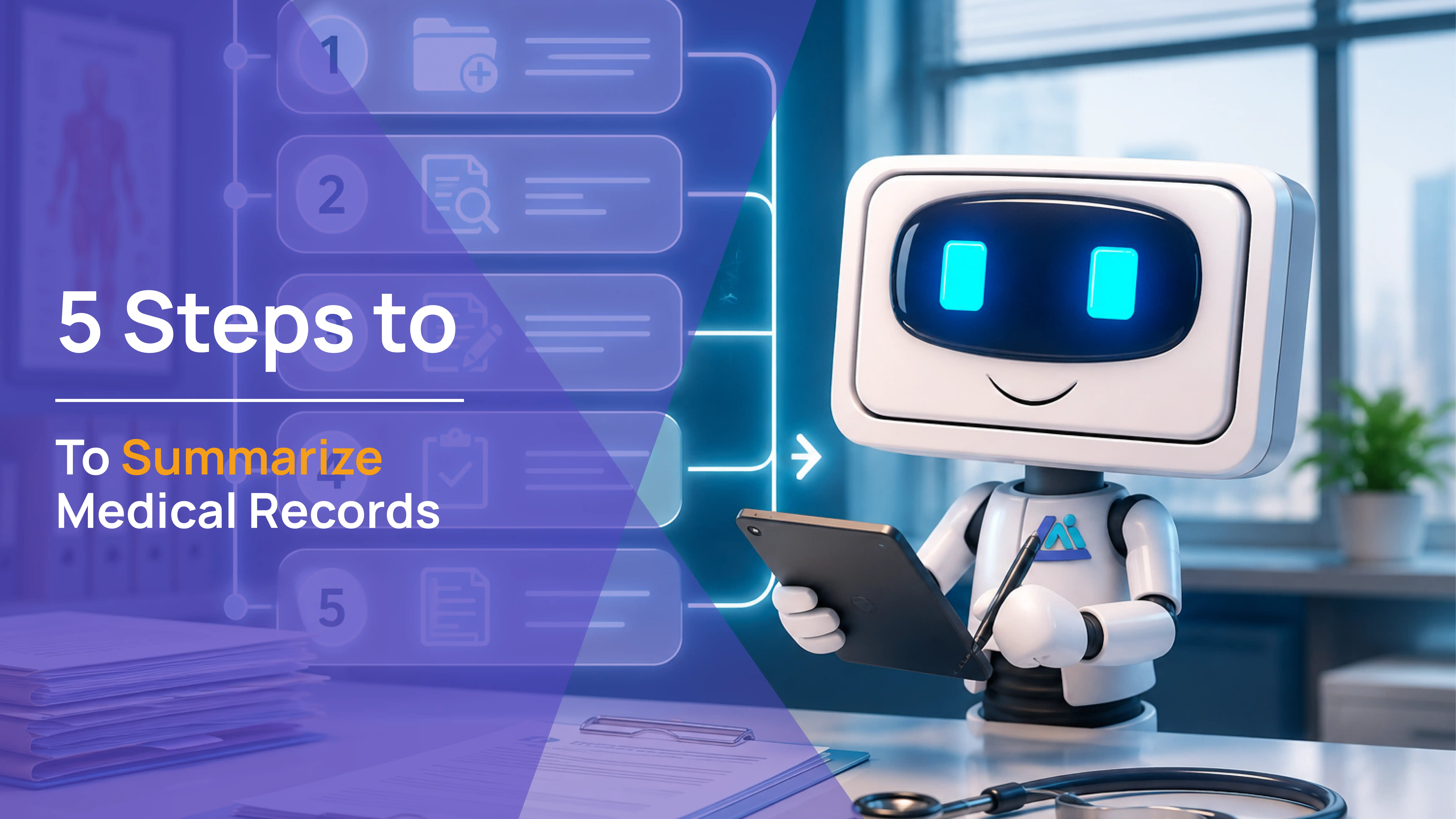
5 Steps to Summarize Medical Records

Preparing a summary from a large volume of files may seem overwhelming, so here are five steps to make the process manageable and efficient:

1. Gather and Organize All Records

Before you start reviewing, request all relevant medical records and make sure you have every page. Note the provider, facility, and date range for each document. Then organize everything by date to establish the sequence early, regardless of the provider. Apply Bates numbers to every page so you can easily reference the original documents in your summary.

2. Identify Relevant Medical Events

Review the records with a legal lens. Flag any treatment, diagnosis, or event directly related to the injuries or conditions at issue in your case. Skip records that don’t connect to your legal theory—you’re aiming for efficiency, so stay focused.

3. Build a Detailed Chronology

Create a working chronological list of every significant event: date, provider, diagnosis, treatment provided, and any statements regarding causation or prognosis. Be sure to include the corresponding Bates number for each entry.

4. Draft the Summary Narrative

Using your detailed chronology, begin writing the summary in a clear, objective narrative format. Translate complex medical terminology into plain language without losing accuracy so that non-medical readers can easily understand it.

5. Review and Cross-Reference

Once your summary is complete, cross-check every date, diagnosis, and provider name against the original records to verify accuracy. Even a small factual error can undermine the credibility of your entire case. Look for inconsistencies between providers' notes or gaps in the treatment timeline that could affect your legal argument.


Challenges in Preparing a Medical Summary

Even for experienced legal teams, preparing a medical summary can be challenging. Here are the most common hurdles that can slow down a case and introduce errors—things you should consider when planning your workflow:

  • Volume and Complexity: You often face hundreds or even thousands of pages of medical records as your first obstacle, many of which are filled with highly specialized terminology. According to the National Institutes of Health, medical terminology comprises more than 250,000 specialized terms, making it difficult to review quickly and identify what truly matters.
  • Unstructured Data: Records arrive in varying formats because they come from multiple providers—from PDFs to hard-to-read handwritten notes. Standardizing and organizing these documents can require significant time and effort.
  • Identifying Relevance: It can be challenging for non-medical professionals to determine which diagnoses, past conditions, or old entries are relevant to the current legal claim.
  • Time constraint: Tight deadlines add pressure, especially when the review process is done manually, page by page. This increases the chance of missing important details or making errors.


Options for Medical Record Summary Creation

You have several ways to create medical summaries, depending on your budget, timeline, and case complexity. Here are the typical options:

DIY

Handling medical summaries by yourself or with your team gives you complete control over the process. However, it can be time-intensive and carries the risk of human error or misinterpretation of medical facts.

Outsource

Legal nurse consultants or medical record review companies specialize in preparing medical summaries. These professionals understand medical terminology, can spot inconsistencies, and often complete summaries faster than in-house staff.

The tradeoff is less direct control over formatting or prioritization of information for your specific legal arguments. Additionally, outsourced professionals may lack formal legal knowledge, which can affect how the summary aligns with legal strategy.

Legal Medical Summary

Use AI

Professional AI platforms designed for medical record summarization can process large volumes of records in minutes, extracting key information and organizing it into structured summaries.

This option is fast, scalable, and ideal for high-volume work, as AI handles time-consuming extraction and organization. However, while AI is quick and accurate for data extraction, a human expert must still review the output. AI is meant to support human work, not replace it entirely.


Final Notes

Wrapping up, creating effective legal medical summaries involves a lot of focus and attention to detail to identify relevant facts. While the process can be time-consuming, the payoff comes in faster case evaluation, stronger settlement demands, and more persuasive trial presentations.

Whether you handle summaries manually, in-house, outsource, or use AI technology, the key is to develop a clear roadmap that can be quickly understood by judges, attorneys, or other stakeholders. Focus on consistency, accuracy, and relevance of the output to ensure you capture all critical medical information, building a stronger case every time.


Is there a free AI to summarize medical records?

While general-purpose AI tools like ChatGPT are free, they may not be suitable for sensitive legal and medical data due to privacy concerns and the lack of legal-specific formatting.

There are platforms, such as Law Practice AI, that offer free trial versions specifically designed for legal practices to summarize medical records and provide other legal-focused features. These tools invest in infrastructure to secure client confidentiality and comply with industry-standard security. 

However, trial versions may have certain limitations, such as a maximum number of pages processed, which is why full subscriptions are often necessary for more robust usage.

Browse more blogs

Should Law Firms Invest in AI in 2025? A Legal AI Guide

0
min read

Are you wondering if 2025 is the year for your law firm to embrace AI legal tools? The legal field is evolving rapidly, and artificial intelligence (AI) is becoming an essential tool for maintaining a competitive edge. But like many firms, you may have concerns about cost, disruption, or the impact on your team. Practice AI™ is here to help you navigate these uncertainties with confidence.

Let’s explore why AI is worth the investment, the barriers firms face, and how Practice AI can provide tailored solutions to address your concerns.

Table of Contents

  1. Why Law Firms Need AI Legal Tools
  2. Challenges and Concerns About AI Adoption
  3. How Practice AI Solves Key Challenges
  4. Step-by-Step Guide to Adopting Practice AI™

Why Law Firms Need AI Legal Tools

AI technology is reshaping the legal landscape by automating repetitive tasks, enhancing accuracy, and saving time. In 2025, law firms that fail to leverage AI risk falling behind in a market that demands efficiency and innovation. Key benefits include:

  • Streamlined Workflows: Automate tasks like demand letter drafting, legal research, and compliance checks with AI-powered legal writing and legal document automation tools.
  • Increased Accuracy: Reduce human errors with AI for legal professionals, AI-powered tools designed for precision.
  • Cost Savings: Free up valuable time for attorneys to focus on high-value tasks rather than administrative duties— a game-changer for legal and professional services.
  • Improved Client Outcomes: Faster turnaround times and higher-quality work improve client satisfaction and loyalty. This is especially valuable in practice areas like personal injury demand letters and lemon law demand letters, where efficiency directly impacts case success.

Challenges and Concerns About AI Adoption

Law firms often hesitate to adopt AI due to common concerns, such as:

  1. Cost of Implementation: Worries about the upfront investment and long-term expenses.
  2. Disruption to Workflow: Concerns about how AI will integrate into existing systems and processes.
  3. Data Privacy and Security: Fear of breaches when sensitive information is involved, especially in areas like AI in data security and AI HIPAA compliance.
  4. Job Security: Misconceptions that AI will replace human employees rather than complement them.

How Practice AI Solves Key Challenges

Practice AI understands these concerns and offers solutions designed specifically for law firms.

  1. Affordability: Practice AI provides cost-effective tools like Demands and AI Doc Summary, ensuring firms of all sizes can access the best AI for lawyers without breaking the budget.
  2. Seamless Integration: Our products, including AI legal document generator and AI legal assistant solutions can integrate easily into your existing workflows, minimizing disruption and enabling your team to adopt new processes quickly.
  3. Robust Data Security: Practice AI prioritizes data security in AI with advanced encryption and compliance with legal industry standards, safeguarding sensitive client information.
  4. Empowering, Not Replacing: Practice AI enhances human capabilities by automating repetitive tasks, allowing attorneys to focus on strategy, advocacy, and client engagement, ideal for law firms looking for time-saving AI for lawyers, not job-replacing bots.

Step-by-Step Guide to Adopting Practice AI™

  1. Assess Your Firm’s Needs: Identify areas where AI can add the most value, such as document drafting, AI-powered demand letters, legal document automation, or AI Doc Summary™ for legal document  or medical record analysis.
  2. Schedule a Demo: Explore Practice AI’s tools through a live demonstration to see how exploring AI for law firms or expanding into AI for personal injury lawyers work in real-world scenarios.
  3. Involve Your Team: Include key stakeholders in the decision-making process to ensure buy-in and smooth adoption of AI in the legal field.
  4. Start Small: Begin with one or two tools, such as Demands or AI Doc Summary, and gradually expand as your team becomes comfortable.
  5. Provide Training: Practice AI offers training resources to ensure your team understands how to maximize the tools’ potential — whether they need help with AI-generated legal documents, document summarization, or automating legal documents.

2025 is the year to invest in AI for your law firm. The potential for improved efficiency, accuracy, and client outcomes is undeniable, and Practice AI is your partner in this transformative journey.

Don’t let concerns hold you back. With affordable, secure, and user-friendly tools like Demands and AI Doc Summary, Practice AI addresses the challenges of AI adoption while delivering tangible benefits.

Automate your next demand letter with Practice AI™.

From AI-powered legal writing to medical records analysis, our tools like AI Demands™ and AI Doc Summary™ help law firms boost efficiency, accuracy, and client outcomes. Sign up today and empower your firm to lead in 2025 and beyond.

The Future of Demand Letters: AI-Powered Efficiency

0
min read

Personal injury and lemon law attorneys understand that demand letter drafting is a crucial yet time-consuming part of the claims process. Manually creating case-specific demand letters requires extensive research, legal expertise, and precise formatting. AI Demands revolutionizes this process by offering a seamless, efficient, and highly customizable AI-driven solution for generating demand letters.

How AI Transforms Legal Workflows

With the rise of AI automation for law practices, attorneys now have access to efficient legal document AI tools that streamline demand letter creation. Instead of spending hours drafting, lawyers can leverage customizable AI legal drafting software like AI Demands to produce polished, case-specific documents in minutes.

The Key Benefits of AI Demands for Attorneys

1. Speed and Efficiency

Traditional demand letter drafting is labor-intensive. AI Demands eliminates inefficiencies, enabling attorneys to generate high-quality letters faster. This allows legal professionals to save time on demand letters and focus on case strategy and client advocacy.

2. Case-Specific Demand Letters with AI

Generic templates often lack the depth needed for successful settlements. With case-specific demand letters using AI, attorneys can generate detailed, well-structured letters tailored to each claim, including medical summaries, accident details, and policy references.

3. Accuracy and Legal Precision

AI-powered tools minimize human errors, ensuring that each letter includes precise legal terminology, accurate financial calculations, and compelling arguments to increase settlements.

4. Customizable and Comprehensive Demand Letter Templates

With demand letter templates for different practice areas, personal injury and lemon lawattorneys can customize letters based on case specifics while ensuring consistency and professionalism.

5. Affordable AI Solutions for Law Firms

Hiring additional staff for drafting can be costly. AI Demands provides an affordable AI solution for law firms, reducing overhead expenses while maintaining high-quality output.

What Attorneys Need to Know About AI Demand Letters

The transition to AI-driven demand generation using AI Demands may seem like a significant shift, but the challenges of drafting demand letters manually prove that automation can actually enhance legal expertise, and not replace it entirely. Attorneys will remain in control, reviewing and refining AI-generated drafts to ensure personalized representation for clients.

Increase Settlements with AI Demand Tools

By integrating AI into their workflow, personal injury and lemon law attorneys can significantly increase settlements with AI demand tools. Automated drafting improves efficiency, allowing firms to handle more cases effectively, ultimately leading to higher client satisfaction and improved revenue.

Final Thoughts: AI Software for Personal Injury & Lemon Law Attorneys

Using the best available tools for demand letter creation like AI Demands can transform how attorneys approach legal documentation. By adopting AI-powered demand generation, law firms can optimize efficiency, reduce costs, and improve case outcomes.

Start using AI Demands today and experience the future of legal drafting!

Our Partnership with MyCase

0
min read

When Two Legal Tech Tools Click

Let’s face it. In the legal tech space, not every integration is worth writing about. And with AI making headlines, it’s easy for people seeking legal help to see it as a threat to human expertise. But if you look deeper, you’ll find there’s real gold beneath the surface. Simply, there’s untapped potential you may not have explored yet.

Get the official announcement and details as they happen. Read our live press release on this integration here!

When Practice AI and MyCase joined forces, it wasn’t just about connecting two platforms. It was about solving real problems for law firms of all sizes. Whether you're a small practice or a large firm, this integration streamlines operations by automating time-consuming tasks and providing solid end to end value. This partnership is working to help you focus on your clients.

A Fresh Take on Law Firm Automation

Practice AI builds tools that help you deliver work your attorneys are proud of, just  faster. Our AI cuts the time spent on repetitive tasks like drafting demand letters and summarizing documents, without sacrificing quality or accuracy.

With one-click access to your MyCase data, you can feed critical information directly into the system, streamlining your workflow. MyCase’s cloud-based platform keeps everything, from case tracking to timekeeping and client communication,  in one place.

This integration was built with your goals in mind: to cut through complexity, reduce busywork, and free you to focus on what matters most.

MyCase

Meet MyCase: AI for Legal Professionals in Action

MyCase provides law firms with the tools to stay organized and reduce inefficiencies. With time tracking, invoicing, and case management all in one place, it simplifies daily operations. The integration with Practice AI adds AI-powered automation to further streamline tasks like demand letter generation and document management.

A full overview of its capabilities is available here.

One Platform, Two Powerhouses

With MyCase managing the full client journey and Practice AI streamlining document-heavy tasks, your law firm gains a seamless experience.
Want to:

  • Message a client about their lemon law case?
  • Pull up a case summary on the go?
  • File a new demand letter and share it directly? Now you can do it all in fewer clicks, with tools that actually make your life easier.

Integrating Practice AI within MyCase means law firms can streamline their workflow and handle repetitive tasks with ease. Practice AI is available as an in-app option within MyCase, allowing users to generate demand letters and automate document-heavy tasks directly from their case files.

Instead of juggling multiple platforms, users will experience a smoother, faster process where document creation happens in the background, freeing them to focus more on strategy and client relationships. This integration makes day-to-day operations simpler, so law firms can work smarter, not harder.

Transform Your Law Firm’s Workflow with Our MyCase Integration

It’s valid to feel confused sometimes, especially when the legal actions you’re taking matter so much considering that these decisions can save lives and set truths free. But you’re on the right page, and you’re reading something truly valuable that could truly make a difference!

If you’re a legal professional looking for ways to work smarter and not harder, this integration was built for you. With Practice AI and MyCase working together, your firm can finally unlock the full potential of automation without sacrificing personal touch.

Book a demo with our team today and see how this partnership delivers real results, right where you need them most.