Discover how the new Practice AI™ and MyCase integration streamlines law firm workflows. Automate demand letters, manage cases in one platform, and focus more on clients with AI-powered efficiency.
Let’s face it. In the legal tech space, not every integration is worth writing about. And with AI making headlines, it’s easy for people seeking legal help to see it as a threat to human expertise. But if you look deeper, you’ll find there’s real gold beneath the surface. Simply, there’s untapped potential you may not have explored yet.
Get the official announcement and details as they happen. Read our live press release on this integration here!
When Practice AI and MyCase joined forces, it wasn’t just about connecting two platforms. It was about solving real problems for law firms of all sizes. Whether you're a small practice or a large firm, this integration streamlines operations by automating time-consuming tasks and providing solid end to end value. This partnership is working to help you focus on your clients.
A Fresh Take on Law Firm Automation
Practice AI builds tools that help you deliver work your attorneys are proud of, just faster. Our AI cuts the time spent on repetitive tasks like drafting demand letters and summarizing documents, without sacrificing quality or accuracy.
With one-click access to your MyCase data, you can feed critical information directly into the system, streamlining your workflow. MyCase’s cloud-based platform keeps everything, from case tracking to timekeeping and client communication, in one place.
This integration was built with your goals in mind: to cut through complexity, reduce busywork, and free you to focus on what matters most.
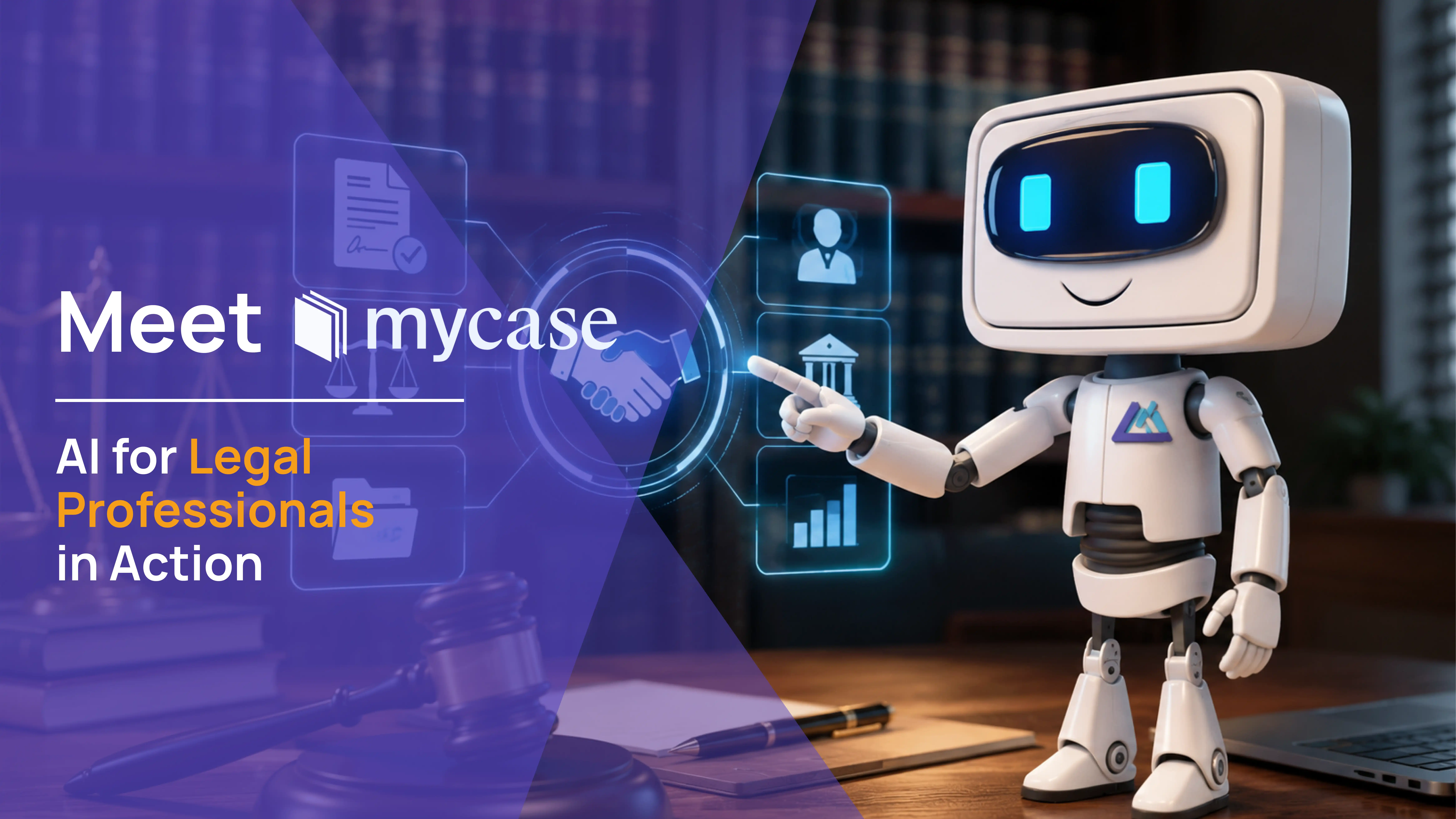
Meet MyCase: AI for Legal Professionals in Action
MyCase provides law firms with the tools to stay organized and reduce inefficiencies. With time tracking, invoicing, and case management all in one place, it simplifies daily operations. The integration with Practice AI adds AI-powered automation to further streamline tasks like demand letter generation and document management.
A full overview of its capabilities is available here.
One Platform, Two Powerhouses
With MyCase managing the full client journey and Practice AI streamlining document-heavy tasks, your law firm gains a seamless experience. Want to:
Message a client about their lemon law case?
Pull up a case summary on the go?
File a new demand letter and share it directly? Now you can do it all in fewer clicks, with tools that actually make your life easier.
Integrating Practice AI within MyCase means law firms can streamline their workflow and handle repetitive tasks with ease. Practice AI is available as an in-app option within MyCase, allowing users to generate demand letters and automate document-heavy tasks directly from their case files.
Instead of juggling multiple platforms, users will experience a smoother, faster process where document creation happens in the background, freeing them to focus more on strategy and client relationships. This integration makes day-to-day operations simpler, so law firms can work smarter, not harder.
It’s valid to feel confused sometimes, especially when the legal actions you’re taking matter so much considering that these decisions can save lives and set truths free. But you’re on the right page, and you’re reading something truly valuable that could truly make a difference!
If you’re a legal professional looking for ways to work smarter and not harder, this integration was built for you. With Practice AI and MyCase working together, your firm can finally unlock the full potential of automation without sacrificing personal touch.
Book a demo with our team today and see how this partnership delivers real results, right where you need them most.
Medical professionals, from doctors to medical assistants, require records and documents to provide the best care for their patients. The accuracy and timeliness of patient record analysis can greatly affect patient outcomes. However, this means dedicating hours to generating summaries or analyses or using tools that may not always guarantee compliant and accurate summaries. This has created the need for efficient and accurate document summarization and review, driving innovation in AI-powered solutions and expanding careers in artificial intelligence within the healthcare industry.
Our fully AI-poweredlegal and medical solution, AI Doc Summary, focuses on transforming the way both medical and legal professionals handle document reviews by analyzing multiple documents and files and generating summaries with precision. This ensures that crucial information is swiftly and accurately identified. AI Doc Summary can be used by both AI for medical professionals and AI for legal professionals to apply to their medical and legal workflows.
Table of Contents:
The Growing Need for AI in Medical Document Review
How AI Doc Summary Enhances Patient Care
Real-World Impact on Patient Outcomes
Getting Started with AI Doc Summary
The Growing Need for AI in Medical Document Review and Compliance
The rapid growth of medical information technology has created challenges for healthcare providers, who find it difficult to manage the ever-increasing amount of data.
From patient histories to treatment plans, each document contains vital information that must be understood and acted upon swiftly. AI Doc Summary is designed with precision and speed in mind, eliminating a large portion of the manual work needed for document summaries.
How AI Doc Summary Enhances Patient Care
Accurate Summaries: One of the standout features of AI Doc Summary is its ability to swiftly generate accurate AI-powered legal writing summaries from complex medical records. This capability allows healthcare providers to quickly understand the main points and pertinent details, freeing up time to focus on patient care and critical decision-making.
Highlighting Key Details: Missing key details can be disastrous in patient care. AI Doc Summary is designed to scan documents meticulously and highlight critical information, ensuring that no essential detail is overlooked. This feature is instrumental in developing comprehensive treatment plans and making informed decisions.
Reducing Errors: Human error is inevitable, especially when dealing with vast amounts of information under tight deadlines. AI Doc Summary reduces these errors by providing a more reliable document review process. With its ability to analyze information accurately, healthcare professionals can be confident in the decisions they make, based on dependable data. As careers in artificial intelligence continue to grow, AI-driven tools like AI Doc Summary are not only enhancing efficiency and accuracy in medical workflows but also shaping the future of AI-driven healthcare solutions.
Review & Revise as Needed: Revising summaries or analyses can be a time-consuming and redundant process, and it may lead to complications with document control. With Demands AI, medical professionals can make adjustments and edits if necessary, ensuring that all generated summaries meet their requirements.
Real-World Impact: AI-Driven Accuracy for Better Patient Outcomes
Consider a scenario where a patient's treatment plan needs urgent revision based on the latest test results. With AI Doc Summary, medical teams can quickly identify and act on key information, reducing the time taken from diagnosis to treatment. Such efficiency not only optimizes resource use but can significantly improve AI for healthcare legal cases like patient outcomes by ensuring timely and accurate interventions.
Getting Started with AI Doc Summary
Adopting AI Doc Summary into your healthcare practice is simple and rewarding. The tool is designed for intuitive use, making integration seamless for medical teams seeking to enhance their document management in healthcare such as document review processes.
By offering a clear and user-friendly interface, AI Doc Summary ensures that healthcare professionals can adapt quickly and start reaping the benefits almost immediately.
Transform Your Document Workflow
Adopt AI Doc Summary to simplify document review, improve efficiency, and help healthcare teams manage medical documents with ease.
Last week, Practice AI™ attended the ALM Legalweek 2025 in New York City, held from March 24th to 27th. This premier event brought together a diverse community of legal professionals and technology innovators, offering an ideal setting for exploring emerging trends, forging new partnerships, and reimagining the future of legal services.
Expanding Horizons Through Strategic Engagement
ALM Legalweek 2025 provided a dynamic networking platform where industry leaders, legal practitioners, and tech experts connected and exchanged valuable insights. Practice AI™, attending alongside its strategic partner Legal Soft, seized this opportunity to engage in meaningful discussions and identify new collaborative ventures. The event underscored the importance of building alliances in a rapidly evolving landscape where innovation and collaboration go hand in hand.
The Convergence of Law and Technology
The conference showcased a rich variety of sessions covering topics such as data security, AI-driven analytics, and digital transformation. These sessions highlighted the pivotal role of advanced technologies in modernizing legal practices—from streamlining case management to integrating ethical AI applications. The insights shared during the event have paved the way for transformative changes in legal operations, inspiring new approaches to enhance both efficiency and compliance.
Unlocking Opportunities for Future Growth
Throughout ALM Legalweek 2025, discussions with prospective collaborators underscored the immense potential for future growth within the legal tech sector. Practice AI™ focused on exploring avenues for joint initiatives and technology integrations that can drive operational efficiencies and improve client outcomes. The event served as a catalyst, igniting conversations that promise to translate into innovative projects and long-term partnerships.
Looking Ahead
As the legal industry continues to navigate the digital age, the experiences and connections made at ALM Legalweek 2025 have reinforced Practice AI™'s commitment to delivering cutting-edge AI solutions. With an eye on the future, the company is eager to embark on new ventures that not only enhance legal workflows but also set new standards for technological excellence in the legal domain.
Sign up with Practice AI now to explore the benefits of a fully AI-powered demand generation tool for your practice!
One of the basic stages of the legal workflow is document review, where law firms deal with large volumes of documents every single day. Each one contains valuable data buried in dense paragraphs and complex formatting. Manually extracting information from these lengthy documents can be time-consuming and exhausting.
For anyone wishing there were a faster way to deal with piles of paperwork, there is an alternative: legal document data extraction.
What Is Legal Document Data Extraction?
Legal document data extraction is the process of identifying and retrieving relevant information from legal documents. It works by scanning a document, recognizing the characters on the page, and understanding the context of those characters so they can be labeled accurately. This allows diverse documents to be queried, analyzed, and integrated into internal databases.
In the past, manual extraction required legal professionals to read documents line by line, locate relevant information, and enter it into spreadsheets or case management systems. Modern legal technology now uses artificial intelligence to automate the whole extraction process.
How AI Powers Legal Document Data Extraction
AI is powered by a combination of technologies that allow it to read and understand documents and work in a way similar to humans, but at a much faster scale. Here are the key technologies that make this possible:
Optical Character Recognition (OCR)
OCR converts scanned documents and images into text that computers can read and analyze. This is important because many legal documents are received as PDFs or scanned copies.
Natural Language Processing (NLP)
If OCR serves as the “eyes,” NLP functions as the language center. It helps AI understand context, sentence structure, and grammar so it can extract meaning, not just keywords. It can recognize that “party of the first part” is a specific contractual term, or that “plaintiff” and “claimant” may refer to the same party.
Machine Learning
Machine learning algorithms improve by learning from examples. As the system processes more legal documents, it gets better at recognizing patterns and extracting information. The more documents it encounters, the more accurate it becomes over time.
Large Language Models (LLMs)
LLMs understand context and meaning at a deeper level. They can interpret complex legal concepts, identify relationships between sections of a document, and even recognize implied information that may not be stated directly.
What AI Data Extraction Can Do
AI data extraction goes far beyond simple copy-and-paste. Here's what modern systems can handle:
Automation: AI eliminates manual data entry and enables workflows that handle routine documents entirely on their own, without human intervention.
Classification: AI automatically sorts documents into categories, routes them to the appropriate extraction workflow, and applies the correct rules for each document type.
Visualization: Extracted data can be turned into visual dashboards, timelines, and relationship maps. This converts text into insights, for example, showing contract expiration dates on a calendar or visualizing case timelines across multiple documents.
Search & Querying: Instead of searching for file names, you can search across thousands of documents for specific terms or concepts, such as locating every mention of a particular party.
Intent/Topic Detection: AI understands the “why.” It can detect what a document is about and what the parties intend to accomplish.
Features of Legal Document Data Extraction
Not all extraction tools are built the same. Modern legal document extraction tools include advanced features such as:
Entity Extraction
The system automatically identifies and extracts specific data points, such as names of parties, dates, monetary amounts, and locations.
Metadata Extraction
Beyond the document content, AI captures metadata like file creation dates, author information, document version numbers, and edit history.
Clause Identification
This feature lets you quickly see which contracts contain specific provisions without reading each one cover to cover. It locates and categorizes clauses regardless of their placement in the document.
Table Extraction
This feature pulls data from tables, schedules, and exhibits while maintaining the relationships between data points. It preserves the organization of the key information rather than converting it into jumbled text.
Batch Processing
As caseloads and document volumes grow, this feature improves efficiency by allowing firms to process hundreds or thousands of documents at once, extracting data from all of them simultaneously.
Software Integration
For practices using software or CRM platforms, legal data extraction tools can connect directly to existing systems, eliminating the need for manual data entry.
Benefits of Automated Legal Document Data Extraction
Why are firms making the switch? Here are key advantages over traditional manual extraction:
Time Savings: What once took hours or days can now be completed in minutes. Teams can review large volumes of contracts in the time it previously took to process just one manually, freeing time for tasks that require legal expertise.
Improved Accuracy: Humans can get tired, especially in fast-paced work environments, which can often lead to missing things, particularly when reviewing repetitive documents. Automated data extraction, powered by machine learning and artificial intelligence, maintains consistent accuracy and catches details that might otherwise be overlooked.
Better Client Service: Faster document processing means quicker responses to client questions, shorter turnaround times, and more time for strategic legal advice rather than administrative tasks.
Cost Reduction: According to Clio's 2024 Legal Trends Report, lawyers spend only 2.9 hours per day on billable tasks, with the rest spent on non-billable administrative work. Manual review and extraction of documents adds more work, making automation a solution to save time and reduce costs.
Scalability: Handle sudden increases in workload or take on more cases without needing extra staff. This technology helps law firms work more efficiently and grow their processes beyond what people can do manually.
Common Use Cases for Legal Data Extraction
Legal professionals use data extraction across many practice areas and document types:
By applying these tools across different document types, legal teams can focus on more important work and provide better service to clients.
What to Look for in an AI Extraction Tool
Not all extraction tools work the same way, they’re built for specific purposes and industries. For legal documents, here are the key factors to consider when choosing a tool for your practice:
Key Considerations
Accuracy rates: Look for systems with proven high accuracy on legal documents. Lower accuracy means more manual correction, which defeats the purpose of automation.
Legal-specific training: General-purpose AI won’t understand legal terminology or document structures. Choose tools trained or designed specifically for legal documents and concepts.
Customization options: No two law practices are the same. Find tools that allow custom templates and writing styles that reflect your practice’s unique needs.
Security and compliance: Legal documents contain sensitive and confidential client information protected by law. Ensure the tool meets legal industry security standards and has clear privacy policies explaining how information is handled.
Common Pitfalls to Avoid
You're responsible for the tools you use in your practice, so watch out for these common mistakes:
Overlooking training requirements: Some tools need extensive training or configuration before they work well. Understand the setup time required before committing.
Ignoring document variety: Many tools offer trial versions, use this opportunity to test them with your actual documents. Performance on sample files doesn't always translate to real-world documents with varying quality and formats.
Neglecting vendor support: When you encounter problems or need customization, responsive support makes the difference. Evaluate the vendor's reputation and support options carefully.
3 Steps to Extract Data From Legal Documents Using AI
Getting started is simple and doesn't require a steep learning curve. Here's an example process using Law Practice AI:
1. Upload the Legal Document
Simply drag and drop your document into the extraction tool to upload it to the platform. The system supports batch processing, letting you upload multiple documents or entire folders at once.
2. Review and Verify Extracted Data
The AI processes the file and presents the data in a summarized, structured format. You review the output on a dashboard and verify that all relevant information is captured. An intelligent search feature lets you find exact information from your documents instantly.
3. Export Legal Data to Your Preferred Format
Once verified, click export to send the structured data directly to your software system, share it with your team, or download it in your preferred format.
See Legal Document Data Extraction in Action for free
Get Started with Automated Legal Document Data Extraction
The way law practices operate is constantly evolving, and new technologies powered by artificial intelligence are transforming how legal work is done. The question isn't whether to adopt this technology, but how you'll use it to enhance your legal services and better support for your team.
At Law Practice AI, we've built extraction tools specifically designed for legal professionals who need reliability, accuracy, and security. Our systems are engineered to meet the unique demands of legal practice while maintaining industry standards for confidentiality and data protection.
Ready to see how much time you could save? Start with a few documents and experience the difference automated extraction can make.
Frequently Asked Questions
Can AI extract data from multiple documents at the same time?
Can it Understand Legal Language?
Is AI-powered data extraction accepted in the legal industry?




.jpg)