5
min read time

Identifying High-value Personal Injury and Lemon Law Cases Using Practice AI

Identifying high-value cases is critical for success in personal injury and lemon law cases. These cases often involve significant damages, compelling evidence, and clear liability, making them more likely to yield favorable outcomes for both the client and the firm. However, the process of evaluating potential cases is often time-consuming and complex, requiring careful review of medical records, police reports, and other critical documentation.
a human typing on a laptop keyboard for law purposes

Identifying high-value cases is critical for success in personal injury demand letters and lemon law cases. These cases often involve significant damages, compelling evidence, and clear liability, making them more likely to yield favorable outcomes for both the client and the firm. However, the process of evaluating potential cases is often time-consuming and complex, requiring careful review of medical records, police reports, and other critical documentation.

Practice AI’s innovative tools—AI Demands and AI Doc Reader—are transforming how personal injury and lemon law attorneys assess case value. By leveraging AI technology, these tools streamline the evaluation process, providing faster, more accurate insights that empower attorneys to focus on the cases with the highest potential.

Table of Contents

  1. The Importance of Identifying High-Value Cases
  2. Challenges in Case Evaluation
  3. How Practice AI Helps Identify High-Value Cases
    1. AI Demands for Case Strength Analysis
    2. AI Doc Summary for Data Insights
  4. Benefits of Using Practice AI Tools

The Importance of Identifying High-Value Cases

High-value personal injury and lemon law cases can make a significant difference for a law firm. These cases often:

  • Provide larger settlements or verdicts due to the extent of damages involved.
  • Strengthen a firm’s reputation by showcasing its ability to handle complex, impactful cases.
  • Allow attorneys to maximize their time and resources by focusing on cases with the highest return on investment.

Identifying these cases early in the process ensures that resources are allocated effectively, avoiding wasted effort on low-value or unviable claims. AI for law firms can play a pivotal role in this early assessment by helping firms distinguish truly valuable cases from less promising ones.

Challenges in Case Evaluation

Despite its importance, evaluating personal injury demand letter and lemon law demand letter cases comes with challenges, including:

  • Complex Medical Records in Personal Injury Cases: Understanding and summarizing extensive medical documentation can be overwhelming and prone to errors.
  • Insufficient Vehicle Information in Lemon Law Cases: A lemon law case may be missing crucial repair orders, details regarding faults and issues, or inconclusive documents that require deep investigations.
  • Inconsistent Evidence: Piecing together police reports, witness statements, repair orders, and other documents to assess liability can be time-consuming.
  • Subjectivity in Valuation: Estimating damages and potential settlement values often relies on subjective judgment, leading to variability in assessments.

These challenges highlight the need for legal document automation tools that can simplify and standardize the evaluation process, enabling attorneys to make informed decisions with confidence.

How Practice AI Helps Identify High-Value Cases
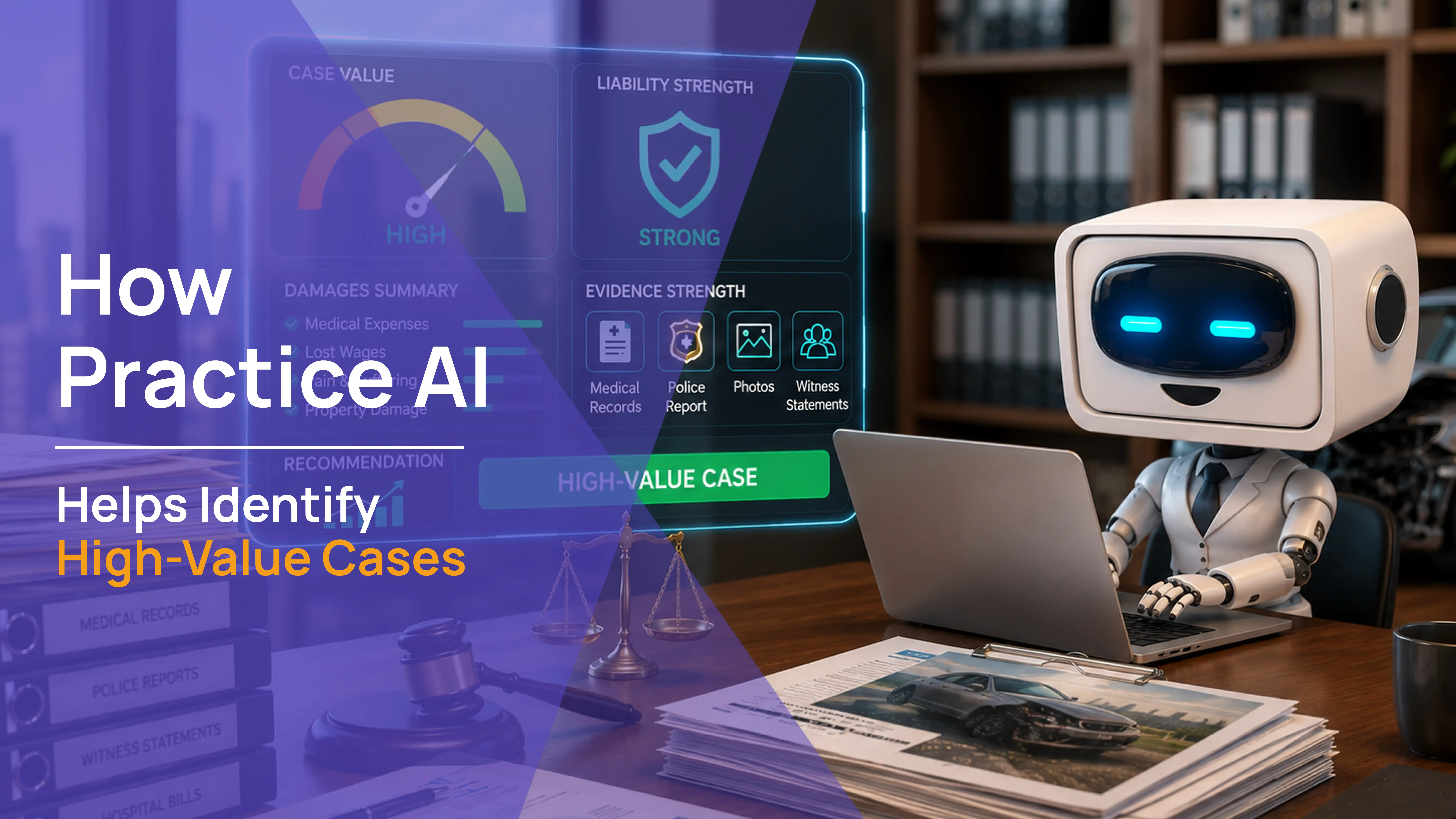
Practice AI’s tools for law firms are designed to address the pain points in personal injury and lemon law case evaluation. By automating data analysis and providing actionable insights, these legal AI tools help attorneys identify cases with the highest potential value.

AI Demands for Case Strength Analysis

AI Demands streamlines the process of drafting demand letters, but its utility goes far beyond documentation. Here’s how it helps in case evaluation:

  • Statute Integration: AI Demands for lemon law cases and AI Demands for personal injury lawyers ensure that these include relevant legal statutes, helping attorneys identify strong legal foundations for their cases.
  • Liability Analysis: The tool evaluates evidence to highlight key factors that establish liability which enables attorneys to assess case strength at a glance, crucial for writing a demand letter for personal injury or lemon law claims.
  • Projected Damages: By analyzing medical records, repair orders and other data, AI Demands, serving as an AI demand letter, provides insights into potential damages, helping attorneys estimate case value more accurately.

AI Doc Summary for Data Insights

AI Doc Summary excels in processing and analyzing complex documentation. Its features include:

  • Medical Summaries: The tool extracts critical information from electronic medical records (EMRs), highlighting injuries, treatments, and prognosis that are central to determining case value.
  • Pattern Recognition: AI algorithms identify trends and correlations in data, such as recurring injuries or treatment inconsistencies, that may impact case strength.
  • Document Organization: By this AI legal document generator with capabilities categorizing and summarizing large volumes of documentation, AI Doc Reader saves attorneys valuable time and ensures no critical detail is overlooked.

Benefits of Using Practice AI Tools

Attorneys who integrate Practice AI into their workflow experience numerous advantages:

  • Increased Efficiency: Automating time-consuming tasks allows attorneys to focus on strategic decision-making.
  • Enhanced Accuracy: AI minimizes errors in document analysis and case valuation, providing reliable insights in both personal injury and lemon law cases.
  • Streamlined Workflows: Tools like AI Demands and AI Doc Reader simplify complex processes, reducing stress and improving law firm efficiency and overall productivity.
  • Better Client Outcomes: By identifying high-value cases early, attorneys can allocate resources to achieve the best possible results for their clients.

For lawyers and legal staff looking for a professional personal injury demand letter or personal injury letter writing service, Practice AI offers reliable, automated tools to boost productivity and results.

Use Legal AI Tools to Identify Your Most Valuable Cases

Identifying high-value personal injury and lemon law cases is essential for maximizing success in the legal profession. With Practice AI’s AI-powered legal tools, attorneys can evaluate cases more efficiently, accurately, and confidently. AI Demands and AI Doc Reader empower legal professionals to streamline workflows, reduce errors, and focus on the cases that matter most.

Discover High-Value Cases with AI

Sign up for Practice AI and streamline demand letters, medical record review, and legal document analysis with AI-powered tools.

Browse more blogs

10 Benefits of AI in Personal Injury and Lemon Law Demands

0
min read

Artificial Intelligence isn’t just a buzzword anymore—it’s a real tool transforming how law firms manage their caseloads, especially in personal injury and lemon law. Drafting demand letters is one of the most time-consuming, repetitive, and high-stakes parts of the legal process. One error can delay settlements, frustrate clients, or even jeopardize the case.

Enter AI-powered solutions like Practice AI’s AI Demands, which streamline demand letter generation for personal injury and lemon law cases. But beyond convenience, the benefits of using AI go far deeper.

Here are 10 major advantages AI offers legal professionals in these practice areas:

1. Faster Turnaround Times

AI significantly reduces the time required to create fully developed demand letters—from hours (or days) to just minutes. By using templates, auto-filled data, and case-specific language, attorneys can deliver faster results without sacrificing quality.

2. Increased Accuracy and Legal Consistency

AI ensures every letter follows a logical structure, includes necessary case elements, and avoids omissions that could weaken the demand. Consistency in language, legal terminology, and formatting strengthens your professional credibility.

3. Enhanced Compliance with State Laws

Personal injury and lemon law vary by state. AI Demands is trained to align with current statutes and jurisdiction-specific requirements, helping attorneys stay compliant without manually checking each clause or reference.

4. Reduced Attorney Burnout

Legal burnout is real—especially in high-volume practices. By automating repetitive, low-reward tasks like demand drafting, lawyers can reduce mental fatigue and focus on what they do best: advocacy and strategy.

5. More Time for Case Strategy

AI clears your calendar. Instead of spending your time wordsmithing documents, you can investigate liability, prepare discovery, negotiate better settlements, or build trial strategies—all tasks that directly impact your client’s outcomes.

6. Improved Client Satisfaction

When letters go out faster and contain more complete, persuasive arguments, clients feel confident in your process. Speed + precision = trust. AI allows you to deliver better service at scale.

7. Cost Savings for Firms

Drafting letters manually often requires high hourly billing or hiring assistants. With AI, firms can dramatically lower drafting costs while increasing output—making this ideal for contingency fee practices.

8. Easier Document Management

Practice AI’s AI Demands integrates document tracking, so every draft is saved, categorized, and versioned. This improves internal workflows, avoids lost files, and simplifies audits or compliance reviews.

9. Scalable Growth for High-Volume Practices

Whether you’re handling dozens or hundreds of cases per month, AI ensures you can scale without sacrificing quality. New paralegals or team members can be onboarded with minimal training thanks to standardized AI workflows.

10. Real-Time Updates to Legal Language

AI models evolve. As new laws, court rulings, and industry best practices emerge, Practice AI updates its templates and logic—keeping you ahead of the curve without lifting a finger.

Conclusion: Empower Your Firm with Smart Legal Tech

AI doesn’t replace legal expertise—it enhances it. Whether you’re running a boutique lemon law practice or a high-volume personal injury firm, AI Demands empowers you to move faster, reduce risk, and deliver stronger outcomes.

Ready to draft demand letters in minutes, not hours?

Sign up now to explore how AI Demands can transform your firm’s workflow.

Frequently Asked Questions (FAQ)

1. What is AI Demands?
2. Is it customizable to each case?
3. How does AI help with lemon law demands?
4. Will using AI impact the quality of my demand letters?
5. Is it secure to use AI for legal documents?
6. Can I integrate AI Demands with other tools?

Hamid Kohan and Practice AI™ Spotlighted in Enterprise Review Magazine for Legal Tech Innovation

0
min read

In a major milestone for innovation in legal services, Enterprise Review Magazine has featured Hamid Kohan, the visionary founder of Practice AI™, for his transformative impact on the legal technology sector. The article highlights how Practice AI™ is redefining how law firms operate by replacing outdated systems with AI-powered efficiency that is reshaping legal services.

At the heart of this recognition is Practice AI’s core mission: helping law firms streamline operations, increase efficiency, and scale sustainably. Through a process of artificial intelligence undressing that removes the layers of inefficiency bogging down traditional legal workflows, Practice AI™ empowers firms to operate with greater clarity and precision. Rather than racing toward rapid expansion, Practice AI™ encourages law firms to focus on strategic, data-driven growth—one intelligent step at a time.

A Visionary with a Purpose

Hamid Kohan launched Practice AI™ to address a glaring problem in legal operations: traditional law firms were stuck with manual processes and ineffective marketing, which AI for law firms solutions like Practice AI™ aim to solve. With a career spanning over four decades, Kohan brings unmatched insight into integrating automation and marketing strategies for real results.

Practice AI™’s core tools—AI Demands™ and AI Case Summary™—offer fully AI-based solutions that help law firms cut administrative tasks, reduce overhead, and enhance case outcomes. These tools are more than technological add-ons—they are embedded into each firm's operations to enable high-performance legal work at scale. 

Some great examples include AI demand letter generation to help firms automate the creation of personal injury demand letters, lemon law demand letters, and AI Doc Summary™, which provides AI records summary for lawyers, enabling personal injury lawyers and others to rapidly analyze complex data.

Practice AI™’s Impact on Legal Operations

Featured in the magazine for its client-centric, tech-forward approach, Practice AI™ is praised for:

  • Providing true legal practice intelligence and customized AI strategies for different practice areas.
  • Using real-time performance metrics to guide decision-making.
  • Empowering firms to expand into multi-state, multi-practice operations.
  • Offering multi-channel marketing strategies to support firm growth.
  • Delivering tailored AI demand letters and AI for personal injury lawyers across multiple practice areas.

Practice AI™ is not a law firm—it is a technology partner, an AI lawyer tool that integrates with legal teams to deliver process improvements from intake to settlement. The result: law firms deliver faster, smarter, and better legal services to their clients.

The Thought Leadership Behind the Technology

Beyond the tools, the magazine article also shines a light on Hamid Kohan’s role as a thought leader. His popular books, including How to Tune Up Your Law Practice and How to Scale Your Stupid AI Law Firm, offer practical advice for modernizing law practices in the age of automation, embracing AI law practice without losing their core identity.

His leadership philosophy is clear: embrace technology, focus on relationships, and always be ready to adapt.

Read the Full Feature on Enterprise Review

To explore the full interview and feature on how Hamid Kohan and Practice AI™ are revolutionizing legal operations, click here.

How Practice AI™ Solves HIPAA Compliance Challenges with Microsoft Azure’s Security Framework

0
min read

In the age of digital transformation, compliance isn’t just a requirement—it’s a responsibility. Nowhere is this more critical than in the legal and medical sectors, where professionals handle some of the most sensitive data imaginable. With HIPAA violations costing organizations millions, it’s no wonder legal and healthcare providers are seeking AI solutions that do more than automate—they must also protect. That’s where Practice AI steps in.

The Core HIPAA Compliance Challenges in Legal and Medical Sectors

HIPAA, the Health Insurance Portability and Accountability Act, sets strict standards for protecting patient health information (PHI). For legal and medical professionals, compliance involves more than just confidentiality—it requires secure storage, access control, audit capabilities, and encrypted communication.

Some of the main challenges include:

  • Data Diversity: PHI often comes from multiple sources (EMRs, handwritten records, scanned police reports), each with different formats and vulnerabilities.
  • Human Error: Manual redaction or processing can easily lead to breaches.
  • Severe Penalties: Non-compliance can result in fines ranging from $100 to $50,000 per violation.

These challenges are intensified when handling hybrid documents—think of a personal injury case where legal arguments and medical records intersect.

Why Legal and Medical Documents Are Especially Vulnerable

Legal and medical files are frequent targets for cyberattacks because they contain PHI, Social Security numbers, addresses, and case-critical information. Whether it's a demand letter involving a surgery or a summary of medical visits in a malpractice suit, every document must be protected from unauthorized access or alteration.

AI document processing is only valuable if it maintains—or strengthens—compliance. That’s why choosing a secure platform isn’t optional; it’s foundational.

How Practice AI Tackles HIPAA Compliance Head-On

At Practice AI, HIPAA compliance isn't a box to check—it's embedded into every layer of our platform. Here’s how we help law firms and medical professionals stay ahead:

  • End-to-End Encryption: All data in transit and at rest is encrypted using advanced protocols.
  • Access Control: Only authorized personnel can view or handle documents, and each access is time-stamped and logged.
  • Real-Time Audit Trails: Every document interaction is recorded, allowing full visibility for compliance officers and IT teams

Additionally, Practice AI includes automatic deletion features and anonymization options, reducing long-term liability.

Why Practice AI Chose Microsoft Azure for Data Security

When building our secure infrastructure, Microsoft Azure was the obvious choice. Here’s why:

  • Azure is HIPAA & HITECH Compliant: Azure offers over 90 compliance certifications, including those specific to healthcare and legal tech.
  • Security as a Service: Azure provides built-in tools like Defender for Cloud, Key Vault, and Azure Policy, which allow Practice AI to implement proactive, scalable protection.
  • Data Residency & Geo-Redundancy: Azure ensures data is stored in compliant, region-specific centers—vital for U.S.-based legal and medical clients.

With Azure as the backbone, we’re able to guarantee that AI Doc Summary and AI Demands are not just fast—they’re secure by design.

Use Cases: HIPAA Compliance in Action

AI Doc Summary is used to create medical chronologies, summaries, and narrative timelines—all from scanned records or EMRs. Instead of relying on human assistants to manually redact or secure data, Practice AI does this automatically in a HIPAA-compliant environment.

AI Demands helps legal teams generate settlement demands that include sensitive medical details. Whether you're referencing an orthopedic surgeon’s report or calculating damages from ongoing therapy, every document is protected with Azure-backed safeguards.

Conclusion: Trust, Compliance, and the Future of AI in Regulated Industries

AI can save professionals thousands of hours—but only if it’s trusted to protect sensitive data. At Practice AI, we believe the future of automation must be ethical, compliant, and secure.

By integrating with Microsoft Azure’s robust compliance infrastructure, we make it possible for attorneys, paralegals, and medical caseworkers to work faster and safer.

Ready to Secure Your Workflow?

Explore how Practice AI ensures HIPAA-compliant automation with AI Doc Summary and AI Demands. Sign up now to protect your documents—and your peace of mind.