How to Avoid Top 5 Mistakes with Your Legal/Medical Summaries Using AI Doc Summary
Accurate legal and medical summaries are vital for informed decision-making, whether you're preparing for a court case or analyzing patient records. However, common mistakes can undermine the effectiveness of these summaries, leading to missed details, inefficiencies, or even costly errors.
Accurate legal and medical summaries are vital for informed decision-making, whether you're preparing for a court case or analyzing patient records. However, common mistakes can undermine the effectiveness of these summaries, leading to missed details, inefficiencies, or even costly errors. Here, we explore five frequent mistakes and show how AI Doc Summary can help you avoid them, ensuring your summaries are precise, organized, and reliable.
Table of Contents:
Missing Critical Details
Inconsistent Terminology Usage
Incomplete or Disorganized Information
Human Error in Data Extraction
Failure to Spot Patterns or Connections
Simplify and Strengthen Your Summaries with AI Doc Summary
1. Missing Critical Details
The Problem: Legal documents, such as deposition transcripts or witness statements, and medical records, like surgery notes or diagnostic reports, often contain key details buried in lengthy text. Missing these details can weaken a legal argument or lead to incorrect medical assessments.
Example: Overlooking a witness’s contradictory statement or missing a crucial lab result.
AI Doc Summary Solution:AI Doc Summary scans entire documents meticulously, highlighting critical details such as dates, key statements, or vital medical findings. This ensures that no essential information is overlooked, strengthening your case or patient assessment.
2. Inconsistent Terminology Usage
The Problem: Legal contracts or medical summaries often suffer from inconsistent terminology, which can create confusion. Misused legal terms or varying medical abbreviations (like using "BP" for blood pressure but also for business processes) can lead to misunderstandings.
Example: A legal brief inconsistently referring to a "plaintiff" as a "claimant" or mixing terms like "hemorrhage" and "hematoma" in medical reports.
AI Doc Summary Solution: The AI focuses on standardizing terminology, aligning with legal or medical industry standards. This ensures clarity and consistency across all documents, reducing the risk of misinterpretation.
3. Incomplete or Disorganized Information
The Problem: Disorganized summaries make it difficult to extract relevant information quickly. Legal case files or medical history reports might lack a coherent structure, leading to inefficient reviews.
Example: A summary that doesn’t chronologically order events in a malpractice case or a medical report missing treatment timelines.
AI Doc Summary Solution: AI Doc Summary organizes information logically, creating structured summaries with clear sections (like timelines or treatment stages). This makes it easier for professionals to find and understand critical information quickly.
4. Human Error in Data Extraction
The Problem: Manually summarizing large volumes of data from legal or medical records can introduce errors, especially when dealing with complex or repetitive information.
Example: Misquoting a testimony from a deposition or recording incorrect dosages from a patient’s medication history.
AI Doc Summary Solution: Using advanced algorithms, AI Doc Summary extracts and summarizes data with high accuracy. It minimizes human errors by cross-referencing data points, ensuring the summary reflects the source document correctly.
5. Failure to Spot Patterns or Connections
The Problem: Legal and medical professionals often need to identify patterns or connections between data points. Missing these insights can weaken legal arguments or affect medical diagnoses.
Example: Overlooking a pattern of patient symptoms indicating a misdiagnosis or missing connections between multiple contracts in a legal dispute.
AI Doc Summary Solution: The AI detects patterns and trends within documents. For example, it can identify recurring symptoms in medical cases or highlight similar clauses across different legal contracts. This helps professionals uncover insights that might otherwise be missed.
6. Simplify and Strengthen Your Summaries with AI Doc Summary
Avoiding these common mistakes is crucial for accuracy and efficiency in legal and medical work. AI Doc Summary not only reduces errors but also enhances the quality of your summaries, allowing you to make better decisions and deliver exceptional outcomes. Lastly, AI Doc Summary allows you to make revisions and adjustments before downloading the generated summary, ensuring you have total control over the output.
Try AI Doc Summary today and experience the difference.
Every plaintiff attorney has done the manual version of personal injury case valuation.
Pull the medical bills. Tally the past expenses. Estimate the future treatment costs. Apply a pain and suffering multiplier based on judgment and experience. Double-check the wage loss calculation. Hope nothing was missed.
That process works. But it is slow, it is inconsistent across attorneys, and it is entirely dependent on the person running the numbers having every document in front of them at the right time.
Personal injury case valuation software is designed to replace that manual process with a structured, data-driven output that gives attorneys a consistent starting point on every case.
This article walks through what case valuation tools actually do, how to evaluate them, and what separates a useful personal injury damages calculator from one that just produces a number your attorney cannot rely on.
KEY TAKEAWAYS
Personal injury case valuation software should pull figures from your actual case documentation, not from a generic multiplier formula applied to entered numbers.
The most important output from a case valuation tool is not a dollar figure. It is the structured breakdown of how that figure was calculated.
Personal injury law firm software used for case valuation must be HIPAA compliant before any medical records enter the workflow.
An automated case valuation tool that flags missing documentation before producing an output is significantly more reliable than one that calculates from whatever data is available.
Defining Personal Injury Case Valuation
Personal injury case valuation is the process of calculating the total compensatory damages a plaintiff is entitled to based on the documented evidence in their case file.
A complete personal injury case valuation is not a single number. It is a structured, component-by-component breakdown covering past medical expenses, future treatment costs, lost wages, pain and suffering, and property damage. Each component is drawn from verified documentation, not from estimates or averages.
The valuation forms the foundation of the settlement demand. How it is calculated, what documentation it is based on, and how each figure is supported determines whether the demand holds up under adjuster scrutiny or gives opposing counsel grounds to challenge it.
What Personal Injury Case Valuation Actually Involves
Before evaluating any software, it helps to be precise about what personal injury case valuation means in practice for a plaintiff law firm.
Case valuation is not a single calculation. It is a multi-component process that requires accurate documentation of every relevant damages category.
The Core Damages Categories
A complete personal injury case valuation covers the following:
Past Medical Expenses: Total billed amounts organized by provider, including emergency department care, specialist visits, imaging, physical therapy, and any other documented treatment. The figure is drawn from verified billing statements, not estimates.
Future Medical Expenses: Projected ongoing care costs based on treating physician recommendations. This typically includes physical therapy, specialist follow-ups, pain management, and any anticipated surgical interventions.
Pain and Suffering: Non-economic damages calculated using either a multiplier applied to total medical expenses or a per diem approach based on the duration and severity of the injury. Multipliers typically range from 1.5x to 5x total medical expenses depending on injury severity. A soft tissue case may support 1.5x to 2x, while a permanent disability case with documented long-term functional limitations may support 4x or higher.
Per diem calculations assign a daily value to the injury and multiply it by the number of days the plaintiff experienced pain and limitation. The appropriate method depends on jurisdiction, documented injury severity, and the strength of the clinical evidence.
Lost Wages: Income lost during the recovery period, documented with employer verification and pay stubs. Where applicable, future earning capacity loss is addressed with vocational expert input.
Property Damage: Vehicle repair or total loss value, documented with appraisals or repair estimates.
Why Manual Case Valuation Creates Inconsistency
When personal injury case valuation is done manually, the output depends entirely on who is running the numbers, what documentation they have in front of them, and what multiplier they choose to apply.
Two attorneys at the same firm can review the same case file and arrive at materially different valuations. That inconsistency affects settlement positioning, negotiation strategy, and ultimately client outcomes.
Personal injury case valuation software standardizes the process by applying consistent calculation logic to the same verified documentation every time.
What Case Valuation Software Actually Does
A personal injury damages calculator embedded in a plaintiff law firm workflow does more than multiply medical bills by a number.
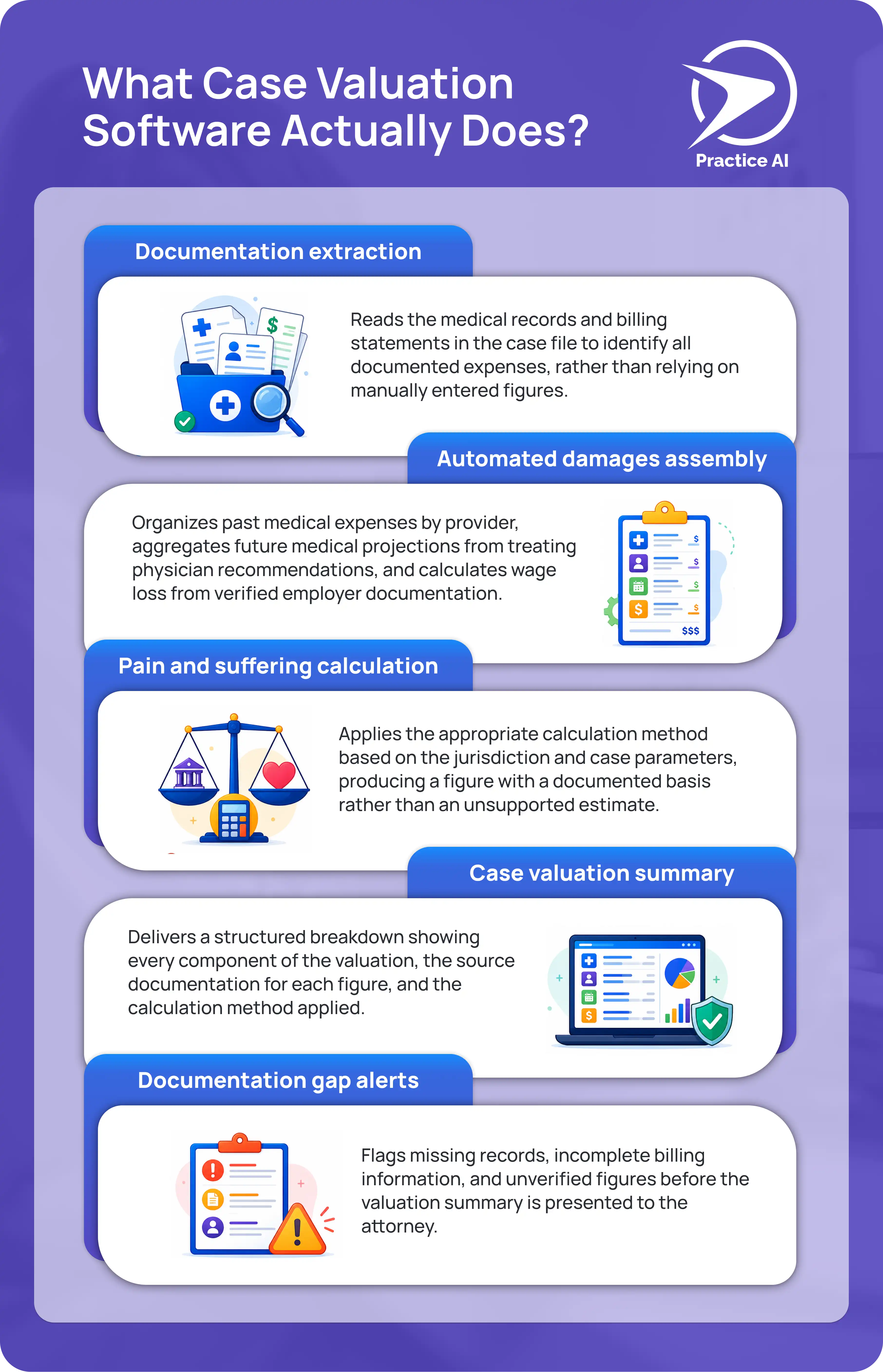
Here is what a properly built case valuation tool produces:
Documentation extraction
Reads the medical records and billing statements in the case file to identify all documented expenses, rather than relying on manually entered figures.
Automated damages assembly
Organizes past medical expenses by provider, aggregates future medical projections from treating physician recommendations, and calculates wage loss from verified employer documentation.
Pain and suffering calculation
Applies the appropriate calculation method based on the jurisdiction and case parameters, producing a figure with a documented basis rather than an unsupported estimate.
Case valuation summary
Delivers a structured breakdown showing every component of the valuation, the source documentation for each figure, and the calculation method applied.
Documentation gap alerts
Flags missing records, incomplete billing information, and unverified figures before the valuation summary is presented to the attorney.
A personal injury damages calculator that skips any of these steps is producing a number, not a valuation.
How to Evaluate Case Valuation Software for a Plaintiff PI Firm
These are the criteria that separate useful case valuation software from tools that add more steps than they remove.
1. Does It Read Your Actual Case Documents?
The most important question is whether the tool reads your uploaded case documents or asks you to enter figures manually.
A tool that accepts manual entries produces output based on what someone typed in. A tool that reads your uploaded records produces output based on what the documentation actually shows.
For personal injury case valuation, that distinction is significant. A billing total entered manually is only as accurate as the person who entered it. A billing total extracted from the uploaded provider records is verified against the source.
2. Does It Integrate With Your Legal Software?
Case valuation software that does not connect to your existing platform CASEpeer, Filevine, SmartAdvocate requires your team to re-enter information that is already in your system.
Personal injury law firm software used for case valuation should pull case data, billing records, and client information automatically. An automated case valuation that requires manual data transfer between platforms is not actually automated.
3. Does It Produce a Structured Breakdown, Not Just a Total?
A dollar figure without a breakdown is not a usable case valuation for a plaintiff attorney.
The output needs to show every component of the calculation, the source for each figure, and the method used to calculate pain and suffering. An attorney reviewing the valuation should be able to verify every line before using it to set a demand.
4. Does It Flag What Is Missing?
An automated case valuation tool that calculates from whatever documentation is available, without flagging what is missing, will produce an inaccurate valuation whenever the case file is incomplete.
The tool should identify missing provider records, unverified wage loss documentation, incomplete billing statements, and any other gaps before presenting the valuation. Catching missing documentation before the calculation runs is significantly better than discovering it after the demand letter is sent.
5. Is It HIPAA Compliant and SOC 2 Certified?
Every personal injury case file contains protected health information. Any case valuation software that processes medical records must be HIPAA compliant and SOC 2 Type II certified, with a signed Business Associate Agreement in place before any client data enters the platform.
This is not optional for plaintiff law firms. It is a baseline requirement.
6. Does Attorney Review Remain Mandatory?
No automated case valuation should produce a final figure that goes directly into a demand letter without attorney review.
The software handles the data assembly and calculation. The attorney reviews the output, adjusts where judgment requires it, and approves the final valuation before it is used. Firms using tools that skip this step are assuming professional responsibility risk they do not need to take.
General Calculator vs. Purpose-Built Case Valuation Software
Factor
General PI Calculator
Purpose-Built Case Valuation Software
Input method
Manually entered figures
Reads uploaded case documents
Damages breakdown
Total only
Component by component with sources
Legal software integration
None
Native with CASEpeer, Filevine, SmartAdvocate
Documentation gap detection
None
Flags missing records before calculating
Pain and suffering method
Single multiplier
Jurisdiction-aware calculation
HIPAA compliance
Varies
Required and certified
Attorney review step
Optional
Mandatory
Output usability
Reference only
Ready for attorney review and demand drafting
How Law Practice AI Handles Personal Injury Case Valuation
The platform reads the uploaded medical records, billing statements, and case documentation to assemble a complete valuation. Past medical expenses are organized by provider. Future medical projections are drawn from treating physician recommendations. Wage loss is calculated from verified employer documentation.
The pain and suffering calculation is documented with the method and basis used. Every component of the valuation shows its source so the attorney can verify every figure before using it.
Documentation gaps are flagged before the valuation summary is produced. Attorney review is required before any output is used. No valuation leaves the platform without explicit attorney approval.
Frequently Asked Questions: Personal Injury Case Valuation
Q1: What is personal injury case valuation?
Q2: How does a personal injury damages calculator work?
Q3: How does Law Practice AI automated case valuation differ from a general PI damages calculator?
Q4: Is HIPAA compliance required for personal injury case valuation software?
Q5: Does Law Practice AI offer a free trial?
The Right Case Valuation Tool Produces a Breakdown Your Attorney Can Actually Use
A personal injury case valuation is only as reliable as the documentation behind it.
Tools that accept manual inputs produce estimates. Tools that read your actual case documents, flag what is missing, and deliver a component-by-component breakdown with documented sources produce valuations.
That is the distinction worth holding every case valuation software option to before your firm commits to using it.
Book a Consultation to see how automated case valuation software fits your plaintiff practice.
The legal world has always balanced tradition with change. From the way cases are researched to how arguments are presented in court, every innovation reshapes the practice of law just a little more. And today, one of the biggest shifts is happening with the rise of artificial intelligence, not as a distant concept, but as a tool lawyers are already testing, questioning, and adopting in different ways, especially in areas like case valuation and verdict analysis. How big could this be?
In this blog, we’ll explore how Practice AI™ is driving that shift by integrating verdict analysis and case valuation directly into the AI Demands platform, helping firms work faster, negotiate smarter, and prepare cases with greater confidence.
AI’s Growing Role in the Legal Landscape
As highlighted ina recent article about AI and legal space, scholars are examining how generative AI is influencing judicial decision-making, with a strong call for careful research and collaboration across disciplines.
It’s a reminder that AI is no longer just a small talk but it is now a growing presence in courtrooms, law firms, and client interactions. And with the latest expansion of our AI Demands product, we’re introducing case valuation intelligence and verdict analysis tool directly into demand letters, equipping firms with real-time data on potential settlement ranges, past verdicts with case citations, and actionable insights that give attorneys an edge in negotiations, trial preparation, and deciding whether to litigate or settle.
Why Law Firms Need Verdict Analysis Tools in 2025
Verdict outcomes shape the entire strategy of a case. Attorneys often spend hours, even days, researching past trial results to understand potential risks and opportunities. Knowing how juries or judges have ruled in similar cases is critical when deciding whether to negotiate, settle, or pursue litigation. Yet this process is traditionally slow, fragmented, and dependent on piecing together precedent from multiple sources.
This is where AI is proving to be a game-changer. By bringing verdict analysis into the same space where demand letters are created, attorneys no longer need to switch between databases or rely on limited anecdotal knowledge. Instead, they gain immediate access to relevant case citations, outcomes, and settlement ranges, all while drafting. This integration doesn’t just save time; it fundamentally shifts how legal professionals prepare and strategize.
What’s Next for AI Demands at Practice AI™
The release of our case valuation and verdict analysis tools is just the beginning. At Practice AI™, our vision is to transform demand letter drafting into a fully strategic process, one that doesn’t just save time, but actively improves case outcomes.
Here’s a look at what’s ahead:
Deeper Data Intelligence – Expanding the accuracy and scope of our case valuation models, factoring in more variables such as jurisdiction, injury type, and evolving case law.
Expanded Verdict Databases – Building a richer library of past outcomes and citations so attorneys can draw from the widest possible set of precedents.
Smarter Drafting Integration – Embedding insights even more seamlessly into the demand creation flow, so research and strategy happen in real time while drafting.
Enhanced Trial Preparation Tools – Developing features that help firms move from pre-litigation to litigation phases with confidence, armed with AI-powered benchmarks and insights.
Continued Time & Cost Savings – Strengthening efficiency so firms can consistently reduce drafting time by up to 90% and cut costs by as much as 95%, without sacrificing strategic depth.
Built for Lawyers Who Want the Edge
Looking ahead, our goal is simple: to empower firms to negotiate smarter, prepare more effectively for trials, and deliver stronger results for clients, all while making the process more efficient.
AI Demands is more than a drafting tool. It’s a strategic partner designed to give attorneys the insights they need, when they need them. With real-time case valuation and integratedverdict analysis, Practice AI™ is setting a new standard for how law firms approach demand letters, negotiations, and trial preparation.
If you’re ready to see how AI can streamline your workflow and give your firm a competitive edge, explore the full capabilities of Practice AI’s AI Demands platform today!
Attorneys and legal professionals deal with vast amounts of documents daily, from medical records to court transcripts. Extracting key details from these documents manually is time-consuming and prone to errors. AI Doc Summary™, an emerging leader in Legal AI tools, offers a transformative AI-powered legal writing solution, used for law practices to generate precise and efficient legal summaries.
This technology is especially vital for AI for personal injury lawyers and lawyers for lemon law who handle high volumes of paperwork. Whether you’re drafting a personal injury demand letter, reviewing medical records, or preparing lemon law demand letters, AI-powered demand letters and document summarization help you gain clarity faster and serve clients more efficiently.
offers a transformative solution, using AI automations for law practices to generate precise and efficient legal summaries.
Why Legal Professionals Need AI for Document Summarization
Legal workflows demand speed, accuracy, and consistency. Manually reviewing and summarizing large case files or medical records takes valuable time, often delaying case progression. With AI for legal professionals, they can quickly extract key insights, reducing workload and improving decision-making and law firm efficiency.
Solutions like AI Doc Summary for medical records or AI Doc Summary for legal documents save time and help reduce error rates, improving both client outcomes and overall firm productivity.
How AI Transforms Legal Workflows with Summarization
1. Speed and Efficiency
AI eliminates hours of manual reading by processing and summarizing documents in minutes. Whether it's medical records or police reports, attorneys receive clear, well-structured summaries instantly and that’s because AI summarizes legal documents in a structured format. This is especially helpful for those writing a personal injury demand letter or drafting lemon law documents.AI eliminates hours of manual reading by processing and summarizing documents in minutes. Whether it's medical records or police reports, attorneys receive clear, well-structured summaries instantly.
2. Accuracy and Consistency
Manual summaries are prone to human oversight, leading to missing or misinterpreted information. AI in the legal field helps firms save time on demand letters and case analysis and ensure consistent and accurate reporting.
3. Customizable Summarization for Different Case Types
Legal AI solutions allow attorneys to personalize summaries to highlight relevant medical conditions, legal facts, or financial damages based on the specific needs of their case. Whether you need a sample personal injury demand letter, or are navigating AI document management in healthcare, AI makes it easier to adapt based on case needs.Attorneys can tailor AI-generated summaries to highlight relevant medical conditions, legal facts, or financial damages based on the specific needs of their case.
4. Affordable AI Solutions for Law Firms
Instead of hiring additional legal assistants for documentation tasks, firms can leverage affordable AI solutions for law firms like AI Doc Summary to handle high-volume document analysis efficiently.
The Benefits of AI in Demand Generation and Summarization
AI-powered legal and medical solutions do more than summarize. AI-driven summaries complement case-specific demand letters with AI, making demand letter drafting faster and more accurate. Instead of sifting through complex documents, attorneys can rely on structured AI-generated insights to build stronger, more compelling arguments.
Those searching for the best free AI lawyer or an AI legal document generator free often turn to solutions like Practice AI, which provides the best AI for legal research, demand letter writing, and AI legal compliance. By offering structured, AI-generated insights, Practice AI helps attorneys draft more accurate and compelling demand letters while improving the overall efficiency of legal workflows.
AI Across Legal and Medical Industries
Practice AI isn’t just for attorneys—it serves the entire legal-medical ecosystem. For firms involved in healthcare litigation or insurance disputes, AI offers:
AI for healthcare legal cases
AI HIPAA compliance
Medical records analysis AI
Patient data security AI
AI in medical tech
AI Adoption in Healthcare
Top AI companies in healthcare
Data security in AI
Legal Research & Contract Management
Need help with AI for legal research? Wondering what are the best AI tools for legal research? Practice AI integrates contract intelligence, case law databases, and compliance modules. Firms looking for which company in the legal tech field offers the best AI for contract management or what is the best company for contract review AI in the legal tech industry will find Practice AI an optimal choice.
If you're searching for any of the following, you're in the right place:
Personal injury demand letter services
Hire demand letter writer for personal injury
Best personal injury demand letter service near me
AI medical records summary for lawyers
Time-saving AI for lawyers
AI-driven case summaries
AI for faster settlements
Ethical legal and professional issues in counseling
How does AI improve the accuracy of legal research
Final Thoughts: Why AI Doc Summary™ is a Must-Have
If you’re in legal and professional services looking to streamline document-heavy workflows, AI Doc Summary offers an indispensable solution. By integrating AI-powered summarization, medical and legal professionals can enhance productivity, improve accuracy, and focus on higher-value legal work.
Discover how AI Doc Summary can transform your legal practice today!