How to Increase Case Settlements with Practice AI Demands
Writing demand letters for personal injury and lemon law cases is time-consuming and tedious. Lawyers must customize each letter, ensure legal accuracy, and go through multiple revisions, taking valuable time away from clients. AI Demands™ streamlines this process with customizable templates, AI-driven content, and accurate legal citations, reducing errors and drafting time. By incorporating case details seamlessly, it creates stronger, more persuasive letters that lead to higher settlements. With consistent quality and faster submissions, attorneys can focus on advocacy instead of paperwork. Sign up for Practice AI today and see how AI Demands can transform your workflow!
Let’s face it: Being a personal injury or lemon law lawyer can feel like a juggling act. Between managing clients and building cases, there’s barely enough time to breathe, let alone draft detailed lemon law demand letters or personal injury demand letters. That’s where Practice AI™ and AI Demands™ come in to save the day.
AI Demands is designed to simplify your workflow. It creates strong, persuasive AI-powered demand letters tailored to your cases, so you can focus on what you do best, advocating for your clients. By using advanced technology like legal AI solutions, AI Demands ensures your letters are not just accurate, but also effective at securing higher settlements.
The Struggle of Writing Demand Letters
Imagine you’re an attorney going through multiple cases. You have to write demand letters such as personal injury demand letters and lemon law demand lettersfor each one, and it’s not as easy as it sounds. Here’s what you’re up against:
Creating a Template: Each case is unique. Building a good template that fits motor vehicle accidents, slip-and-fall incidents, or dog bites can feel like reinventing the wheel every time.
Writing the Letter: A good demand letter has to check all the boxes. It needs to be persuasive, packed with evidence, and completely accurate. Finding the right tone and flow can take hours.
Endless Revisions: You’ll likely go back and forth making edits to fine-tune the letter. Each revision eats up more time, delaying the process.
The result? Writing a single letter for a personal injury or lemon law case can take hours, leaving you with less time to focus on your clients or negotiations.
How Can Practice AI Solve Your Legal Challenges?
AI Demands was built to make your life easier. Here’s how it takes the headache out of deamnd letters:
Ready-Made Templates: Stop starting from scratch! AI Demands offers customizable templates for common personal injury cases, such as motor vehicle accidents, dog bites, and slip and fall cases, as well as lemon law cases
Tailored Letters: The AI extracts case details to craft a demand letter specifically for your client. It pulls in the uploaded medical records, police reports, repair orders, and other key information seamlessly.
Accurate and Reliable: With built-in legal references and the ability to cite statutes and regulations, AI Demands ensures every citation is relevant to the case and minimizes the errors. Ultimately, you are given the option to review and revise any part of the generated demand.
Fast and Efficient: Tasks that might take you hours can now be done in minutes, giving you more time to focus on other parts of your case.
5 Ways AI Demands Helps You Secure Higher Settlements
Using AI tools for tasks like AI-powered legal writingdoesn’t just save time; it can also help you secure better outcomes for your clients. Here’s how:
Stronger Arguments: AI Demands creates polished, persuasive letters that present your client’s case in the best light, which insurance adjusters and vehicle manufacturers will take more seriously.
All the Details, Every Time: By incorporating all your uploaded documents, from medical records to treatment timelines for personal injury cases, and repair orders for lemon law cases, AI Demands ensures nothing gets missed. A complete and detailed demand makes it easier to argue for higher compensation.
Consistent Quality: Everyone has off days, but AI doesn’t. With AI Demands, you can deliver high-quality demand letters consistently across all your cases.
Accurate Legal Citations: By referencing statutes and regulations accurately, AI Demands strengthens the credibility of your arguments, making them harder for insurance adjusters to dismiss.
Quicker Results: Faster drafting means you spend less time approving demand letters, which in turn result in faster submissions. When you speed up the process, you can settle cases quicker and avoid prolonged negotiations that might result in lower offers.
AI Demands Takes The Manual Work off Your Desk
Drafting demand letters doesn’t have to drain your time or energy. With AI Demands, you can create strong, accurate, and persuasive letters in a fraction of the time. Not only does this make your workflow smoother, but it also helps you aim higher for your clients, leading to better settlements and more satisfied clients.
Need help writing a personal injury demand letter? Sign up for Practice AI today and see the difference AI Demands can make!
Attorneys and legal professionals deal with vast amounts of documents daily, from medical records to court transcripts. Extracting key details from these documents manually is time-consuming and prone to errors. AI Doc Summary™, an emerging leader in Legal AI tools, offers a transformative AI-powered legal writing solution, used for law practices to generate precise and efficient legal summaries.
This technology is especially vital for AI for personal injury lawyers and lawyers for lemon law who handle high volumes of paperwork. Whether you’re drafting a personal injury demand letter, reviewing medical records, or preparing lemon law demand letters, AI-powered demand letters and document summarization help you gain clarity faster and serve clients more efficiently.
offers a transformative solution, using AI automations for law practices to generate precise and efficient legal summaries.
Why Legal Professionals Need AI for Document Summarization
Legal workflows demand speed, accuracy, and consistency. Manually reviewing and summarizing large case files or medical records takes valuable time, often delaying case progression. With AI for legal professionals, they can quickly extract key insights, reducing workload and improving decision-making and law firm efficiency.
Solutions like AI Doc Summary for medical records or AI Doc Summary for legal documents save time and help reduce error rates, improving both client outcomes and overall firm productivity.
How AI Transforms Legal Workflows with Summarization
1. Speed and Efficiency
AI eliminates hours of manual reading by processing and summarizing documents in minutes. Whether it's medical records or police reports, attorneys receive clear, well-structured summaries instantly and that’s because AI summarizes legal documents in a structured format. This is especially helpful for those writing a personal injury demand letter or drafting lemon law documents.AI eliminates hours of manual reading by processing and summarizing documents in minutes. Whether it's medical records or police reports, attorneys receive clear, well-structured summaries instantly.
2. Accuracy and Consistency
Manual summaries are prone to human oversight, leading to missing or misinterpreted information. AI in the legal field helps firms save time on demand letters and case analysis and ensure consistent and accurate reporting.
3. Customizable Summarization for Different Case Types
Legal AI solutions allow attorneys to personalize summaries to highlight relevant medical conditions, legal facts, or financial damages based on the specific needs of their case. Whether you need a sample personal injury demand letter, or are navigating AI document management in healthcare, AI makes it easier to adapt based on case needs.Attorneys can tailor AI-generated summaries to highlight relevant medical conditions, legal facts, or financial damages based on the specific needs of their case.
4. Affordable AI Solutions for Law Firms
Instead of hiring additional legal assistants for documentation tasks, firms can leverage affordable AI solutions for law firms like AI Doc Summary to handle high-volume document analysis efficiently.
The Benefits of AI in Demand Generation and Summarization
AI-powered legal and medical solutions do more than summarize. AI-driven summaries complement case-specific demand letters with AI, making demand letter drafting faster and more accurate. Instead of sifting through complex documents, attorneys can rely on structured AI-generated insights to build stronger, more compelling arguments.
Those searching for the best free AI lawyer or an AI legal document generator free often turn to solutions like Practice AI, which provides the best AI for legal research, demand letter writing, and AI legal compliance. By offering structured, AI-generated insights, Practice AI helps attorneys draft more accurate and compelling demand letters while improving the overall efficiency of legal workflows.
AI Across Legal and Medical Industries
Practice AI isn’t just for attorneys—it serves the entire legal-medical ecosystem. For firms involved in healthcare litigation or insurance disputes, AI offers:
AI for healthcare legal cases
AI HIPAA compliance
Medical records analysis AI
Patient data security AI
AI in medical tech
AI Adoption in Healthcare
Top AI companies in healthcare
Data security in AI
Legal Research & Contract Management
Need help with AI for legal research? Wondering what are the best AI tools for legal research? Practice AI integrates contract intelligence, case law databases, and compliance modules. Firms looking for which company in the legal tech field offers the best AI for contract management or what is the best company for contract review AI in the legal tech industry will find Practice AI an optimal choice.
If you're searching for any of the following, you're in the right place:
Personal injury demand letter services
Hire demand letter writer for personal injury
Best personal injury demand letter service near me
AI medical records summary for lawyers
Time-saving AI for lawyers
AI-driven case summaries
AI for faster settlements
Ethical legal and professional issues in counseling
How does AI improve the accuracy of legal research
Final Thoughts: Why AI Doc Summary™ is a Must-Have
If you’re in legal and professional services looking to streamline document-heavy workflows, AI Doc Summary offers an indispensable solution. By integrating AI-powered summarization, medical and legal professionals can enhance productivity, improve accuracy, and focus on higher-value legal work.
Discover how AI Doc Summary can transform your legal practice today!
You're staring at a stack of medical records three inches thick, and your client's case hearing is next week. Sound familiar? Medical record summaries can turn that overwhelming pile of documentation into an organized narrative that strengthens your case.
Whether you're handling a personal injury case or just want to learn about the process, this guide will give you the practical steps and walk you through everything from structuring your summary to using modern tools that can streamline your work.
What Is a Medical Summary?
A medical summary is a concise document that organizes and condenses information from a patient’s medical records. It highlights key details such as diagnoses, treatments, and prognoses, while excluding unnecessary data.
Medical summaries serve as reference tools that allow attorneys, insurance adjusters, and other legal professionals to quickly understand a patient's medical history without having to review hundreds of pages of raw medical records.
What to Include in a Legal Medical Summary
When creating a medical summary, focus on pulling in the right documents and information that directly support your case. Let's break it down.
Documents
Your medical summary should reference all relevant medical documents that support your case, including:
Hospital admission and discharge summaries
Physician office visit notes
Emergency room records
Laboratory test results
Imaging reports (e.g., X-rays, MRIs, CT scans)
Surgical or procedure reports
Prescription and medication records
Physical therapy or rehabilitation notes
Specialist consultation reports
Billing statements (for cost-related claims)
Don’t overlook any document that helps establish the severity of injuries, duration of treatment, or the connection between the incident and the medical care. These documents work together to build a clear timeline and ensure your summary is fully backed by verifiable evidence.
Information
Each entry in your medical summary should include the following important information:
Date of Service: The exact date the medical event occurred, crucial for establishing a chronological timeline.
Provider and Facility: The name and specialty of the doctor, hospital, or clinic that provided the service.
Bates Number (or Page Reference): The unique identifier for the page(s) in the original records where the fact can be verified.
Diagnosis (DX): The official medical finding or condition identified by the provider to link to the legal claims.
Chief Complaint (CC): What the patient specifically reported or complained about during that visit.
Treatment or Plan (TX/Plan): The medical intervention performed, such as surgery, medication, or a referral for therapy.
Test results: Key findings from labs or imaging that support or refute the claims.
Prognosis: Any statement by the provider regarding the expected outcome, long-term effects, or future limitations.
Pre-existing conditions: Relevant medical history that helps distinguish new injuries from pre-existing issues.
Include all information that helps you create a clear narrative that supports your legal arguments. The more accurate and complete your entries are, the easier it becomes to identify strengths, weaknesses, and gaps in your case.
How to Structure a Medical Record Summary
Start with a brief introduction that outlines the context of the injury and the cause of the case. Follow this with the body of your summary, presented as a chronological breakdown of the care received. Next, include a section highlighting the key supporting evidence such as diagnoses, test results, and significant medical findings.
End with a summary section that synthesizes the most important information. This is where you connect the dots between treatments, identify any gaps in care, and emphasize facts that support your legal theory.
This structure ensures that all essential legal and medical details are easy to locate and understand, making it simpler for any reader, whether a judge, adjuster, or opposing counsel, to follow the narrative.
Legal Medical Summary Example (Free Template)
Here’s an example to have better analysis on the structure of a legal medical summary.
TO: Michael Rodriguez, Esq.
FROM: Patricia Chen, Paralegal | Legal Support Services
DATE: November 12, 2025
RE: Medical Summary - Robert Martinez v. Summit Construction Group, LLC
Case Information
Patient: Robert Martinez, DOB: 08/22/1981 (Age 43)
Case No: 2024-CV-08947 (Superior Court, Maricopa County)
Date of Incident: March 15, 2024
Records Period: March 15, 2024 through October 28, 2025
Incident Description
On March 15, 2024, at approximately 2:35 p.m., Mr. Robert Martinez, a 43-year-old warehouse supervisor, was struck by a falling pallet of construction materials while conducting a safety inspection at the defendant's construction site. Witness statements indicate improperly secured materials became dislodged when a forklift operator collided with support scaffolding. Mr. Martinez was struck on his left side and fell approximately 4 feet onto concrete. He remained conscious but was unable to stand without assistance due to severe left shoulder pain, chest pain, and difficulty breathing.
Alleged Injuries (from Complaint):
Orthopedic:
Full-thickness rotator cuff tear (left shoulder) – 2.5-3 cm with retraction
Multiple rib fractures (ribs 4, 5, 6 – left side)
Lumbar disc herniation L4-L5 with nerve root compression (8mm, right paracentral)
Neurological:
Traumatic brain injury with cortical contusion
Post-concussive syndrome with cognitive deficits
Other:
Pulmonary contusion
Major depressive disorder and PTSD (post-injury onset)
Chronic pain syndrome
Pre-Existing Conditions
Hypertension (controlled with medication since 2019)
Type 2 Diabetes (managed with Metformin)
Mild degenerative disc disease on 2021 X-ray (asymptomatic)
Note: No prior shoulder injuries, head trauma, or mental health issues documented.
Claimed Damages
Category
Amount
Past Medical Expenses
$127,450.00
Future Medical Expenses
$85,000.00
Past Lost Wages
$42,300.00
Future Lost Earning Capacity
$380,000.00
Non-Economic Damages
$750,000.00
Total Amount
$1,384,750.00
Medical Chronology (Key Events)
Date
Facility / Provider
Bates No.
Summary
03/15/2024
Banner Desert Medical Center Emergency Department - Dr. Sarah Kim, MD
RM-0005 to RM-0087
Patient transported via EMS following workplace injury. CT head revealed small cortical contusion in left frontal lobe (no hemorrhage)...
03/29/2024
Arizona Advanced Imaging Center - Dr. Thomas Brewster, MD
RM-0164 to RM-0169
MRI revealed full-thickness tear of supraspinatus tendon (2.5 cm) with retraction and moderate muscle atrophy...
Phoenix Orthopedic & Sports Medicine - Dr. Andrew Martinez, MD
RM-0268 to RM-0275
6-month post-operative follow-up. Significant improvement in shoulder function...
Current Medical Status (as of 10/28/2025)
Left Shoulder: Maximum medical improvement. Permanent 15% upper extremity disability. Cannot lift >25 lbs or perform prolonged overhead work.
Traumatic Brain Injury: Persistent post-concussive syndrome with documented cognitive deficits. Ongoing headaches and concentration difficulties.
Lumbar Spine: L4-L5 disc herniation with radiculopathy. Temporary relief from injection, symptoms recurring.
Mental Health: Major depressive disorder and PTSD secondary to injury. Active treatment ongoing.
Work Status: Totally disabled from warehouse supervisor occupation.
Causation Analysis
Strength: Strong
Temporal Relationship: All injuries occurred immediately following workplace incident with documented mechanism of injury
Shoulder: Acute traumatic tear confirmed surgically. No prior shoulder complaints or injuries in medical history.
Lumbar Spine: Comparison MRI (2021 vs. 2024) definitively shows NEW herniation. Radiologist documented acute traumatic appearance. Prior imaging showed only minimal asymptomatic bulge at different characteristics.
TBI: Immediate neurological symptoms documented by EMS and ER. Objective cognitive deficits confirmed on formal neuropsychological testing 6 months post-injury.
Mental Health: No prior psychiatric history. Symptoms directly related to workplace trauma and physical limitations.
Key Findings & Conclusion
Injury Severity: Multi-system traumatic injuries including surgical rotator cuff repair, TBI with objective cognitive deficits, lumbar disc herniation requiring pain management, and significant psychological trauma.
Permanency: 15% permanent upper extremity impairment with ongoing cognitive deficits, chronic pain syndrome, and permanent work restrictions.
Treatment Necessity: All treatment medically appropriate. Conservative care attempted before surgical and pain management interventions.
Pre-Existing Impact: Minimal. Prior degenerative changes were asymptomatic and at a different spinal level than acute herniation.
Work Disability: Multiple physicians confirm total disability from prior warehouse supervisor occupation. Permanent restrictions preclude return to previous work duties.
Damage Exposure: High. Documented past medicals ($127,450), permanent disability affecting earning capacity, and strong non-economic damages given life-altering injuries and chronic conditions.
Outstanding Records
Date Range
Facility
Notes
07/10/2024 - 08/05/2024
Resilience Physical Therapy
Four PT session notes missing. Billing confirms attendance. Requested 09/15/2024 and 10/20/2024. Still pending.
08/20/2024
Valley Neurology Associates
Follow-up neurology appointment referenced but consultation report not provided. Requested 10/05/2024. Pending.
09/25/2024
Arizona Pain & Spine Institute
Follow-up visit noted in pharmacy records but no office note received. Requested 10/22/2024. Pending.
Prepared by: Patricia Chen, Paralegal
Records Reviewed: 267 pages (Bates RM-0005 through RM-0275)
Preparing a summary from a large volume of files may seem overwhelming, so here are five steps to make the process manageable and efficient:
1. Gather and Organize All Records
Before you start reviewing, request all relevant medical records and make sure you have every page. Note the provider, facility, and date range for each document. Then organize everything by date to establish the sequence early, regardless of the provider. Apply Bates numbers to every page so you can easily reference the original documents in your summary.
2. Identify Relevant Medical Events
Review the records with a legal lens. Flag any treatment, diagnosis, or event directly related to the injuries or conditions at issue in your case. Skip records that don’t connect to your legal theory, you’re aiming for efficiency, so stay focused.
3. Build a Detailed Chronology
Create a working chronological list of every significant event: date, provider, diagnosis, treatment provided, and any statements regarding causation or prognosis. Be sure to include the corresponding Bates number for each entry.
4. Draft the Summary Narrative
Using your detailed chronology, begin writing the summary in a clear, objective narrative format. Translate complex medical terminology into plain language without losing accuracy so that non-medical readers can easily understand it.
5. Review and Cross-Reference
Once your summary is complete, cross-check every date, diagnosis, and provider name against the original records to verify accuracy. Even a small factual error can undermine the credibility of your entire case. Look for inconsistencies between providers' notes or gaps in the treatment timeline that could affect your legal argument.
Challenges in Preparing a Medical Summary
Even for experienced legal teams, preparing a medical summary can be challenging. Here are the most common hurdles that can slow down a case and introduce errors, things you should consider when planning your workflow:
Volume and Complexity: You often face hundreds or even thousands of pages of medical records as your first obstacle, many of which are filled with highly specialized terminology. According to the National Institutes of Health, medical terminology comprises more than 250,000 specialized terms, making it difficult to review quickly and identify what truly matters.
Unstructured Data: Records arrive in varying formats because they come from multiple providers, from PDFs to hard-to-read handwritten notes. Standardizing and organizing these documents can require significant time and effort.
Identifying Relevance: It can be challenging for non-medical professionals to determine which diagnoses, past conditions, or old entries are relevant to the current legal claim.
Time constraint: Tight deadlines add pressure, especially when the review process is done manually, page by page. This increases the chance of missing important details or making errors.
Options for Medical Record Summary Creation
You have several ways to create medical summaries, depending on your budget, timeline, and case complexity. Here are the typical options:
DIY
Handling medical summaries by yourself or with your team gives you complete control over the process. However, it can be time-intensive and carries the risk of human error or misinterpretation of medical facts.
Outsource
Legal nurse consultants or medical record review companies specialize in preparing medical summaries. These professionals understand medical terminology, can spot inconsistencies, and often complete summaries faster than in-house staff.
The tradeoff is less direct control over formatting or prioritization of information for your specific legal arguments. Additionally, outsourced professionals may lack formal legal knowledge, which can affect how the summary aligns with legal strategy.
Use AI
Professional AI platforms designed for medical record summarization can process large volumes of records in minutes, extracting key information and organizing it into structured summaries.
This option is fast, scalable, and ideal for high-volume work, as AI handles time-consuming extraction and organization. However, while AI is quick and accurate for data extraction, a human expert must still review the output. AI is meant to support human work, not replace it entirely.
Final Notes
Wrapping up, creating effective legal medical summaries involves a lot of focus and attention to detail to identify relevant facts. While the process can be time-consuming, the payoff comes in faster case evaluation, stronger settlement demands, and more persuasive trial presentations.
Whether you handle summaries manually, in-house, outsource, or use AI technology, the key is to develop a clear roadmap that can be quickly understood by judges, attorneys, or other stakeholders. Focus on consistency, accuracy, and relevance of the output to ensure you capture all critical medical information, building a stronger case every time.
Is there a free AI to summarize medical records?
While general-purpose AI tools like ChatGPT are free, they may not be suitable for sensitive legal and medical data due to privacy concerns and the lack of legal-specific formatting.
There are platforms, such as Law Practice AI, that offer free trial versions specifically designed for legal practices to summarize medical records and provide other legal-focused features. These tools invest in infrastructure to secure client confidentiality and comply with industry-standard security.
However, trial versions may have certain limitations, such as a maximum number of pages processed, which is why full subscriptions are often necessary for more robust usage.
Every plaintiff attorney has done the manual version of personal injury case valuation.
Pull the medical bills. Tally the past expenses. Estimate the future treatment costs. Apply a pain and suffering multiplier based on judgment and experience. Double-check the wage loss calculation. Hope nothing was missed.
That process works. But it is slow, it is inconsistent across attorneys, and it is entirely dependent on the person running the numbers having every document in front of them at the right time.
Personal injury case valuation software is designed to replace that manual process with a structured, data-driven output that gives attorneys a consistent starting point on every case.
This article walks through what case valuation tools actually do, how to evaluate them, and what separates a useful personal injury damages calculator from one that just produces a number your attorney cannot rely on.
KEY TAKEAWAYS
Personal injury case valuation software should pull figures from your actual case documentation, not from a generic multiplier formula applied to entered numbers.
The most important output from a case valuation tool is not a dollar figure. It is the structured breakdown of how that figure was calculated.
Personal injury law firm software used for case valuation must be HIPAA compliant before any medical records enter the workflow.
An automated case valuation tool that flags missing documentation before producing an output is significantly more reliable than one that calculates from whatever data is available.
Defining Personal Injury Case Valuation
Personal injury case valuation is the process of calculating the total compensatory damages a plaintiff is entitled to based on the documented evidence in their case file.
A complete personal injury case valuation is not a single number. It is a structured, component-by-component breakdown covering past medical expenses, future treatment costs, lost wages, pain and suffering, and property damage. Each component is drawn from verified documentation, not from estimates or averages.
The valuation forms the foundation of the settlement demand. How it is calculated, what documentation it is based on, and how each figure is supported determines whether the demand holds up under adjuster scrutiny or gives opposing counsel grounds to challenge it.
What Personal Injury Case Valuation Actually Involves
Before evaluating any software, it helps to be precise about what personal injury case valuation means in practice for a plaintiff law firm.
Case valuation is not a single calculation. It is a multi-component process that requires accurate documentation of every relevant damages category.
The Core Damages Categories
A complete personal injury case valuation covers the following:
Past Medical Expenses: Total billed amounts organized by provider, including emergency department care, specialist visits, imaging, physical therapy, and any other documented treatment. The figure is drawn from verified billing statements, not estimates.
Future Medical Expenses: Projected ongoing care costs based on treating physician recommendations. This typically includes physical therapy, specialist follow-ups, pain management, and any anticipated surgical interventions.
Pain and Suffering: Non-economic damages calculated using either a multiplier applied to total medical expenses or a per diem approach based on the duration and severity of the injury. Multipliers typically range from 1.5x to 5x total medical expenses depending on injury severity. A soft tissue case may support 1.5x to 2x, while a permanent disability case with documented long-term functional limitations may support 4x or higher.
Per diem calculations assign a daily value to the injury and multiply it by the number of days the plaintiff experienced pain and limitation. The appropriate method depends on jurisdiction, documented injury severity, and the strength of the clinical evidence.
Lost Wages: Income lost during the recovery period, documented with employer verification and pay stubs. Where applicable, future earning capacity loss is addressed with vocational expert input.
Property Damage: Vehicle repair or total loss value, documented with appraisals or repair estimates.
Why Manual Case Valuation Creates Inconsistency
When personal injury case valuation is done manually, the output depends entirely on who is running the numbers, what documentation they have in front of them, and what multiplier they choose to apply.
Two attorneys at the same firm can review the same case file and arrive at materially different valuations. That inconsistency affects settlement positioning, negotiation strategy, and ultimately client outcomes.
Personal injury case valuation software standardizes the process by applying consistent calculation logic to the same verified documentation every time.
What Case Valuation Software Actually Does
A personal injury damages calculator embedded in a plaintiff law firm workflow does more than multiply medical bills by a number.
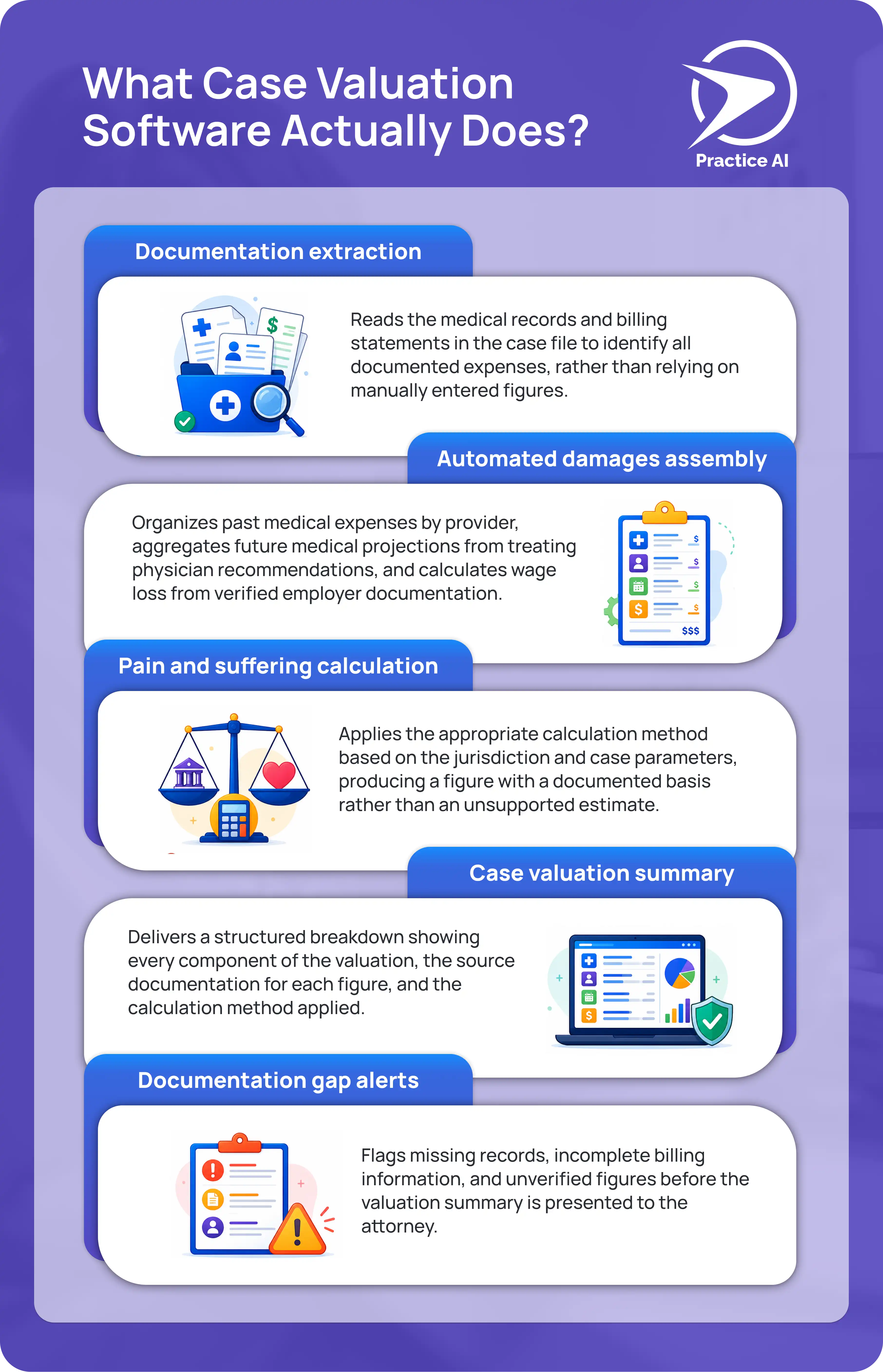
Here is what a properly built case valuation tool produces:
Documentation extraction
Reads the medical records and billing statements in the case file to identify all documented expenses, rather than relying on manually entered figures.
Automated damages assembly
Organizes past medical expenses by provider, aggregates future medical projections from treating physician recommendations, and calculates wage loss from verified employer documentation.
Pain and suffering calculation
Applies the appropriate calculation method based on the jurisdiction and case parameters, producing a figure with a documented basis rather than an unsupported estimate.
Case valuation summary
Delivers a structured breakdown showing every component of the valuation, the source documentation for each figure, and the calculation method applied.
Documentation gap alerts
Flags missing records, incomplete billing information, and unverified figures before the valuation summary is presented to the attorney.
A personal injury damages calculator that skips any of these steps is producing a number, not a valuation.
How to Evaluate Case Valuation Software for a Plaintiff PI Firm
These are the criteria that separate useful case valuation software from tools that add more steps than they remove.
1. Does It Read Your Actual Case Documents?
The most important question is whether the tool reads your uploaded case documents or asks you to enter figures manually.
A tool that accepts manual entries produces output based on what someone typed in. A tool that reads your uploaded records produces output based on what the documentation actually shows.
For personal injury case valuation, that distinction is significant. A billing total entered manually is only as accurate as the person who entered it. A billing total extracted from the uploaded provider records is verified against the source.
2. Does It Integrate With Your Legal Software?
Case valuation software that does not connect to your existing platform CASEpeer, Filevine, SmartAdvocate requires your team to re-enter information that is already in your system.
Personal injury law firm software used for case valuation should pull case data, billing records, and client information automatically. An automated case valuation that requires manual data transfer between platforms is not actually automated.
3. Does It Produce a Structured Breakdown, Not Just a Total?
A dollar figure without a breakdown is not a usable case valuation for a plaintiff attorney.
The output needs to show every component of the calculation, the source for each figure, and the method used to calculate pain and suffering. An attorney reviewing the valuation should be able to verify every line before using it to set a demand.
4. Does It Flag What Is Missing?
An automated case valuation tool that calculates from whatever documentation is available, without flagging what is missing, will produce an inaccurate valuation whenever the case file is incomplete.
The tool should identify missing provider records, unverified wage loss documentation, incomplete billing statements, and any other gaps before presenting the valuation. Catching missing documentation before the calculation runs is significantly better than discovering it after the demand letter is sent.
5. Is It HIPAA Compliant and SOC 2 Certified?
Every personal injury case file contains protected health information. Any case valuation software that processes medical records must be HIPAA compliant and SOC 2 Type II certified, with a signed Business Associate Agreement in place before any client data enters the platform.
This is not optional for plaintiff law firms. It is a baseline requirement.
6. Does Attorney Review Remain Mandatory?
No automated case valuation should produce a final figure that goes directly into a demand letter without attorney review.
The software handles the data assembly and calculation. The attorney reviews the output, adjusts where judgment requires it, and approves the final valuation before it is used. Firms using tools that skip this step are assuming professional responsibility risk they do not need to take.
General Calculator vs. Purpose-Built Case Valuation Software
Factor
General PI Calculator
Purpose-Built Case Valuation Software
Input method
Manually entered figures
Reads uploaded case documents
Damages breakdown
Total only
Component by component with sources
Legal software integration
None
Native with CASEpeer, Filevine, SmartAdvocate
Documentation gap detection
None
Flags missing records before calculating
Pain and suffering method
Single multiplier
Jurisdiction-aware calculation
HIPAA compliance
Varies
Required and certified
Attorney review step
Optional
Mandatory
Output usability
Reference only
Ready for attorney review and demand drafting
How Law Practice AI Handles Personal Injury Case Valuation
The platform reads the uploaded medical records, billing statements, and case documentation to assemble a complete valuation. Past medical expenses are organized by provider. Future medical projections are drawn from treating physician recommendations. Wage loss is calculated from verified employer documentation.
The pain and suffering calculation is documented with the method and basis used. Every component of the valuation shows its source so the attorney can verify every figure before using it.
Documentation gaps are flagged before the valuation summary is produced. Attorney review is required before any output is used. No valuation leaves the platform without explicit attorney approval.
Frequently Asked Questions: Personal Injury Case Valuation
Q1: What is personal injury case valuation?
Q2: How does a personal injury damages calculator work?
Q3: How does Law Practice AI automated case valuation differ from a general PI damages calculator?
Q4: Is HIPAA compliance required for personal injury case valuation software?
Q5: Does Law Practice AI offer a free trial?
The Right Case Valuation Tool Produces a Breakdown Your Attorney Can Actually Use
A personal injury case valuation is only as reliable as the documentation behind it.
Tools that accept manual inputs produce estimates. Tools that read your actual case documents, flag what is missing, and deliver a component-by-component breakdown with documented sources produce valuations.
That is the distinction worth holding every case valuation software option to before your firm commits to using it.
Book a Consultation to see how automated case valuation software fits your plaintiff practice.