Top 3 Personal Injury Demand Letter Generation Tools
Demand letters play a critical role in personal injury cases, serving as the formal request for compensation from the at-fault party or their insurance company. A well-crafted demand letter clearly outlines the facts of the case, details the injuries sustained, and specifies the compensation sought. It's often the first step in securing a fair settlement and can set the tone for negotiations.
Traditionally, demand letter drafting is a time-consuming and meticulous process. However, AI-powered tools have emerged to streamline this task, helping law firms save time, reduce errors, and enhance their effectiveness. In this post, we'll explore the top three personal injury demand letter generation tools.
Table of Contents:
Why Are Demand Letters Important?
AI Demand by Practice AI
Filevine's DemandsAI
Evenup Demands
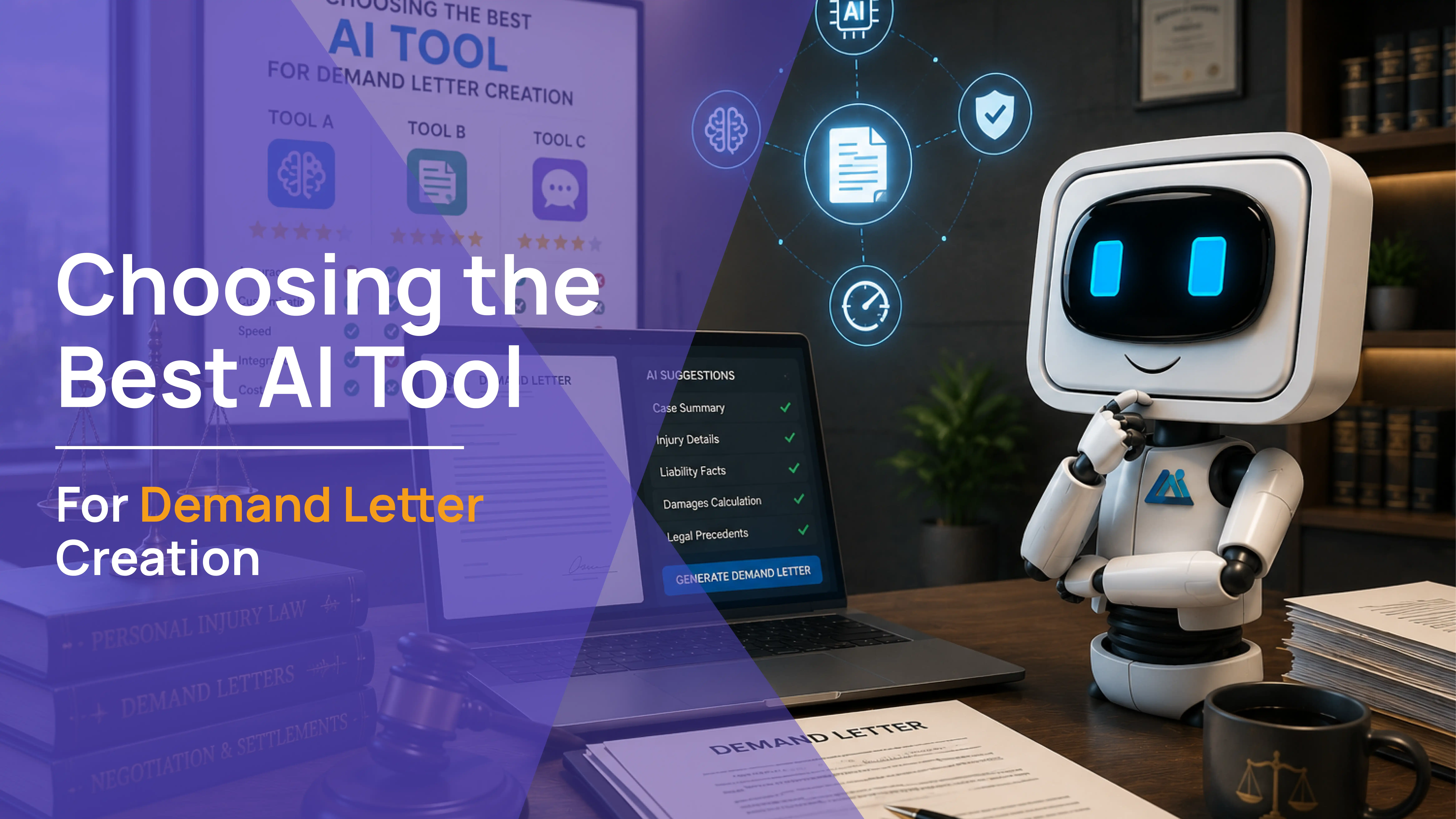
Choosing the Best AI Tool for Demand Letter Creation
Why Are Demand Letters Important?
Demand letters are more than just paperwork, they are strategic documents that can significantly impact the outcome of a personal injury case. A strong demand letter:
Sets the Foundation for Negotiations: It establishes the facts and the basis for the claim such as personal injury claim, helping to prevent misunderstandings.
Demonstrates Serious Intent: It signals to the opposing party that the plaintiff is prepared to pursue legal action if necessary.
Aims to Maximize Compensation: By clearly outlining damages, medical expenses, and their impact, a well-drafted settlement demand letter can lead to faster and more favorable settlements.
Let's compare three of the best options available.
AI Demand by Practice AI
Overview: AI Demand by Practice AI is specifically designed to streamline the creation of demand letters for personal injury law firms. It focuses on speed, accuracy, and compliance with U.S. personal injury legal standards.
Key Features:
Quick Drafts: Generates detailed demand letters in minutes, reducing the time spent on manual drafting.
Built-in Compliance: Ensures that all letters align with personal injury statutes and legal frameworks.
Customizable Templates: Provides pre-built templates for various types of personal injury cases, which can be tailored to individual client needs.
Unlimited Revisions: Allows continuous refinement to ensure the demand letter meets case-specific requirements.
Why It Stands Out: AI Demand offers a user-friendly, cost-effective solution tailored specifically for personal injury law. Its focus on legal compliance and customizable templates makes it accessible for firms of all sizes. The tool's unlimited revision feature also ensures that the final letter is polished and persuasive.
Considerations:
As a newer tool, user feedback is still developing.
Best suited for firms focusing primarily on personal injury cases as of December 2024.
Filevine's DemandsAI
Overview: Filevine's DemandsAI is designed to automate and streamline the creation of demand letters. Integrated with Filevine's case management platform, it uses existing case data to generate detailed and persuasive demand letters quickly.
Key Features:
Automation: Generates demand letters in minutes, pulling relevant data directly from case files.
Data Integration: Seamlessly integrates with Filevine's case management system, ensuring accuracy and consistency.
Customization: Offers adaptable templates for various types of personal injury cases.
Professional Review: Optional legal expert review ensures high-quality outputs.
Why It Stands Out: Filevine's DemandsAI is ideal for firms already using the Filevine platform. It reduces the need for manual data entry and ensures that demand letters are consistent and accurate. The tool's integration with case management software helps maintain a smooth workflow
Considerations:
Best suited for firms within the Filevine ecosystem.
Some manual oversight may still be needed to capture case-specific nuances.
Evenup Demand Letter
Overview: Evenup focuses on maximizing settlements by generating data-driven demand letters tailored to specific personal injury cases. It uses insights from a database of past settlements to help justify the compensation requested.
Key Features:
Data-Driven Valuations: Compares case details to similar past settlements to suggest appropriate compensation amounts.
Narrative Support: Helps build compelling narratives around the plaintiff's injuries and their impact on quality of life.
Custom Templates: Provides templates for various injury types, such as car accidents, slip-and-falls, and dog bites.
Why It Stands Out: Evenup's strength lies in its data-driven approach. By benchmarking against past cases, it helps attorneys justify their compensation demands with solid evidence. This can lead to higher settlements and more successful negotiations..
Considerations:
There may be a learning curve to fully utilize its benchmarking features.
Customization can require additional input to align with specific firm standards.
Choosing the Best AI Tool for Demand Letter Creation
Demand letters are a crucial part of personal injury cases, setting the stage for successful negotiations. Choosing the right AI tool depends on your firm's specific needs and workflow:
Filevine's DemandsAI: Ideal for firms already using the Filevine platform, offering seamless integration and consistent data handling.
Evenup: Best for maximizing settlements with data-driven valuation insights and detailed narrative support.
AI Demand by Practice AI: A user-friendly, compliant, and cost-effective solution tailored specifically for personal injury law, perfect for firms of all sizes.
Each tool offers unique benefits, so consider what aligns best with your firm's requirements, whether it's integration, accuracy, or settlement optimization.
Explore Demands AI today and see how it can transform your demand letter process.
You already know AI demand letters exist. You have probably seen the pitch: faster drafting, less manual work, stronger output. What most of those pitches skip is the part that actually matters to a personal injury attorney managing 60 to 100 active cases.
How accurate is the output when it counts? How does it hold up when an experienced insurance adjuster reads it? And what does it actually do to your settlement numbers when you use it across your full caseload?
Those are the questions this article answers.
Key Takeaways
Speed is the entry point for AI demand letters, but accuracy and documentation depth are what drive settlement impact at the negotiating table.
AI demand letters built on general-purpose language models produce clean, readable output that experienced adjusters can identify as template-driven, which weakens negotiating leverage.
Purpose-built PI platforms pull clinical language directly from medical records rather than paraphrasing them, a distinction that directly affects how adjusters evaluate claim value.
Firms fully integrated on purpose-built AI demand letter software report handling 40% more active cases per attorney, with preparation time dropping from 3 hours to under 20 minutes per letter.
The settlement multiplier for attorney-represented claimants is 3.5 times higher on average than unrepresented claimants, and that gap narrows when the demand letter is weak regardless of how it was produced.
Why Speed Is the Wrong Metric for Evaluating AI Demand Letters
Every AI demand letter platform will tell you it is faster. That part is true across the board. A tool that generates a first draft in minutes will always outpace a paralegal building one from scratch. Speed is not where the platforms differentiate.
The metric that actually determines whether an AI demand letter moves your settlement number is documentation precision. Insurance adjusters are trained to find gaps. A demand letter that is fast but imprecise gives them exactly what they need to justify a reduced payout. A demand letter that is fast and airtight removes that option entirely.
According to the Insurance Research Council, attorney-represented claimants receive settlements averaging 3.5 times higher than unrepresented claimants. That multiplier does not come from the speed at which the letter was produced. It comes from the quality of the documentation inside it. AI demand letters only improve settlement outcomes when the output quality is high enough to close the gaps adjusters look for.
The Real Difference Between AI Demand Letter Platforms
General AI Tools vs. Purpose-Built PI Platforms
Most AI demand letter tools on the market today are general-purpose language models with a legal prompt layered on top. They produce grammatically clean, professionally structured output. They also produce language that paraphrases medical records rather than pulling from them directly.
That distinction matters more than most attorneys realize. When a demand letter describes an injury in summarized language rather than mirroring the physician's own clinical documentation, an experienced adjuster sees the difference immediately. It signals that the letter was assembled from a summary rather than built from the source records. That gap creates negotiating room the adjuster will use.
Purpose-built PI demand letter platforms are trained specifically on personal injury document structures, medical terminology, and damage calculation frameworks. They integrate directly with case management systems like CASEpeer, Filevine, and SmartAdvocate to pull structured case data automatically, including treatment timelines, physician notes, billing records, and wage loss documentation. The clinical language in the output reflects the actual records, not a paraphrase of them.
Documentation Gap Detection Changes the Pre-Send Process
One capability that separates strong AI demand letter platforms from weak ones is what happens before the letter is finalized. Purpose-built platforms audit the draft against the case file and flag missing documentation before the letter reaches the adjuster.
Missing medical records, unverified wage loss figures, gaps in the treatment timeline, and unsupported liability claims are all identified at the drafting stage rather than discovered after the adjuster has already used them to discount the claim. That pre-send audit function has a direct and measurable impact on the quality of demand packages your firm sends consistently across every case.
Integration Depth Determines Real-World Time Savings
A platform that requires manual data re-entry to function is not delivering the time savings its marketing claims. The genuine time reduction in AI demand letter workflows comes from direct integration with the case management system your firm already uses. When case data flows automatically into the drafting environment, preparation time drops from 3 hours to under 20 minutes per letter. When it requires manual input, the savings shrink significantly.
What AI Demand Letters Actually Do to Settlement Outcomes
Metric
Manual Drafting
Purpose-Built AI Demand Letters
Average preparation time
3 to 5 hours per letter
15 to 20 minutes per letter
Clinical language source
Paralegal paraphrase of records
Pulled directly from medical documentation
Documentation gap detection
Found during review or missed entirely
Flagged before the letter is sent
Consistency across caseload
Varies by attorney and paralegal
Standardized structure on every case
Cases handled per attorney
Baseline
40% more active cases per attorney
Adjuster response to output
Variable based on draft quality
Consistently stronger demand packages
The 40% increase in cases per attorney is sourced from Law Practice AI client performance data published in the National Law Review in March 2026. That figure reflects firms using purpose-built AI demand letter software across their full caseload, not firms using AI selectively on individual cases.
The settlement impact compounds over time. When every demand letter your firm produces follows the same evidence-backed structure, adjusters learn to take your packages seriously. That reputation has a value that is difficult to quantify per case but visible across a full year of settlement outcomes.
Why Attorney Review Is Not Optional
The firms getting the strongest results from AI demand letters are not the ones using the most automated platforms. They are the ones that have built a clear review process around every AI-generated draft.
The Bloomberg Law AI Trends Report identified AI-assisted legal drafting as one of the fastest-growing technology categories in the legal sector, with high-volume practice areas like personal injury leading adoption. The firms cited for the strongest outcomes consistently shared one practice: structured attorney review at every stage of the drafting workflow.
AI handles the documentation assembly. The attorney evaluates liability strength, sets the final demand figure, adjusts tone for the specific insurer and adjuster, and takes professional responsibility for the letter. That division of labor is where the time savings and quality improvements coexist. Removing attorney oversight from the process does not improve efficiency. It introduces risk that shows up in the settlement room.
How Law Practice AI Is Built for This
Law Practice AI is purpose-built for plaintiff personal injury firms that need AI demand letters with the documentation depth that adjusters take seriously.
The platform pulls structured case data directly from CASEpeer, Filevine, and SmartAdvocate. It generates demand letter drafts with clinical language sourced from actual medical records, organized treatment chronologies, verified damage calculations, and liability narratives built from case documentation. Every draft is audited for documentation gaps before the attorney reviews it, and every letter requires attorney approval before it is sent.
Firms using Law Practice AI report handling 40% more active cases per attorney, with demand letter preparation time consistently under 20 minutes per letter across their full caseload.
Frequently Asked Questions: AI Demand Letter Platforms for Personal Injury Firms
Q1: What makes one AI demand letter platform better than another?
The key differentiator is whether the platform pulls clinical language directly from medical records or paraphrases them through a general language model. Purpose-built PI platforms produce output with the evidentiary specificity that adjusters evaluate seriously. General AI tools produce readable but template-driven output that experienced adjusters recognize and discount.
Q2: Do AI demand letters actually improve settlement amounts?
Settlement improvement depends on documentation quality, not the tool itself. When AI demand letters are built on purpose-built PI platforms with direct case data integration and documentation gap detection, they consistently produce stronger demand packages than manual drafting at scale. The Insurance Research Council data shows a 3.5 times settlement multiplier for attorney-represented claimants, and that gap narrows when demand letter quality is weak.
Q3: How do AI demand letters handle complex cases with multiple providers and injuries?
Purpose-built platforms are designed to handle complex medical chronologies across multiple providers. They organize treatment timelines sequentially, pull billing totals per provider, and flag documentation gaps specific to each provider's records. General AI tools struggle with this level of case complexity and typically require significant manual restructuring of the output.
Q4: What happens if the AI misses something in the medical records?
Purpose-built AI demand letter platforms include pre-send auditing that flags documentation gaps before the letter is finalized. The attorney review process is the final check. No reputable platform positions itself as a replacement for attorney oversight, and firms that use AI demand letters most effectively treat every draft as a reviewed first draft rather than a finished product.
Q5: Is AI demand letter software worth it for smaller PI firms?
Yes, particularly for solo practitioners and small firms managing 20 or more active cases. The time savings per letter are consistent regardless of firm size, and the recovered attorney hours have proportionally higher impact in smaller practices where every hour of attorney time carries significant weight. Law Practice AI's per-document pricing model makes it accessible without requiring an annual subscription commitment.
The Firms Getting Results Are Not Just Using AI Faster: They Are Using It Better
The personal injury practices seeing the strongest settlement outcomes from AI demand letters are not the ones using the most automated workflow. They are the ones using purpose-built tools with documented clinical precision, structured attorney review, and full caseload integration.
AI demand letters have moved past the adoption question. The question now is which platform is built well enough to trust with your cases and your clients. That answer comes down to documentation depth, integration quality, and whether the tool treats your medical records as source material or as something to summarize.
Law Practice AI is built for the firms that want the former. See how it works across your full caseload.
Every personal injury firm knows the demand letter bottleneck. The case is ready. The records are in. But getting a complete, well-documented demand letter out the door still takes days, sometimes longer, because the drafting process is slow by design.
Improving demand letter turnaround with AI is now one of the most discussed operational shifts in plaintiff practice. Yet most firms are still unsure how it actually works, which tools deliver real results, and what the difference is between a platform that saves 30 minutes and one that recovers an entire workday per case.
Manually building a demand letter from scratch requires pulling clinical details from medical records, calculating damages, drafting liability language, organizing exhibits, and reviewing everything before it goes out. In a complex case, that process alone can consume an entire workday. Multiply that across an active caseload and the demand letter turnaround problem compounds fast.
AI demand letter generation is changing that equation. This article explains exactly how AI reduces demand letter turnaround time, what the bottlenecks are that AI solves, and what to look for in a platform before you commit.
Key Takeaways
The average personal injury demand letter takes three to five hours to prepare manually. AI demand letter software reduces that to under 20 minutes per letter when the platform integrates directly with your case data.
The biggest turnaround killers are not drafting speed. They are the time spent locating records, extracting clinical details, and re-entering information that already exists in your case management system.
AI reduces demand letter turnaround time by eliminating the assembly layer, not by replacing attorney judgment. Every draft still requires attorney review and approval before it is sent.
The quality of AI demand letter output depends directly on whether the platform is purpose-built for personal injury workflows or adapted from a general AI tool.
Faster turnaround on demand letters directly affects settlement timelines. The sooner a strong demand package reaches the adjuster, the sooner meaningful negotiations can begin.
Why Demand Letter Turnaround Takes So Long in the First Place
Before understanding how AI helps, it is worth being specific about where the time actually goes. Most attorneys and paralegals assume drafting is the bottleneck. It rarely is.
The real time drains in demand letter preparation are:
Locating and Reviewing Medical Records
Medical records arrive from multiple providers at different times, in different formats, and often out of sequence. Before drafting can begin, someone has to locate every relevant record, read through them, extract the clinical details that support the claim, and organize them into a usable format.
In a case with two or three providers, this process takes two to three hours. In a case with multiple hospitalizations, specialist visits, and ongoing therapy, it can take significantly longer.
Extracting and Organizing Case Data
The information needed to build a demand letter lives in multiple places: the intake file, the medical records, the billing statements, employer verification documents, and the liability documentation. Pulling all of it together and organizing it into a structure that supports the letter is a significant manual effort.
This is where most demand letter preparation time actually goes: not writing the letter, but assembling the raw material the letter is built from.
Drafting Clinical Language Accurately
A well-built demand letter uses clinical language pulled directly from the physician's notes, not a paraphrase of them. Writing that language accurately while maintaining the narrative flow of the letter takes time and focus. Errors here give adjusters room to question the documentation.
Review and Revision Cycles
Once a draft is complete, the attorney reviews it, often revising language, adjusting damage figures, and strengthening the liability argument. On a busy week, that review cycle can take days simply because of scheduling.
How AI Reduces Demand Letter Turnaround Time
AI demand letter software addresses each of these bottlenecks directly.
Automated Record Extraction and Organization
Purpose-built AI platforms trained on medical terminology can read through medical records, extract the clinically relevant findings, and organize them into a structured format ready for the demand letter. The paralegal or attorney does not have to manually read every page and transcribe the key details. The AI surfaces them.
Direct Case Data Integration
The most effective AI demand letter platforms do not ask attorneys to re-enter case information into a separate drafting interface. They pull directly from the case management system your firm already uses, whether that is CASEpeer, Filevine, or SmartAdvocate.
When the AI has access to the full case record from intake through billing, it can build a demand letter that reflects the actual case without manual assembly. That integration is what drives the biggest reduction in turnaround time.
Structured First Draft Generation
Once the records are extracted and the case data is organized, the AI generates a structured first draft that includes the liability narrative, medical chronology, clinical language sourced from the physician notes, damage calculations, and settlement demand. The attorney receives a 90% complete document ready for review rather than a blank page.
Consistent Structure Across Every Case
One of the less obvious benefits of AI demand letter generation is output consistency. When every letter follows the same evidence-backed structure, the review cycle is faster because the attorney knows exactly where to look for each component. There are no structural surprises to correct, no missing sections to rebuild, and no formatting inconsistencies to clean up before the letter goes out.
What the Data Shows About Demand Letter Turnaround and AI
The impact of AI on demand letter turnaround time is measurable at the firm level. Law Practice AI client performance data shows preparation time dropping from an average of two to four hours per letter to under 20 minutes per letter when the platform integrates directly with case management data.
Manual vs. AI Demand Letter Turnaround: A Direct Comparison
Stage
Manual Process
With AI Demand Letter Software
Record location and review
Staff reads through each provider's records page by page to find relevant clinical details
Platform extracts and organizes key findings automatically
Case data assembly
Additional manual effort
Pulled automatically from case management system
First draft generation
Can take an hour or more
Generated from case data in minutes
Clinical language accuracy
Depends on paralegal transcription
Sourced directly from physician notes
Attorney review cycle
Variable, often delayed by scheduling
Focused review of structured draft
Total preparation time
3 to 5 hours per letter
Under 20 minutes per letter
What to Look for in AI Demand Letter Software
Not all AI demand letter tools reduce turnaround time equally. The difference between a tool that saves 30 minutes and one that saves three hours comes down to a few specific capabilities.
Integration With Your Case Management System
This is the single most important factor. A tool that requires manual data entry to function is not solving the assembly problem. It is adding a step. Look for platforms that connect directly to CASEpeer, Filevine, or SmartAdvocate so case data flows into the drafting workflow automatically.
Tavrn AI's research on AI demand letter drafting highlights integration depth as the primary differentiator between AI tools that deliver meaningful turnaround improvements and those that simply reformat manually entered information.
Purpose-Built for Personal Injury
General AI tools produce generic demand letter output. They are not trained on PI document structures, medical terminology, or the evidentiary standards insurance adjusters use to evaluate claims. Purpose-built PI platforms produce clinically precise output that requires editing, not rewriting.
Documentation Gap Detection
The best AI demand letter platforms audit the draft before it is finalized. They flag missing medical records, incomplete wage loss documentation, and unsupported liability claims before the letter reaches the adjuster. This prevents the back-and-forth revision cycles that extend turnaround time after the initial draft is complete.
Attorney Review Built In
Every AI demand letter platform worth adopting requires attorney review and approval before a letter is sent. This is not optional. The attorney is professionally responsible for every document that leaves the firm. A platform that skips this step introduces risk that no time saving justifies.
How Law Practice AI Reduces Demand Letter Turnaround
Law Practice AI is built for plaintiff firms including personal injury, lemon law, and other civil plaintiff practices that need AI demand letter generation integrated directly into their full case workflow.
The platform connects to CASEpeer, Filevine, and SmartAdvocate to pull verified case data automatically. It extracts clinical language from the actual medical records, organizes the treatment chronology, calculates damages from documented figures, and generates a structured first draft ready for attorney review.
Demand letter preparation time drops to under 20 minutes per letter. Every draft requires attorney review and approval before it is sent. The AI handles the assembly. The attorney controls the output.
Frequently Asked Questions: AI Demand Letter Software for Personal Injury Firms
Q1: How much time does AI actually save on demand letter preparation?
For firms using purpose-built AI demand letter software with direct case management integration, preparation time drops from an average of three to five hours per letter to under 20 minutes. The biggest time savings come from automated record extraction and case data assembly, not just drafting speed.
Q2: Does AI demand letter software work for all personal injury case types?
Purpose-built platforms support auto accident, premises liability, product liability, lemon law, and other PI practice areas. The platform generates the structural foundation. Custom templates allow attorneys to adjust the format for different case types and jurisdictions.
Q3: What is the risk of using AI for demand letter drafting?
The primary risk is output quality when the platform is not purpose-built for PI workflows or does not integrate with your case data. Generic AI tools produce generic output that requires significant revision. Purpose-built platforms with direct case data integration produce clinically precise first drafts that require editing. Every draft requires attorney review before sending regardless of which tool is used.
Q4: Will faster demand letter turnaround actually improve settlement timelines?
Yes, when the quality of the demand package is maintained. A strong, well-documented demand letter that reaches the adjuster faster gives negotiations more time to develop before trial deadlines create pressure. Faster turnaround combined with stronger documentation is the combination that moves settlement timelines forward.
Q5: How does AI handle the clinical language in medical records?
Purpose-built AI demand letter platforms extract clinical language directly from the physician notes and medical records in the case file rather than paraphrasing them. This produces language that mirrors the actual documentation, which is more credible to adjusters and more defensible if the case proceeds to litigation.
Faster Turnaround Starts With the Right Platform
The demand letter bottleneck is not going away on its own. As long as the assembly process is manual, demand letter turnaround time will be limited by the time available to do the work. AI addresses that directly by automating the part of the process that consumes the most time without requiring the most judgment.
AI demand letter generation removes that ceiling by automating the part of the process that consumes the most time without requiring the most judgment. The attorney still reviews, edits, and approves every letter. The difference is what they are reviewing: a structured, evidence-backed first draft rather than a blank page.
Law Practice AI gives plaintiff firms the platform to generate that first draft automatically from verified case data. Book a Consultation to see how it fits your firm's demand letter workflow.
Personal injury and lemon law attorneys understand that demand letter drafting is a crucial yet time-consuming part of the claims process. Manually creating case-specific demand letters requires extensive research, legal expertise, and precise formatting. AI Demands revolutionizes this process by offering a seamless, efficient, and highly customizable AI-driven solution for generating demand letters.
How AI Transforms Legal Workflows
With the rise of AI automation for law practices, attorneys now have access to efficient legal document AI tools that streamline demand letter creation. Instead of spending hours drafting, lawyers can leverage customizable AI legal drafting software like AI Demands to produce polished, case-specific documents in minutes.
The Key Benefits of AI Demands for Attorneys
1. Speed and Efficiency
Traditional demand letter drafting is labor-intensive. AI Demands eliminates inefficiencies, enabling attorneys to generate high-quality letters faster. This allows legal professionals to save time on demand letters and focus on case strategy and client advocacy.
2. Case-Specific Demand Letters with AI
Generic templates often lack the depth needed for successful settlements. With case-specific demand letters using AI, attorneys can generate detailed, well-structured letters tailored to each claim, including medical summaries, accident details, and policy references.
3. Accuracy and Legal Precision
AI-powered tools minimize human errors, ensuring that each letter includes precise legal terminology, accurate financial calculations, and compelling arguments to increase settlements.
4. Customizable and Comprehensive Demand Letter Templates
With demand letter templates for different practice areas, personal injury and lemon lawattorneys can customize letters based on case specifics while ensuring consistency and professionalism.
5. Affordable AI Solutions for Law Firms
Hiring additional staff for drafting can be costly. AI Demands provides an affordable AI solution for law firms, reducing overhead expenses while maintaining high-quality output.
What Attorneys Need to Know About AI Demand Letters
The transition to AI-driven demand generation using AI Demands may seem like a significant shift, but the challenges of drafting demand letters manually prove that automation can actually enhance legal expertise, and not replace it entirely. Attorneys will remain in control, reviewing and refining AI-generated drafts to ensure personalized representation for clients.
Increase Settlements with AI Demand Tools
By integrating AI into their workflow, personal injury and lemon law attorneys can significantly increase settlements with AI demand tools. Automated drafting improves efficiency, allowing firms to handle more cases effectively, ultimately leading to higher client satisfaction and improved revenue.
Final Thoughts: AI Software for Personal Injury & Lemon Law Attorneys
Using the best available tools for demand letter creation like AI Demands can transform how attorneys approach legal documentation. By adopting AI-powered demand generation, law firms can optimize efficiency, reduce costs, and improve case outcomes.
Start using AI Demands today and experience the future of legal drafting!